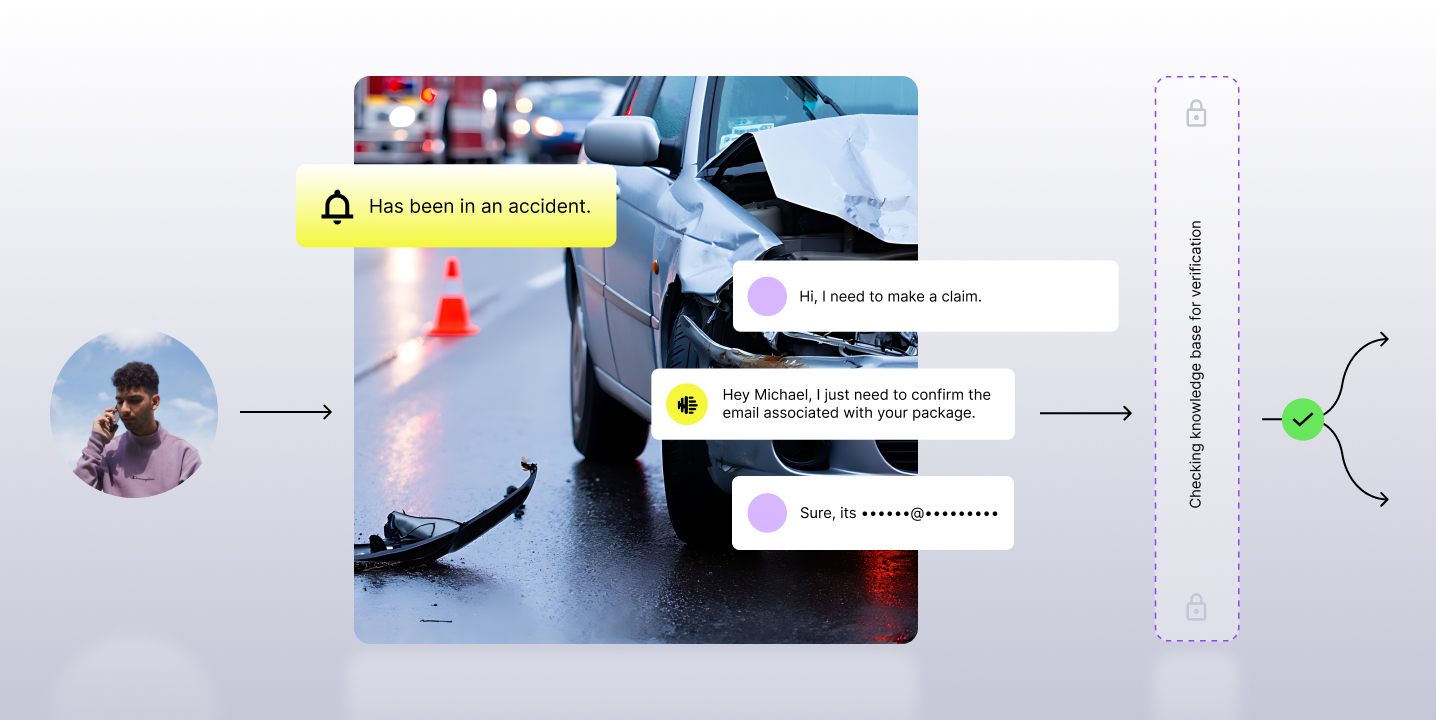
The Critical Role of a Design Blueprint: Why AI Agents Need Experience Design, Not Just Documentation
As more organizations adopt AI agents, a common assumption keeps surfacing: “We already have SOPs for our human agents, can’t we just use those?”
It’s an understandable question. SOPs feel like a logical starting point. They’re detailed, they’re tested, and they represent how real humans solve customer problems every day.
But here’s the truth our customers quickly discover: You can’t lift a human SOP and apply it to an AI agent.
And trying to do so is one of the fastest ways to create confusion, erode trust, and stall adoption. Why? Because AI agents don’t rely on interpretation, intuition, or judgment calls the way humans do. Everything an AI agent says, every turn it takes, and every decision it makes must be intentionally designed. And that’s where the Design Blueprint becomes essential.
The Foundation of an AI Agent
A Design Blueprint is the core framework that defines how an AI agent interprets intents, manages context, makes decisions, and resolves interactions. It establishes the conversational patterns, integration points, and guardrails that shape the entire user experience, essentially functioning as the operating system behind the agent.
Just as importantly, the Design Blueprint aligns every stakeholder, including business leaders, product owners, designers, engineers, and compliance teams, on what the agent will do, how it will behave, and where human support remains necessary. This shared clarity reduces risk, prevents miscommunication, and ensures a consistent vision from design through deployment.
By resolving ambiguity early, the Design Blueprint also saves significant time later. It minimizes rework, prevents scope creep, and avoids the costly surprises that often surface when edge cases or decision gaps are discovered too late.
Why Existing SOPs Don't Translate Directly to AI
In recent implementations, a consistent pattern has emerged: human SOPs contain hidden logic that only humans understand. A simple instruction like “use discretion” may represent dozens of micro-decisions informed by tone, intent, urgency, or empathy, judgment calls that must be unpacked and converted into explicit logic for an AI agent.
While tools can analyze transcripts, surface patterns, or suggest intents, they cannot reliably interpret intent overlap, emotional nuance, regulatory risk, or brand judgment without human input. Deciding where an agent should probe versus proceed, when it should reassure versus escalate, or how much confidence is appropriate in sensitive scenarios requires deliberate human judgment. These are experience decisions, not data extraction tasks. And the application of human discretion in the Design Blueprint process requires stakeholders to extrapolate on these details.
And here is where AI design diverges from both SOPs and traditional IVR systems.
- IVRs route; AI agents resolve.
- IVRs follow menus; AI agents navigate natural language and ambiguity.
Human SOPs assume shared understanding. People fill in gaps instinctively. AI agents do not, they only do what they are explicitly designed, trained, or instructed to do. Lifting an intent map and SOP from your existing IVR-led experience and plopping it into an AI agent will not deliver the expected experience.
Experience Design: The Missing Ingredient
Building an AI agent is not a scripting exercise; it is experience design.
AI agents must be helpful, predictable, compliant, context-aware, and natural-sounding, while handling detours and uncertainty with confidence. Achieving this requires designing not just the logic, but the entire interaction model.
Every element, including intent boundaries, context handling, fallbacks, escalation paths, and tone, must be thoughtfully engineered. AI cannot rely on instinct, so experience design becomes the bridge between human nuance and machine precision.
This is what the Design Blueprint delivers. It transforms fragmented knowledge, legacy SOPs, and human judgment into a cohesive, scalable framework the AI can follow reliably. Because it makes the agent’s behavior transparent, it also accelerates adoption. Stakeholders gain confidence because they understand how the agent works, how it handles errors, and how it protects both users and the business.
When that clarity is in place, alignment grows, trust increases, and the AI agent becomes a natural extension of the brand.
AI Agents Require Experience and Thorough Design
AI agents are not plug-and-play. They are carefully engineered experiences that require strategy, cross-team alignment, and a structured understanding of how interactions should unfold. The Design Blueprint is what makes this possible. It unifies logic, judgment, tone, and process into a single roadmap from design through deployment.
For organizations that want AI agents that feel natural, resolve requests effectively, and inspire confidence, the Blueprint is not just helpful, it is foundational.
Subscribe to our newsletter.
Frequently Answered Questions


.jpg)

.png)
.jpg)