Making AI actionable: it’s about going beyond rules to real intelligence
From a core technology standpoint, the reason AI services continue to grow in market penetration and adoption is at the end of the day, they make repetitive, tedious tasks more automated and more efficient.
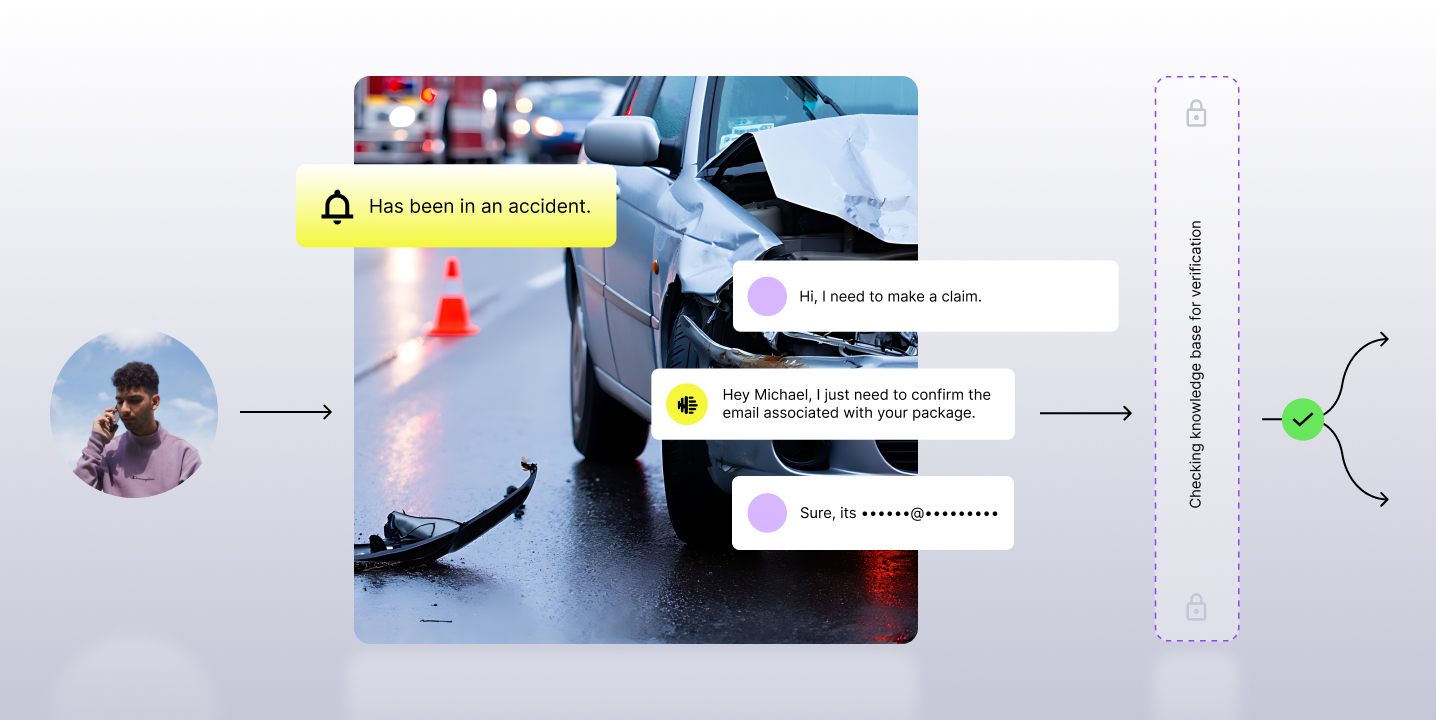
This is precisely the distinction now emerging with agentic AI contact center technology. Rather than following a fixed decision tree that breaks the moment a conversation strays from script, a genuine AI agent for contact centers reasons across the full arc of a customer interaction, weighing intent and context to choose its next step in real time. That capability is what separates automation, which simply executes predefined rules, from an agent, which adapts to what is actually being said. It is also why this argument matters more today than when it was first made: the technology to build real reasoning into contact center software now exists.
Everyone’s jumping on this opportunity. There are over 2000 .AI companies existing in the world today. The majority of these .AI companies are aiming to handle these small tasks, and are building their technology on rules. And that’s not intelligence.
Automation does not equal artificial intelligence.
For the true business value of AI, that AI needs to provide actionable intelligence, and that’s something we don’t see with rule-based AI services today. Actionable AI is built on workflows that analyze and process data, and in turn, make operational tasks more efficient.
For some, it might be revenue data, or IoT device readings. Anything where new data flows through a system and action is taken on that data. For us, that’s on customer interactions. We help contact centers automate for compliance, for quality, and streamline coaching workflows. This includes leveraging AI Voice Calling Agents to handle routine tasks and free up human agents for more complex interactions.
With tons of data being gathered, how do we make it actionable?
In my role as CRO at Observe.AI, I’m speaking with contact center leaders servicing every industry on a daily basis.
If there’s one common theme I’ve seen, it’s that there continues to be a growing focus on the value of every customer interaction. Keyword: every.
Especially with the overnight changes brought on by the pandemic and the rapid shift to work from home, customers are no longer able to interact with a brand in person, in the way that they normally would. We used to go to Safeway, now we’re ordering on Instacart.
The value of a phone call, or a customer chat conversation, has gone up significantly.
With that in mind, the new priority is ensuring that customer service agents are equipped with the best technology available to provide a great interaction, 100% of the time. Brands are looking for new ways to drive empathy and positive sentiment on top of the core business KPIs, whether it’s resolution or retention.
The result is better business outcomes and a better CX.
That’s a massive shift for brands. Enterprises are no longer saying “it costs me $10 to handle a customer call.” Instead, they’re looking at the lifetime value of a customer and looking at the ROI of every interaction. Did that $10 it cost to handle a customer lead to new revenue, like retaining a customer for an additional year, and drive positive ROI?
AI makes sense of the data, and as a result, actionable
When thinking about types of customer interactions, it’s critical to think about it from an enterprise perspective. When it comes to any enterprise, when they interact with a customer, they’re trying to do one of two things:
- Solve a problem (resolution)
- Drive revenue (retention and conversion)
These are the two outcomes, and everything that goes into driving those two outcomes is unearthed and analyzed with interaction analytics. This is where AI does its work.
You have to look at the full line of business. Determine your overall KPI - increasing revenue, improving CSAT. From there, mapping the critical interactions that directly impact those KPIs:
- First call resolution (FCR): did you solve my problem on the first call, first path, and not transfer me around.
- Average handle time (AHT): did you quickly address the customer’s need without making them wait a long time.
- Empathy: did you turn a negative customer experience into a positive one? Did you leave the customer feeling positively about the interaction?
Identifying your top KPI, mapping it to KPIs that influence that top KPI, and using interaction analytics to monitor and improve it over time is where AI goes from just providing data, to providing actionable data.
What separates a true AI agent for contact centers from a rules-based bot
A rules-based bot follows a decision tree: if the customer says X, respond with Y, and anything outside that path routes to a human or a dead end. An agentic AI contact center system works differently, reasoning across the entire interaction, holding context across turns, and deciding its next action based on what the conversation actually requires rather than which branch of a script it happens to be on. That is the difference between an AI agent for contact centers and the automation that has been marketed under the same label for the past decade.
Mapping KPIs to interactions
To get it right, it takes strategy and planning. We’ve got a number of great resources for doing exactly this in our Crushing Your KPIs Bundle, including use cases, strategies on mapping KPIs to your coaching programs, and agent soft skills that drive results.
Subscribe to our newsletter.
Frequently Answered Questions
An AI agent for a contact center is a system that reasons across a customer conversation and decides its own next action, rather than following a fixed script or decision tree like a traditional bot.
Agentic AI contact center technology understands intent and context across an entire interaction, while rule-based automation only matches predefined triggers to predefined responses and breaks outside that path.
AI agents can handle the full range of a conversation that rule-based bots cannot, but most contact centers combine both, using agents for reasoning-heavy interactions and simple automation for narrow, repetitive tasks.


.png)