The Hyper-Personalized Future of Banking and Financial Services Customer Experience
These digital giants are fundamentally changing how customers perceive personalized experiences, by proactively anticipating customers’ wants and needs and delivering tailored offerings deeply in-tune with everyone’s preferences. From customized playlists and binge-worthy movie and TV show recommendations to a discount ride to the restaurant you were planning on going—this level of attention to detail keeps customers coming back for more. And it’s only a matter of time before they will expect this level of service from you.
Delivering on this expectation is harder than it sounds, because most banks and financial services companies manage customer interactions across a patchwork of call center software, chat tools, and analytics dashboards that were never built to talk to each other. An AI customer experience platform addresses this by bringing every voice and chat interaction, along with the customer context behind it, into one system instead of a dozen disconnected point tools. This unified view is what makes hyper-personalization operationally possible, rather than a strategy that only works for consumer tech giants with unlimited engineering resources. For banks, the practical path to hyper-personalization runs through consolidating this data and acting on it in real time, not through adding another standalone tool to the stack.
The Hyper-personalization Secret Sauce
Just like you, these companies have a large volume of customers, yet they somehow manage to account for personalization on a level that goes beyond just knowing the customer’s name and transaction history. They leverage artificial intelligence (AI) to analyze customer interaction data to obtain data-backed insights that enhance the overall customer experience.
Let’s see how the convergence of AI and customer interaction data is shaping the experience at Netflix. The entertainment giant leverages AI-powered personalization to create customer profiles based on their watch and search history, content ratings, time spent watching content and more to drive personalized recommendations through sophisticated filtering. AI continues to learn from each user interaction allowing it to adapt and make better recommendations, even as user preferences shift.
But that’s not all, AI will also adapt the visual thumbnail to account for viewer’s preferences. One viewer who prefers comedy may see an image of a woman falling on her face in front of the Eiffel Tower, while a person who loves romance movies will see an image of a happy couple in Paris. Both images are for the exact same romantic-comedy movie, except the thumbnails are customized to appeal to the individuals’ preferences.
This depth of customer understanding increases predictive analysis capabilities enabling companies like Netflix to be proactive about their recommendations, which in turn increases customer satisfaction and engagement. These companies are just analyzing what customers want, but proactively delivering content, products, and services that they know the customers want.
Purpose-Built AI Agents Bring Hyper-Personalization to the Contact Center
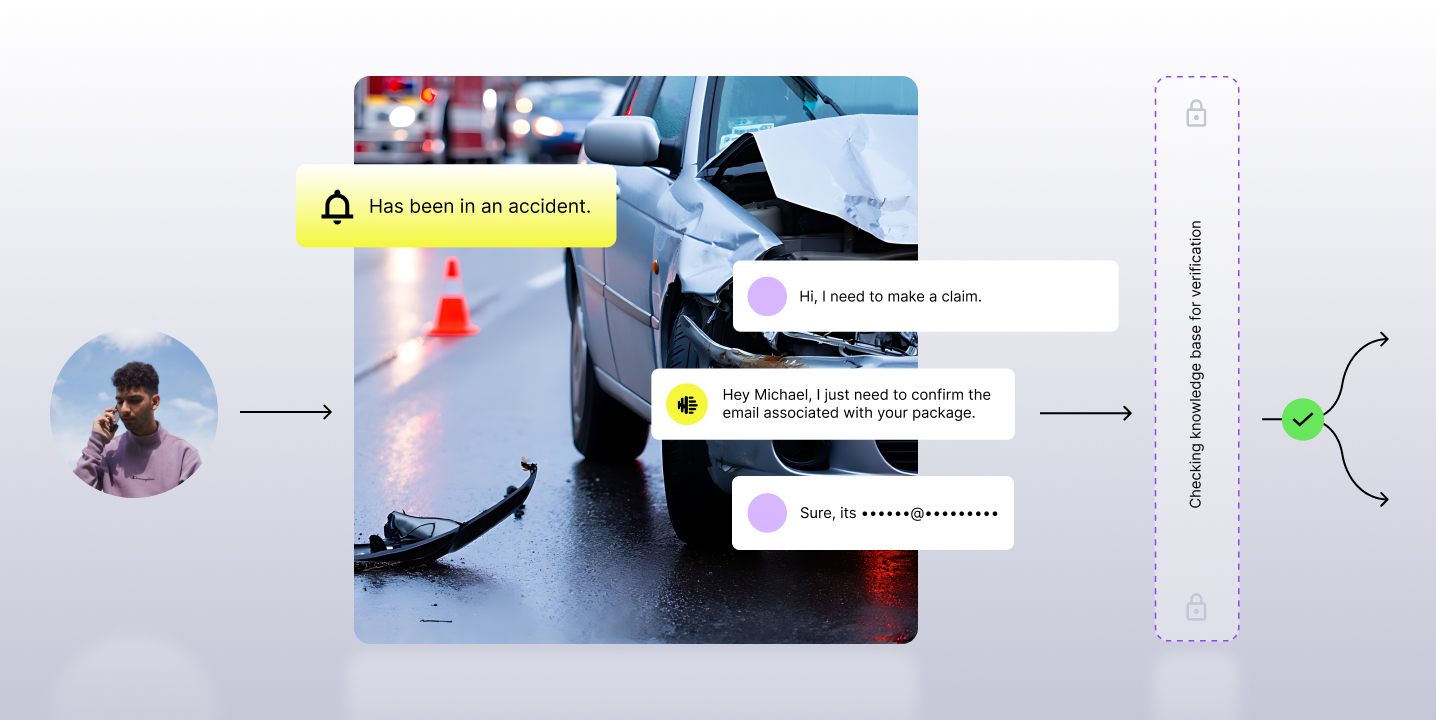
VoiceAI Agents and ChatAI Agents handle high-volume, routine banking conversations end to end, capturing structured data about intent, sentiment, and outcome on every call and chat instead of leaving it buried in a transcript. Companion Agent, the evolution of real-time agent assist, surfaces that same customer context to human agents in the moment, so a customer’s history and preferences travel with them regardless of which channel or agent handles the interaction. Together, these AI agents for contact centers give banks a single, current view of each customer, the exact foundation hyper-personalization depends on. Instead of stitching together data from disconnected tools after the fact, banks get unified context at the moment of the conversation, for both AI agents and human agents.
You can do it, too
The good news is that your organization is already capturing this all-important customer engagement data; you just need a little help from AI to turn this data into actionable insights in the hyper-personalization journey cycle.
Use these 5 tips to get ahead:
- Make sure interaction data gets captured across all your customer-facing systems on one platform.
- Why? There are 20 to 50 different tools through which your customer information flows, and each tool has its own reporting dashboard. To create a personalized banking experience of the future, you need a single view with a comprehensive understanding of each customer touchpoint. Only then can you understand what customers are asking about and how best to serve them in the future.
- Leverage AI-powered tools to analyze 100% of interactions for consistent and accurate data.
- Why? Humans are great at understanding the nuances of communication, but are constrained by time. This is where leveraging purpose-built AI can expedite the process, by reviewing, mining, and understanding every conversation to uncover insights that spot-checking just a few datapoints or generic dashboards will fail to uncover.
- Make customer insights data instantly actionable through AI-generated summaries or ad hoc GenAI-powered searches.
- Why? It’s one thing to have the data, it’s another to have a clear understanding of the greater picture. AI can not only help you analyze every customer touchpoint, but also allow you to uncover things you never thought to ask about.
- Use these insights to improve your products and services.
- Why? Now equipped with a full understanding of your customers and knowing what you never thought to ask, you can build products, services, and experiences that meet your customers where they are. This could be things like process improvement, truly personalized support, or new product offerings.
- Use the AI for proactive, personalized outreach at scale.
- Why? Taking your brand from a provider to a trusted advisor is the ultimate aim. Understanding your customers at this level unlocks a new level of loyalty, where customers welcome outreach, check-ins, and specialized offers. It may be difficult to imagine this world, but you’re closer than you think thanks to the power of AI.
Hyper-personalization is coming, but it doesn’t have to be scary…as long as you don’t mind getting personal with your customer data with a little help from AI.
Check out our Banking and Financial Services page to learn more.
Subscribe to our newsletter.
Frequently Answered Questions
Hyper-personalization in banking customer experience means using AI to analyze every customer interaction, transaction, and preference in real time so that outreach, offers, and service feel tailored to the individual rather than a customer segment. It goes beyond basic personalization, like using a customer’s name, to proactively anticipating what that customer needs next based on their actual behavior and history.
An AI customer experience platform is a unified system that captures, analyzes, and acts on customer interaction data across voice and chat channels, replacing the separate point tools most contact centers use for quality management, analytics, and agent assist. For banks and financial services companies, this unified approach is what makes hyper-personalization achievable at scale.
AI agents for contact centers, such as VoiceAI Agents, ChatAI Agents, and Companion Agent, capture consistent customer context on every interaction and make it available across channels and to human agents in real time. This gives banks the complete, up-to-date customer picture that hyper-personalized service and proactive outreach depend on.


.jpg)

.png)
.jpg)