Call Center Sales Tips for Agents: Top 3 Tactics
Contact centers are on the front line of driving revenue and customer satisfaction, but how well you perform depends entirely on your agents.
Finding these patterns required analyzing more than 230,000 customer conversations, a scale of manual review no contact center team could sustain on an ongoing basis. This is exactly the kind of pattern detection that AI coaching for call center agents now performs automatically and continuously, scoring every interaction against the behaviors that separate top performers from the rest. Instead of a single research project, contact centers can apply this analysis call after call, flagging where an agent used advocacy language, offered reassurance, or hedged with an estimate, and where they did not. That turns a static set of findings into an ongoing coaching signal that keeps every agent aligned to what the data shows actually works.
And let’s face it: An agent’s job is not easy.
In fact, 1 in 4 contact centers reported having mostly bottom performers, according to our survey of 300+ contact center leaders.
When agents don’t execute calls consistently or handle objections well, it results in missed opportunities.
We analyzed 230,000+ customer conversations and found three key behaviors top performing agents exhibit more often than bottom performing agents. (For the purpose of this story, top and bottom performing agents are categorized by conversion rates.)
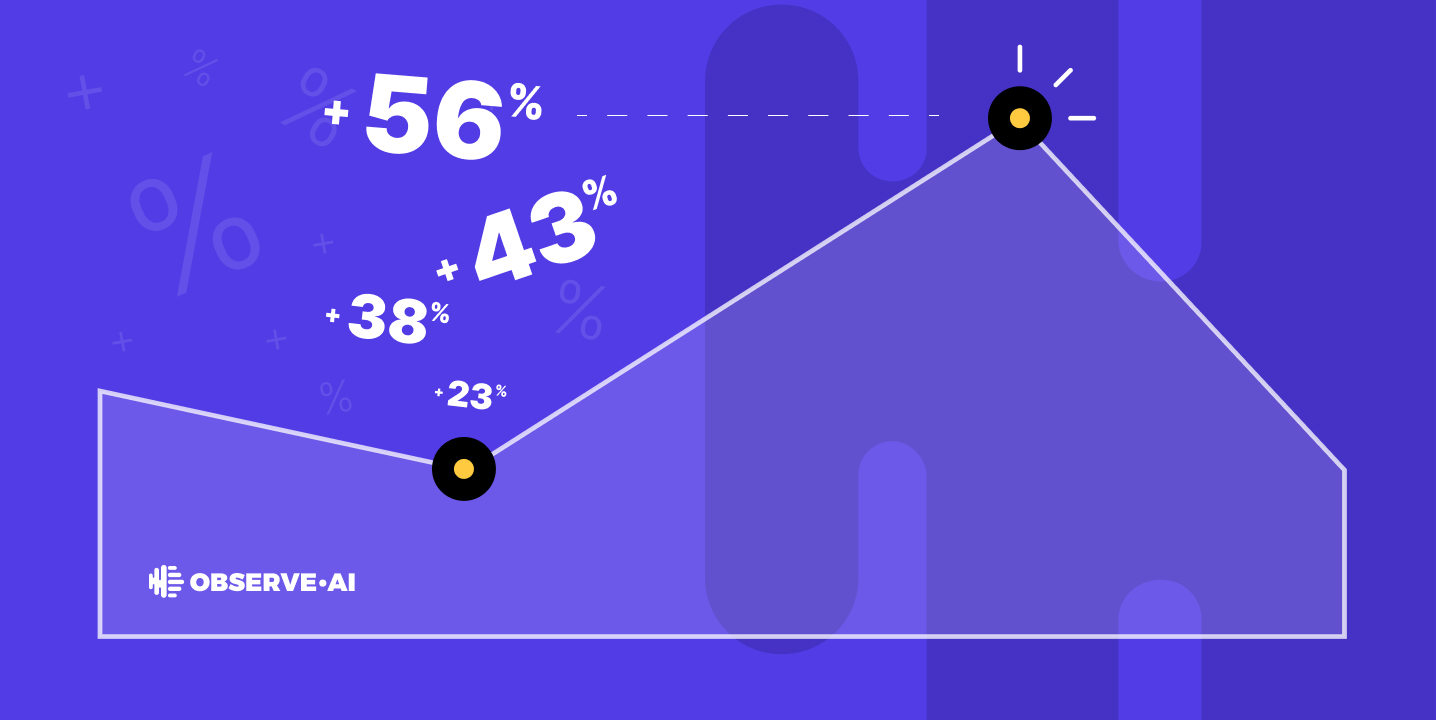
Tactic #1: Top Agents are 56% More Likely to Use Advocacy Language

Everyone likes to be treated with respect and courtesy. No where is that more true than when dealing with customers.
While this one sounds like a no brainer, now you have the data to back it up.
Top performers were 56% more likely to use advocacy language, using phrases like “Happy to assist” or “I appreciate your time” or “I’m here to help.”
Agents have a lot on their plate, but an occasional reminder to be courteous can go a long way.
Providing a visual reminder like a checklist of key phrases to remember may jog their memory even when dealing with a challenging customer.
Tactic #2: Top Agents are 37% More Likely to Provide Reassurance

At the end of the day, customers want to know they’re taken care of—even if their request may be a bit of a challenge.
When agents proactively communicate that their core responsibility is to take care of customers, it can help create trust, confidence, and rapport—all things key to building a long term relationship.
According to our data, top performers exhibited this trait 37% more often by using phrases like “Let me see what I can do for you,” for example.
This simple phrase was a key difference between top and bottom performing agents.
By helping agents focus on providing assurance to customers, businesses can differentiate themselves from competitors, reduce customer complaints and returns, and increase customer retention and referrals.
Tactic #3: Top Agents Use Estimates 3X More

Agents may not know the answer to every question offhand—especially the fine details.
But here’s where things get interesting: Even if they did, the data actually shows that it’s surprisingly better to answer with an approximation.
Top performers were 3X more likely to hedge their answers by using estimations to describe specific details of the product they were selling.
This may seem counterintuitive: Shouldn’t agents be able to answer confidently and specifically?
Not necessarily.
By estimating details, agents appear more transparent by acknowledging they might not know the exact answer. This builds trust and credibility with customers.
In addition, it can reduce the risk of disappointment while still creating the perception of accuracy.
From One-Time Analysis to Ongoing Coaching
The tactics above came from a single deep analysis of past conversations, a snapshot of what already happened. AI agents for contact centers turn that same kind of analysis into a continuous process, reviewing every call as it happens and identifying which agents are using advocacy language, reassurance, and estimates, and which need a nudge. Rather than waiting for the next research project, coaching teams get an always-on view of these behaviors across every agent, every day. That makes it possible to reinforce what top performers do differently long before performance gaps show up in conversion numbers.
Interested in More Data Insights?
We know the best decisions are based on data.
In fact, according to our recent study, 99% of contact center leaders said they use insights from customer conversations to inform business decisions.
However, few contact center leaders actually report having adequate visibility into those conversations.
This is where conversation intelligence comes in.
In our State of Contact Center Conversation Intelligence report, 96% of respondents report conversation intelligence improved transparency, while 92% said it helped make more strategic business decisions.
That’s because conversation intelligence analyzes 100% of your conversations so you can surface insights that improve CX, drive revenue growth, boost operational efficiency, and mitigate compliance risk.
But don’t take our word for it. Just look at the data.
For more contact center actionable insights backed by data, sign up for our newsletter, The Conversation Starter, or watch our most recent LinkedIn Live event below, Keys to High Performing Call Center Agents: An Analysis of 300k Call Center Conversations.
Subscribe to our newsletter.
Frequently Answered Questions
AI coaching for call center agents uses conversation intelligence to automatically review every customer interaction, identify specific behaviors like advocacy language, reassurance, and estimation, and surface targeted coaching for each agent based on what the data shows works.
Instead of relying on a one-time study of past conversations, AI coaching continuously scores live and recorded calls against proven tactics, such as the three found by analyzing 230,000+ conversations in this article, then routes specific, timely feedback to each agent so those behaviors become habitual.
Yes. AI agents for contact centers can evaluate 100% of conversations rather than a sample, applying the same pattern detection used to find these three sales tactics across every agent and every call, then feeding the results into coaching and quality programs automatically.