Adding Staff Doesn’t Solve the Availability Problem
When customer demand rises, the instinctive response is usually to add people.
More calls require more frontline teammates. More branch traffic requires additional coverage. More digital engagement creates another service queue. Growth becomes a workforce planning exercise.
People remain essential to banking. Customers need judgment, reassurance, empathy, and accountability when the issue is complex, sensitive, or financially consequential.
But adding staff does not solve the underlying availability problem when every additional customer request requires additional labor.
For mid-sized and regional banks, that model becomes difficult to sustain. They want to preserve the high-touch service that helps them compete without taking on the cost structure of a much larger institution. They also cannot reduce service quality in the name of efficiency because personal service is often central to the customer relationship.
The answer is not to choose between people and automation. It is to stop treating every customer need as though it requires the same service model.
Service demand does not arrive according to the staffing plan
Banking demand is rarely consistent.
Statement cycles, payment deadlines, fraud events, system outages, severe weather, promotional activity, tax season, and changes to products or policies can all increase customer contact. Some peaks are predictable. Others are not.
A staffing-only model forces banks into an expensive tradeoff.

Staff to the highest possible volume and the bank carries unused capacity during normal periods. Staff to average demand and customers encounter longer queues when they need help most.
Overtime, temporary workers, schedule changes, and outsourced support can provide relief. But each response still depends on finding, training, and deploying more people quickly enough to meet the increase.
The result is a service operation that can grow, but cannot easily flex.
AI customer service for banks creates another source of capacity. Voice AI and Chat AI can absorb appropriate routine demand as it changes, without requiring the bank to rebuild schedules around every volume spike.
Human capacity can then remain focused on the interactions where an employee’s expertise creates meaningful value.
More employees do not create true availability
Adding employees during the day does not necessarily help the customer who needs assistance at 9 p.m.
Banks can extend shifts, add weekend coverage, or operate service teams around the clock. Those options may be necessary for certain functions, particularly urgent or high-risk issues. They are also expensive and difficult to maintain across every servicing need.
The broader question is whether every after-hours request requires live assistance.
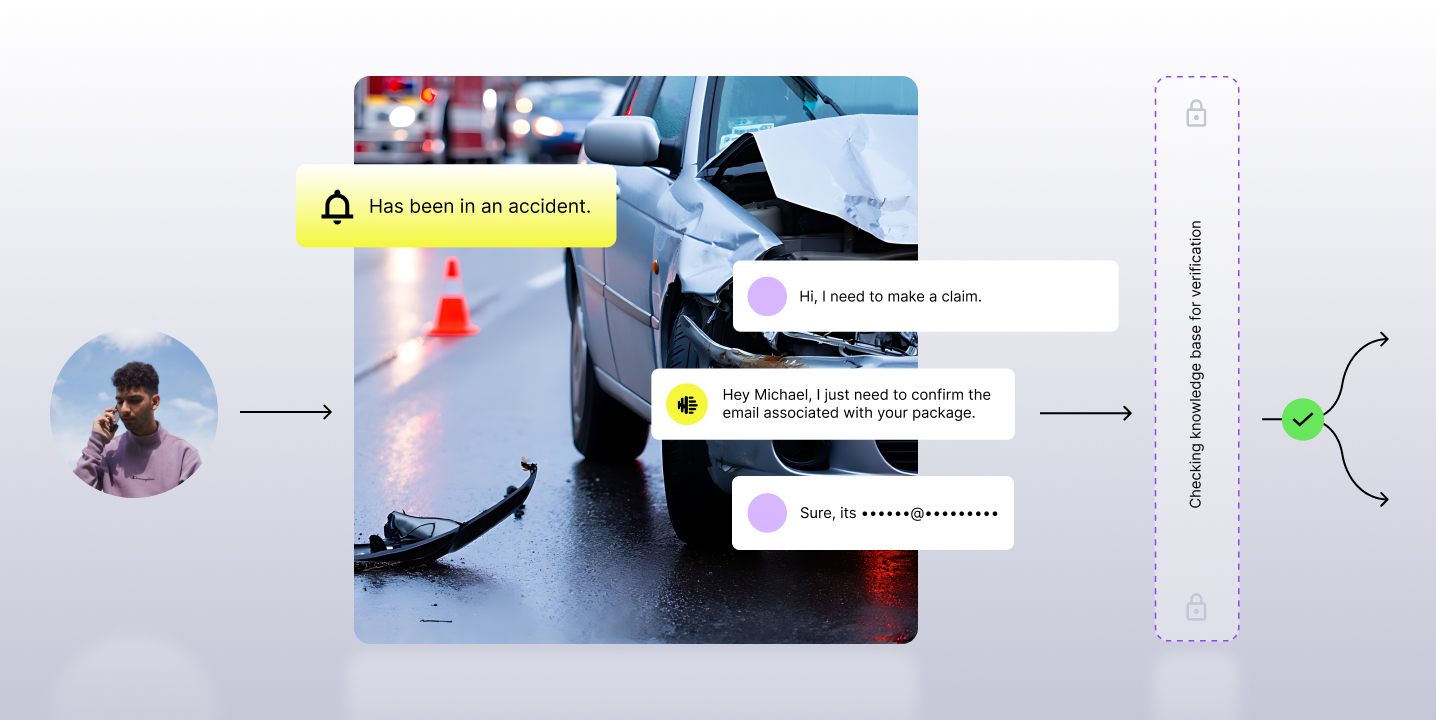
Customers may want to confirm a payment, review transaction information, activate a card, check branch details, or get help with a common digital banking issue. Many of these requests follow defined workflows and can be completed safely through conversational AI.
If the bank can resolve the request immediately, asking the customer to wait for staffed hours does not make the service more personal. It makes the bank less available.
Banking Voice AI and Chat AI can extend service beyond branch and employee hours while operating within approved workflows, authentication requirements, and escalation rules. The bank gains broader availability without placing a person behind every interaction.
Repetitive work consumes the capacity customers need
Banking service teams handle many interactions that matter to customers but require little variation in execution.
The employee authenticates the customer, locates information, follows a standard process, provides the answer, and documents the outcome. That same sequence may occur hundreds or thousands of times.
The work needs to be completed accurately. It does not always need to be completed by a person.
When experienced employees spend much of the day handling predictable requests, customers with complex issues wait in the same queues. A customer asking for routine information competes with someone reporting suspected fraud, dealing with financial hardship, or trying to resolve a complicated payment problem.
Adding staff increases the total number of interactions the bank can handle. It does not correct this allocation of work.

Banking automation allows routine demand to take a faster path. Customers receive immediate service where automation is appropriate, while frontline teammates have more time for the conversations that require investigation, judgment, and empathy.
The bank is not removing people from the customer experience. It is protecting their capacity for the moments when people matter most.
Hiring creates another demand problem
Banking and lending are not simple.
New employees must learn products, policies, systems, disclosures, fraud procedures, authentication requirements, documentation standards, and escalation paths. They need to understand how the rules apply across different accounts and customer situations.
Hiring more people therefore creates additional work before it creates capacity.
Recruiting takes time. Training consumes supervisor and subject-matter expert availability. New employees may need weeks or months to handle a broad range of interactions confidently. Even after training, complex knowledge and frequent policy changes can produce inconsistent execution.
Traditional knowledge bases help, but employees still need to find the right information and apply it during a live conversation.
Real-time agent assist can reduce that burden.
Observe.AI Companion Agent can provide frontline teammates with relevant policies, process steps, required disclosures, and next-best actions based on the conversation. Instead of relying entirely on memory or searching across several systems, the employee receives guidance during the moment of need.
This does not eliminate the need for training. It helps the bank turn training into consistent execution and shortens the distance between knowing a policy exists and applying it correctly with a customer.
Segment the work before adding capacity
A more sustainable banking service model begins by separating demand into three types.
Automate repeatable requests
Voice AI and Chat AI agents for customer support can handle frequent requests with stable rules, approved actions, and clear completion paths.
Potential use cases include transaction inquiries, card activation, payment information, branch details, account servicing, digital banking assistance, and other predictable workflows.
The AI Agent should operate within defined boundaries. It should know what it can access, which actions it can complete, how the customer must be authenticated, and when the request requires escalation.
Assist complex interactions
Some conversations should remain with a frontline teammate but can still benefit from AI.
Companion Agent can surface relevant information, prompt required steps, support accurate disclosures, and help employees navigate difficult workflows. The employee retains responsibility for the conversation and any decisions that require human judgment.
This helps the bank use its existing workforce more effectively while improving consistency across employees, teams, and locations.
Escalate sensitive situations
Certain interactions should reach a qualified person quickly.
Fraud, customer vulnerability, financial hardship, policy exceptions, high-risk transactions, and emotionally charged situations may require immediate human attention. Automation should recognize these signals and make the path to an employee faster.
The goal is not maximum automation. It is the correct division of work.
Routine demand receives speed. Complex demand receives informed assistance. Sensitive demand receives the appropriate expertise.
Elastic capacity should not mean careless automation
The promise of AI-powered banking service is the ability to absorb more demand without adding labor at the same rate.
That does not mean deploying a chatbot and directing every customer toward it.
Poor automation can make the availability problem worse. A customer becomes trapped in repetitive prompts, receives generic answers, or is prevented from reaching an employee. The bank may record a contained interaction while the customer leaves without resolution.
A useful AI Agent should complete a legitimate customer task, not merely keep the customer inside an automated channel. When it cannot finish the work, it should recognize that limit and transfer the customer appropriately.
The handoff should preserve the customer’s intent, information already collected, steps completed, and reason for escalation. The receiving teammate should continue the journey rather than force the customer to restart it.
That is why resolution is a more useful measure than containment.
Customer experience and efficiency are not opposites
Banks sometimes treat service quality and operating efficiency as competing priorities.
One side argues for more employees to protect the customer relationship. The other pushes for more automation to control costs. Both positions assume that every interaction must follow one model or the other.
A segmented approach changes the equation.
Customers with routine needs receive faster service. Customers with complicated problems receive more employee attention. Frontline teammates spend less time repeating predictable steps and more time solving issues where they can create trust.
The customer experience improves because the operating model matches the need.
For mid-sized banks, this matters strategically. Their advantage rarely comes from having the largest branch network, the most employees, or the biggest technology budget. It comes from delivering a noticeably better relationship.
AI can help preserve that advantage by making high-quality service available across more customers, channels, and hours without making the experience impersonal.
Give finance and operations a better capacity model
Segmenting customer demand also changes how banks can plan and forecast service capacity.

Instead of treating every new customer interaction as future employee workload, leaders can model demand based on the type of service required.
What percentage follows stable workflows that can be automated? Which interactions should stay with employees but can become faster with real-time guidance? Which require specialist escalation? How does that distribution change during seasonal peaks, system incidents, or product launches?
This creates a more precise capacity plan.
The bank can forecast AI-assisted and automated volume alongside employee workload. Operations teams can identify where queues are likely to form. Finance leaders can evaluate growth without assuming a linear increase in headcount. Service leaders can protect specialized employee capacity for high-value and high-risk interactions.
The result is a more flexible cost structure grounded in actual customer needs.
Measure completed work, not avoided labor
The success of banking automation should not be measured only by headcount avoided or conversations contained.
Banks should measure whether customers completed what they came to do, how long resolution took, whether they needed to make contact again, and whether context survived an escalation.
They should also examine employee outcomes. Did repetitive workload decline? Did frontline teammates spend more time on complex interactions? Did new employees become proficient faster? Did answer consistency improve? Did the bank absorb peak demand without creating longer waits?
These measures show whether the operating model is becoming more available and effective, not merely less expensive.
Cost matters. But an inexpensive interaction that leaves the customer unresolved is not efficient. It simply pushes the cost and effort into another channel or another day.
Growth should not require labor to rise at the same rate
Mid-sized banks need people. That is not the question.
The question is whether every additional customer, product, and interaction should require a proportional increase in staffing.
A staffing-only model makes service growth expensive and difficult to manage. It leaves the bank exposed to demand spikes, extends ramp time, and places skilled employees behind routine work.
A connected AI model creates a different path.
Voice AI and Chat AI handle appropriate repeatable requests. Companion Agent supports frontline teammates through more complex conversations. Clear escalation paths protect sensitive and high-risk interactions. Interaction Intelligence helps the bank identify what customers need, where service breaks down, and which workflows should improve next.
The bank can absorb more demand while preserving the human experience that makes its service valuable.
Adding staff may increase capacity temporarily. Rethinking how the work gets done makes that capacity more durable.
Solve availability without adding headcount
Read more about the Service Leak in your banking operation.
Related reading
- Your Branch Has Hours. Your Customers Don’t.
- When Digital Self-Service Fails, the Customer Experience Really Starts
- Your Best Customer Experience Can’t Depend on a Branch Visit
Subscribe to our newsletter.
Frequently Answered Questions