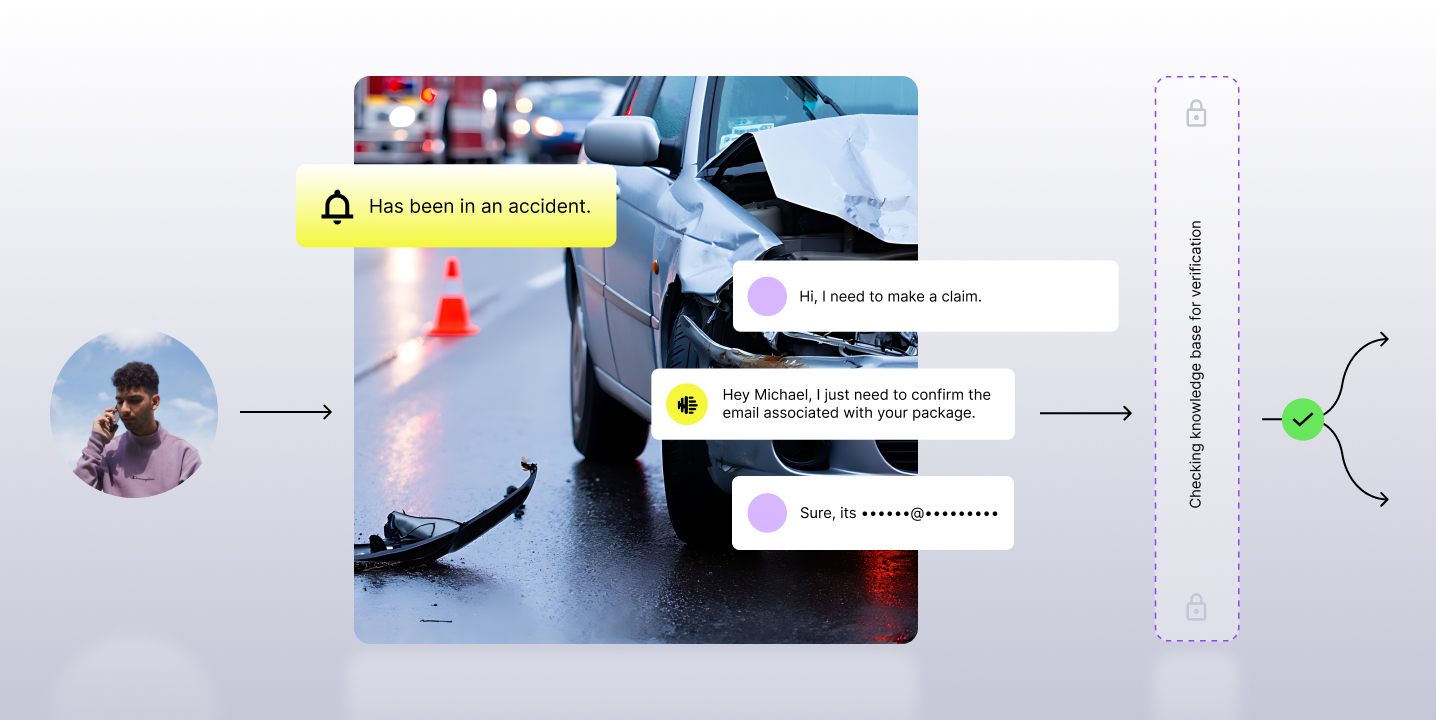
.png)
HIPAA-Compliant AI Voice Agents For Healthcare: A Practical Guide
What AI Voice Agents Do In Healthcare
AI voice agents for healthcare are autonomous, software-based agents that use artificial intelligence to understand natural speech, carry on a conversation, and complete operational tasks—without a human on the other end of the line. They live on phone lines, patient portals, and sometimes in-clinic devices, and they’re tightly integrated with EHR and healthcare systems so they can actually get work done, not just “answer questions.”
Unlike generic voice assistants, healthcare-specific autonomous AI agents are designed from the ground up for clinical and administrative workflows, HIPAA compliance, and handling PHI safely—at enterprise scale and with predictable deployment controls. Their purpose is to offload repetitive, high-volume tasks from call centers and front desks while giving patients faster, 24/7 access to the information and services they need—improving health operations while managing cost. For many health systems, this is also a patient access strategy: using automation to improve access after hours, reduce inbound bottlenecks during peak periods, and keep patient communication consistent.
Common goals for “Voice Agents Healthcare” initiatives include:
- Reducing abandoned calls and wait times
- Increasing self-service rates for scheduling and refills
- Freeing staff from routine phone work
- Improving data quality in EHR and practice management systems
- Maintaining or improving patient experience while scaling operations
How They Differ From IVR And Chatbots
Traditional IVR (interactive voice response) systems follow rigid phone trees: “Press 1 for scheduling, press 2 for billing.” They don’t really understand language—they only react to keypad tones or simple keywords.
Chatbots, by contrast, live mostly on websites or portals and handle text. Even smart chatbots often sit outside clinical systems, providing generic information but not executing many real workflows.
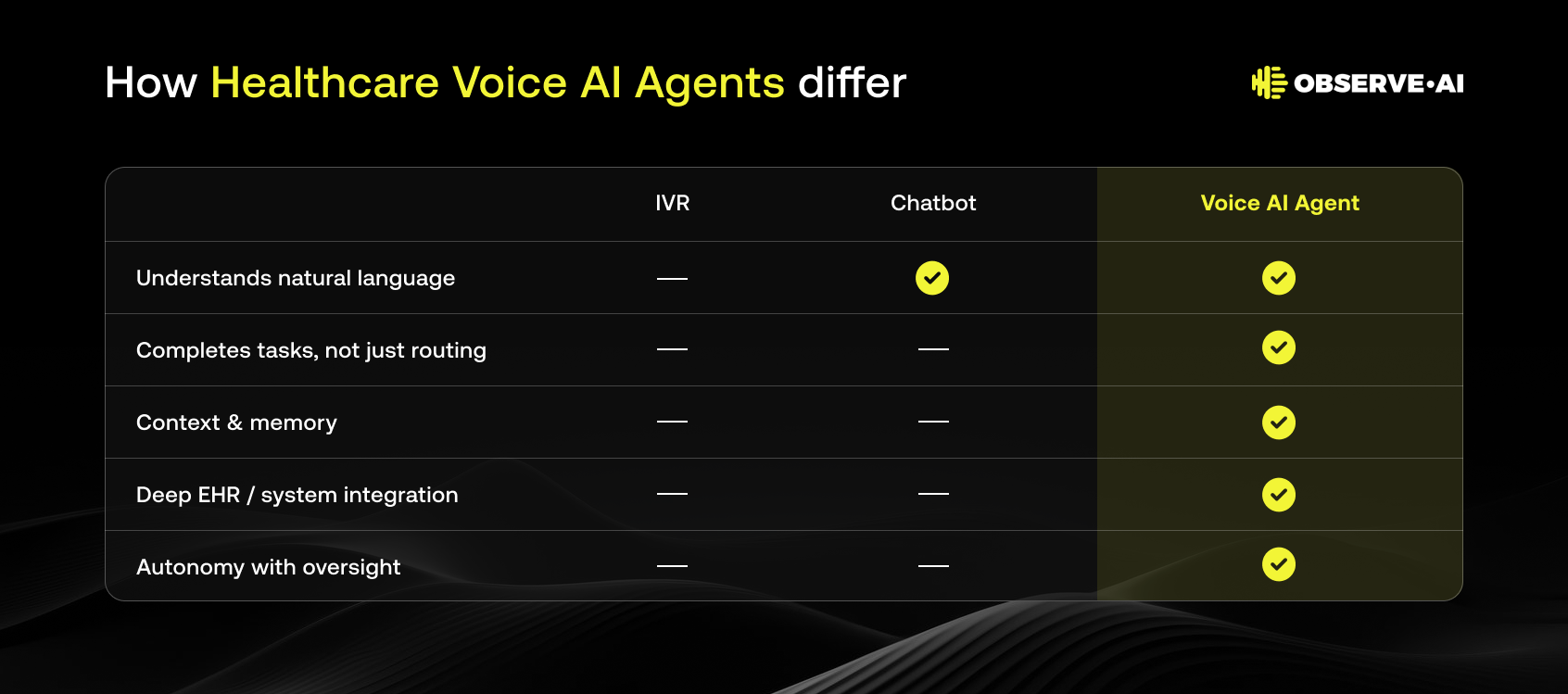
AI voice agents for healthcare differ in several key ways:
- Natural, two-way conversations: Patients can speak in their own words: “I need to move my appointment to next week” or “Refill my blood pressure medication.” The agent understands intent, asks clarifying questions, and responds conversationally.
- Task completion, not just routing: Instead of just forwarding calls, voice AI agents can look up patient records, verify identity, book or change appointments, send reminders, initiate intake forms, or log a refill request in the right queue.
- Context and memory: The agent can remember earlier parts of the conversation—“As you mentioned, you’re seeing Dr. Lee for a follow-up”—and avoid repeating questions unnecessarily.
- Deep system integration: Modern healthcare voice agents integrate with EHR, scheduling, billing, and contact center platforms so they can read and write data in real time.
- Autonomy with oversight: They are autonomous AI agents, but with guardrails: escalation rules, supervision dashboards, and defined workflows that keep them aligned with clinical and operational standards.
In short, where IVR is a decision tree and chatbots are text-only helpers, AI voice agents act like an always-on, voice-enabled digital staff member.
Core Capabilities In Patient Communication
The best AI voice agents for healthcare focus on high-impact, repeatable communication patterns between patients and providers. Typical capabilities include:
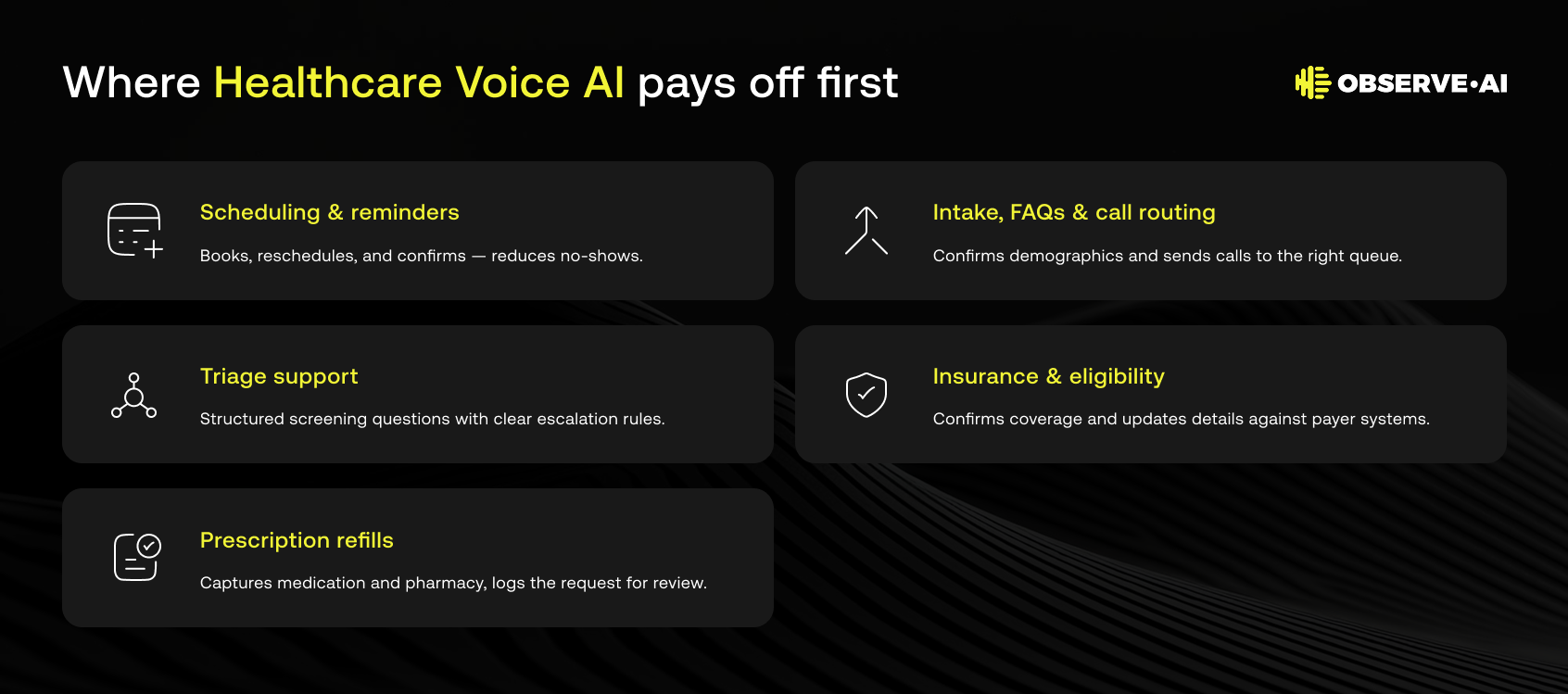
- Scheduling and rescheduling: Checking provider availability, proposing time slots, booking appointments, and sending confirmations over voice, text, or email.
- Appointment reminders and follow-up: Outbound calls reminding patients of upcoming visits, pre-visit instructions, and post-visit follow-up calls to support care plans.
- Intake and registration: Collecting or confirming demographics, insurance information, and basic pre-visit questions, then writing that data back into the EHR or practice management system.
- Call routing and FAQs: Understanding why a patient is calling, answering common questions, or routing the call to the right clinic, department, or queue when human support is needed.
- Prescription refill workflows: Capturing refill requests, validating basic information, and forwarding appropriately to clinical staff or refill queues.
- Basic triage and guidance: Using scripted and supervised triage flows to direct patients to the right level of care (telehealth vs. in-person vs. urgent or emergency care), always with clear escalation rules.
For patients, this feels like calling a knowledgeable, calm staff member who is never rushed and always available. For operations and IT leaders, it’s a way to scale communication without linearly growing headcount.
Why Healthcare Needs Specialized Voice AI
Healthcare is not a generic call center environment. Voice AI agents in healthcare must meet requirements that don’t apply in most other industries:
- Regulatory obligations: HIPAA, state privacy laws, and payer rules shape how PHI is collected, stored, accessed, and transmitted.
- Clinical risk: Advice and triage have direct consequences for patient safety. Agents need strong guardrails, clear escalation, and supervision.
- Complex, fragmented systems: EHRs, practice management platforms, telephony, CRM, and contact center tools all need to work together for true end-to-end automation.
- Sensitive patient populations: Patients may be anxious, elderly, or managing chronic conditions. Voice experiences must be accessible, empathetic, and easy to navigate.
- Trust and security: Providers are custodians of highly sensitive data. Any voice AI platform must prove its commitment to security, compliance, and transparency.
This is why “healthcare-specific autonomous AI agents HIPAA compliant” has become its own category, distinct from generic voice bots. A platform designed for retail or travel cannot simply be “configured” into compliance; it must be architected around PHI protection, healthcare workflows, and clinical governance from day one.
How Healthcare Voice Agents Work
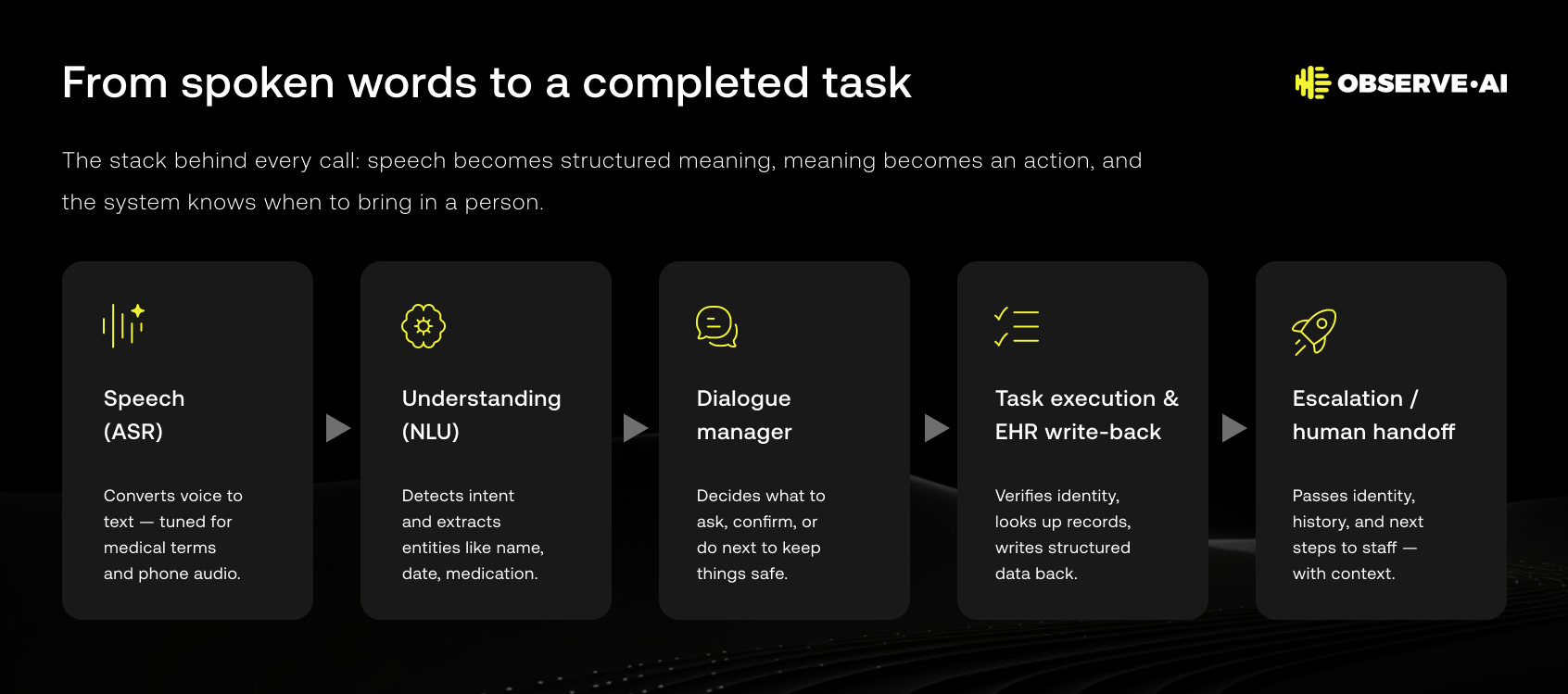
Behind every successful AI voice agent is a stack of technologies that convert speech into structured actions, then safely update healthcare systems.
Speech Recognition And Natural Language Understanding
First, the platform has to understand what the patient is saying. This involves:
- Automatic Speech Recognition (ASR): Converts the patient’s voice into text. For healthcare, this needs to handle medical terms, medication names, accents, and background noise reasonably well.
- Natural Language Understanding (NLU): Interprets the meaning of that text. The agent detects intent (“reschedule appointment,” “refill medication,” “pay bill”) and extracts key entities (patient name, date of birth, desired time, medication name).
Healthcare-specific ASR and NLU models are often trained or tuned on medical vocabulary and typical “phone call” patterns from patients. This domain adaptation is critical: generic models not familiar with clinical terminology can struggle and cause frustration.
The AI voice agent then uses a dialogue manager to decide what to say or do next—ask a clarifying question, confirm information, or proceed to execute a workflow.
Task Execution And EHR Write-Back
Once the intent is clear, the agent executes tasks through integrations with back-end systems:
- Authentication and verification: Using date of birth, phone number, or other factors to confirm identity, in line with the organization’s policies.
- System lookups: Checking appointment schedules, provider availability, insurance status, or prescription information via secure APIs.
- Updates and write-back: Writing structured data back into the EHR, practice management platform, CRM, or ticketing systems—such as updating contact details, booking a visit, or logging a refill request.
For example, in a patient intake scenario, a voice agent might:
- Verify the caller using date of birth and phone number.
- Ask a series of screening and intake questions.
- Map each answer to the correct fields in the EHR.
- Create or update the patient’s record, following your data standards.
Healthcare operations leaders often evaluate accuracy not only by how often the bot “understands” the patient, but also by the quality and completeness of data written back into systems. A “mostly right” transcription is not enough; it must support downstream clinical and billing workflows.
Escalation And Human Handoff
No matter how advanced, AI voice agents will encounter situations they cannot or should not handle autonomously—such as complex clinical questions, distressed callers, or ambiguous intents. Robust handoff is critical to patient safety and experience.
Key elements include:
- Rule-based escalation: Predefined triggers—for example, mention of chest pain, suicidal ideation, or complaints about care—immediately route the call to a human agent or clinician.
- Confidence thresholds: If the system is not confident it has understood the request, it can confirm with the patient; if uncertainty remains, it hands off to staff.
- Warm transfer: The AI can summarize context for the human—reason for call, verified identity data, steps already taken—so patients don’t need to repeat everything.
- Hybrid workflows: In some setups, the voice AI agent handles the front end (authentication, intent, data capture), then forwards a structured summary into a queue for staff to complete the final steps.
This combination of autonomy plus intelligent handoff is what makes AI voice agents practical and safe for real-world healthcare operations.
Healthcare Use Cases With The Highest Impact
Not every workflow is equally suited to automation. The best candidates are high-volume, low-to-moderate complexity tasks with clear rules and limited clinical risk.
Scheduling, Rescheduling, And Reminders
Scheduling is often the first and most impactful use case for voice AI agents in healthcare:
- Inbound appointment calls: The agent can book new visits, change existing appointments, or help patients find the right clinic or provider, all through natural conversation.
- Waitlist and fill management: When a slot opens up, the voice agent can proactively call or text patients on a waitlist, offering earlier times and automatically updating the schedule when slots are accepted.
- Reminders and no-show reduction: Outbound voice reminders (often paired with SMS) can confirm attendance, allow patients to cancel or reschedule via voice, and update the calendar in real time.
Operationally, this reduces call burden on staff and helps keep schedules full and predictable. For patients, it means 24/7 access to scheduling without sitting on hold.
Intake, FAQs, And Call Routing
Another high-value cluster of use cases centers on front-door interactions:
- Pre-visit intake: Patients can complete or confirm key intake elements over the phone—demographics, insurance details, basic screening questions—before they arrive.
- General FAQs: Hours, parking, directions, portal access, visit preparation, and other common questions can often be resolved instantly by the AI voice agent.
- Smart call routing: Instead of clunky menu trees, the agent can ask, “How can I help you today?” and route the call intelligently to the right department (billing, radiology, pediatrics, etc.) or resolve simple issues directly.
For complex organizations with multiple locations and specialties, these capabilities can dramatically reduce misrouted calls and hold times, while still capturing detailed call reasons for reporting and continuous improvement.
Triage, Insurance, And Refill Requests
Some workflows sit closer to clinical or financial operations and require careful design, but can still be partially automated by healthcare-specific agents:
- Symptom screening and triage support: Within defined protocols and with clear escalation, a voice agent can ask structured triage questions, determine urgency, and route the patient appropriately (same-day visit queue, nurse line, telehealth, or emergency guidance).
- Insurance and eligibility: Patients can call to confirm coverage, update insurance information, or check basic eligibility; the agent can verify details against payer systems or practice management platforms.
- Prescription refills: The AI voice agent collects the medication name, pharmacy, and basic information, then logs a refill request for clinical review or feeds a refill management system. It can also update contact preferences and notify patients when the request has been processed.
In these areas, accuracy and safety are paramount. Many organizations start with conservative flows—keeping clinical decisions firmly with humans—and gradually expand automation as they gain confidence in the platform’s behavior and safeguards.
HIPAA Compliance And Safety Requirements
Any deployment of AI voice agents in healthcare must be evaluated through a HIPAA and patient safety lens. At a high level, HIPAA-compliant autonomous AI agents are those that protect PHI’s confidentiality, integrity, and availability while operating under appropriate contracts and safeguards.
BAAs, Encryption, And Access Controls
For HIPAA-covered entities, several foundational requirements apply:
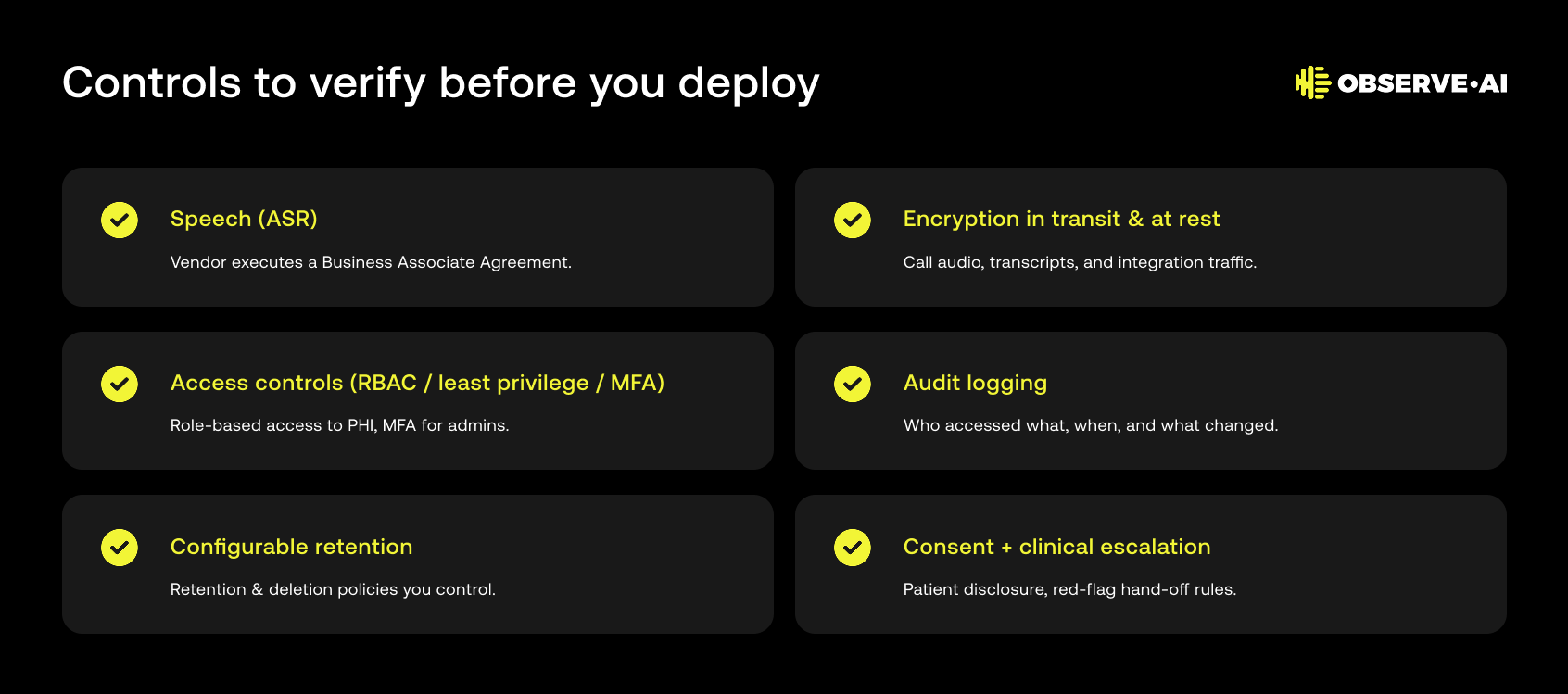
- Business Associate Agreements (BAAs): If your voice AI vendor’s platform creates, receives, maintains, or transmits PHI on your behalf, they are a Business Associate. You need a signed BAA outlining responsibilities, permitted uses and disclosures, breach notification processes, and security obligations. A legitimate healthcare voice AI vendor should be prepared—and willing—to sign a BAA.
- Encryption in transit and at rest: PHI stored or transmitted by the platform should be encrypted using industry-standard methods. This applies to call audio recordings, transcripts, logs containing PHI, and integration traffic between the AI platform and your EHR or other systems.
- Strong access controls: Only authorized personnel (both at your organization and the vendor) should be able to access PHI. Role-based access, least-privilege principles, and robust authentication (ideally multi-factor for administrative access) are core expectations.
Beyond checkboxes, operations and IT leaders should look for evidence of a mature security program: documented policies, regular risk assessments, training, and, where applicable, independent audits or certifications that align with healthcare security expectations.
Audit Logs, Retention, And PHI Handling
HIPAA expects covered entities and business associates to maintain appropriate records of access, disclosures, and system activity:
- Comprehensive audit logging: The platform should log who accessed PHI and when, what changes were made, what systems were touched, and where data flowed. For AI voice agents, this can include call metadata, interaction summaries, and integration events.
- Configurable retention policies: Different organizations have different requirements for how long they retain call recordings, transcripts, and metadata. The vendor’s platform should allow you to configure retention and deletion policies in line with your legal, regulatory, and operational needs.
- Controlled use of data for AI models: Understand how your vendor uses PHI to train or improve models. Some healthcare-specific platforms allow you to opt-out of certain uses or provide private model instances. You should be clear on whether your data is segregated, anonymized, or aggregated, and how it is protected.
- De-identification where appropriate: For analytics and quality improvement, some organizations prefer de-identified or limited data sets. Ask how the vendor supports de-identification and whether analytics dashboards can function without exposing unnecessary PHI.
Clarity on PHI handling—from ingestion through processing to storage and deletion—is central to evaluating whether an AI voice platform is truly HIPAA aligned.
Consent, Escalation, And Patient Safety
Beyond technical security, there are ethical and clinical safeguards that matter:
- Patient awareness and consent: Patients should know they are interacting with an AI voice agent, not a human, and understand how their information will be used. Many organizations start calls with a brief, clear disclosure.
- Clinical escalation rules: For any triage-like or symptom-related interaction, define when and how the agent must escalate. Red-flag symptoms should trigger immediate human review or clear guidance to seek emergency care, in accordance with your clinical governance.
- Scope limits: A HIPAA-compliant voice AI agent should operate within clearly defined workflows—such as scheduling, intake, or basic triage—without improvising medical advice beyond approved content.
- Monitoring and continuous improvement: Periodic call reviews, QA processes, and oversight are essential. Autonomous agents should not be “set and forget”; they should be regularly evaluated for accuracy, safety, and equity (e.g., performance across languages or demographics).
These measures help ensure that AI voice agents enhance care access and efficiency without creating unacceptable clinical risk.
How To Evaluate Healthcare Voice AI Platforms
Selecting the right platform is as much about operational fit as it is about core AI capabilities.
Integration Depth And Workflow Fit
The real value of healthcare AI agents comes from their ability to interact seamlessly with your existing systems:
- EHR and practice management integration: Does the platform provide out-of-the-box connectors for your EHR and scheduling systems, or will integration be a custom project? Can it read and write appointments, patient demographics, and other data reliably?
- Telephony and contact center compatibility: How does the voice agent connect to your current phone systems and contact center platform? Is it cloud-based, on-premises, or hybrid? Can it coexist with existing IVR and routing logic?
- Workflow alignment: Can the AI agent support your specific workflows (multi-site scheduling, specialty-specific intake, complex insurance verification), or will you need to bend your processes to fit the tool? Look for configurable workflows built for healthcare, not generic call scripts.
Strong integration means the agent can truly automate end-to-end processes instead of just acting as a smarter answering service.
Deployment Speed, ROI, And Scalability
For commercial and operational decision-making, time-to-value and long-term scalability matter:
- Deployment approach: Does the vendor offer prebuilt healthcare use cases—like “appointment scheduling,” “intake,” or “refill request”—that can be configured quickly, or will you be building from scratch?
- Pilot and rollout timeline: How long does it typically take customers similar to you (size, complexity) to move from contract to live calls? What’s involved in training, testing, and go-live?
- Measuring ROI: Can the platform provide clear metrics—call containment rates, average handle time reduction, appointment completion rates, reduced no-shows—to help you quantify impact?
- Scalability: As call volume grows or you add new clinics and specialties, can the system scale without major redesign? Are there clear limits on concurrent calls or supported workflows?
A well-designed healthcare voice AI platform should typically deliver measurable operational benefits within months, not years, and grow with you over time.
Questions To Ask Before Choosing A Vendor
When evaluating vendors of AI voice agents for healthcare, consider asking:
- How do you support HIPAA compliance, and will you sign a BAA?
- What PHI do you store, for how long, and how can we control retention and deletion?
- How do your AI models handle healthcare-specific terminology, and how do you measure accuracy?
- What EHR and scheduling systems do you integrate with today, and what will integration entail for our environment?
- How do you handle low-confidence understanding or potentially urgent clinical situations—what are your escalation and handoff mechanisms?
- Can you describe your security program—access controls, encryption, monitoring, and incident response?
- What visibility will we have into performance (dashboards, analytics, audit logs)?
- How customizable are workflows for our specialties and locations?
- How do you ensure ongoing quality and patient safety as the system learns and evolves?
The answers will help you distinguish between generic automation tools and truly healthcare-specific, HIPAA-ready autonomous AI agents.
Frequently Asked Questions About AI Voice Agents
What They Are And How They Work
AI voice agents for healthcare are autonomous software agents that use speech recognition and natural language understanding to converse with patients and perform tasks such as scheduling, intake, reminders, and basic triage. They listen to what a patient says, interpret the intent, access relevant systems (like your EHR and scheduling platform), and take action—always within predefined workflows and safety rules. When they encounter something they can’t handle safely, they escalate to human staff.
Whether They Are HIPAA Compliant
AI voice agents can be HIPAA compliant, but compliance is not automatic. It depends on:
- How the platform handles PHI (collection, storage, transmission, and deletion)
- Whether the vendor signs a Business Associate Agreement and upholds its terms
- The strength of encryption, access controls, and audit logging
- Your own configuration choices (e.g., what data is captured, retention policies, and consent language)
“HIPAA-compliant autonomous AI agents in healthcare” are those deployed within this framework, with both the vendor and the covered entity meeting their obligations.
How They Integrate With EHR Systems
Modern healthcare voice AI agents integrate with EHR systems and related platforms via secure APIs or vendor-specific connectors. Typical patterns include:
- Reading and writing appointment data for scheduling and reminders
- Updating patient demographics and contact information during intake
- Logging call-related notes or tasks into the EHR, CRM, or ticketing systems
- Pulling certain clinical or administrative details to personalize conversations, within policy limits
The depth of integration varies by platform and by EHR, so it is a critical area to explore early in vendor evaluation.
By understanding what AI voice agents for healthcare are, how they work, and how HIPAA rules apply, operations and IT leaders can confidently explore voice automation as a lever for better access, more resilient staffing, and a more modern patient experience—without compromising security or safety.
Subscribe to our newsletter.
Frequently Answered Questions


.jpg)

.png)
.jpg)