From Point Solutions to Connected AI: Building the Next Generation Insurance Contact Center
Insurance organizations are entering a new phase of AI adoption.
Early investments have demonstrated how individual technologies can automate routine service requests, assist employees, evaluate interactions, and analyze customer conversations.
Now, the opportunity is to connect these capabilities across the entire service operation.
Rather than viewing AI as a collection of separate applications, insurers can begin treating it as a coordinated system that supports policyholders, frontline employees, and business operations.
This shift has important implications for customer experience, operational efficiency, and the long-term value of AI investments.
The Limits of Solving One Problem at a Time
Insurance organizations often adopt new technology to address a specific challenge.
An AI Agent may be introduced to reduce routine call volumes. A separate tool may support representatives with knowledge retrieval. Another application may evaluate call quality, while a fourth analyzes customer feedback.
Each can deliver measurable value.
But when these systems operate independently, important information may remain disconnected.
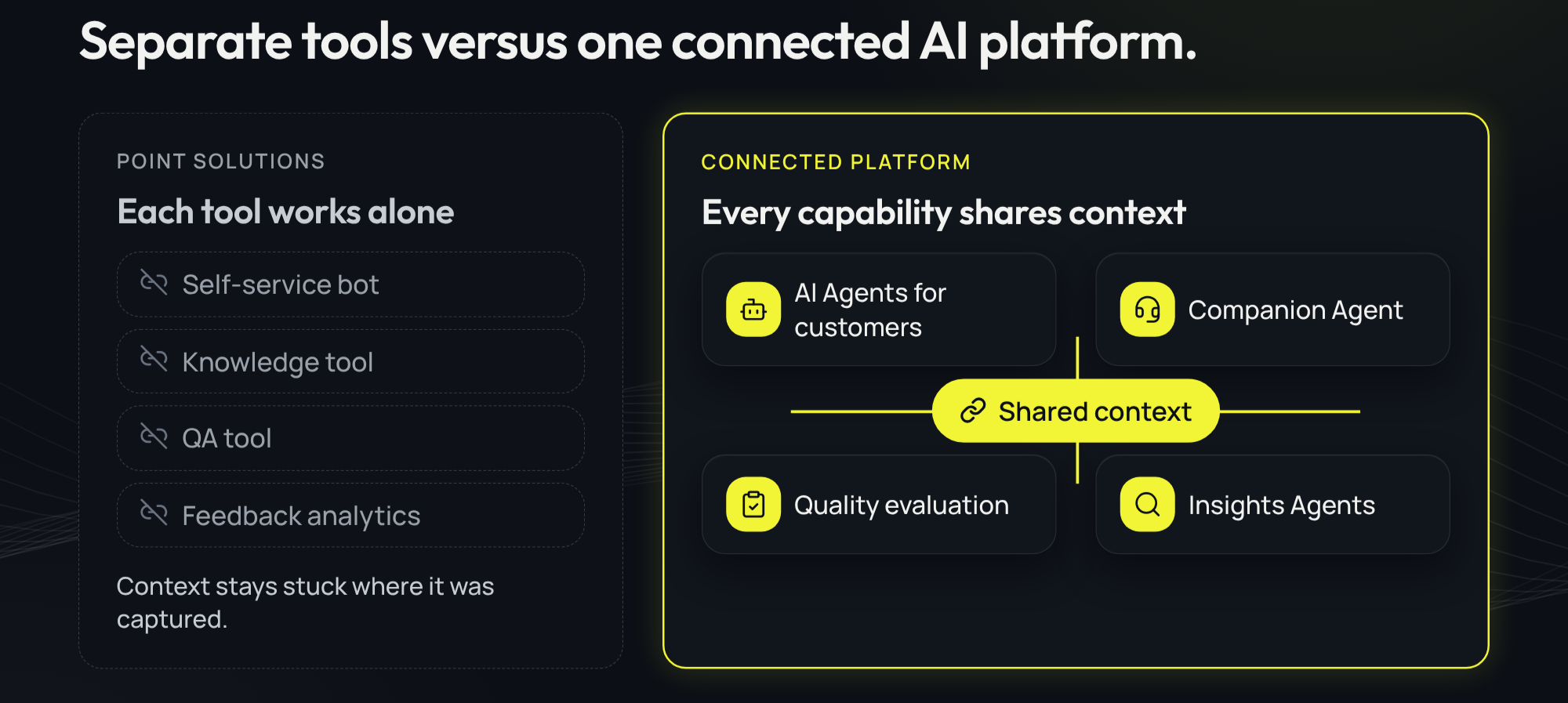
An automated service interaction may not provide the full context needed by a human representative. Quality evaluations may identify a performance issue without informing coaching. Customer insights may reveal a recurring problem without reaching the teams responsible for improving the process.
As insurers expand their use of AI, these gaps become more consequential.
The next phase is about connecting the capabilities already delivering value.
One Connected Experience Across AI and Human Service
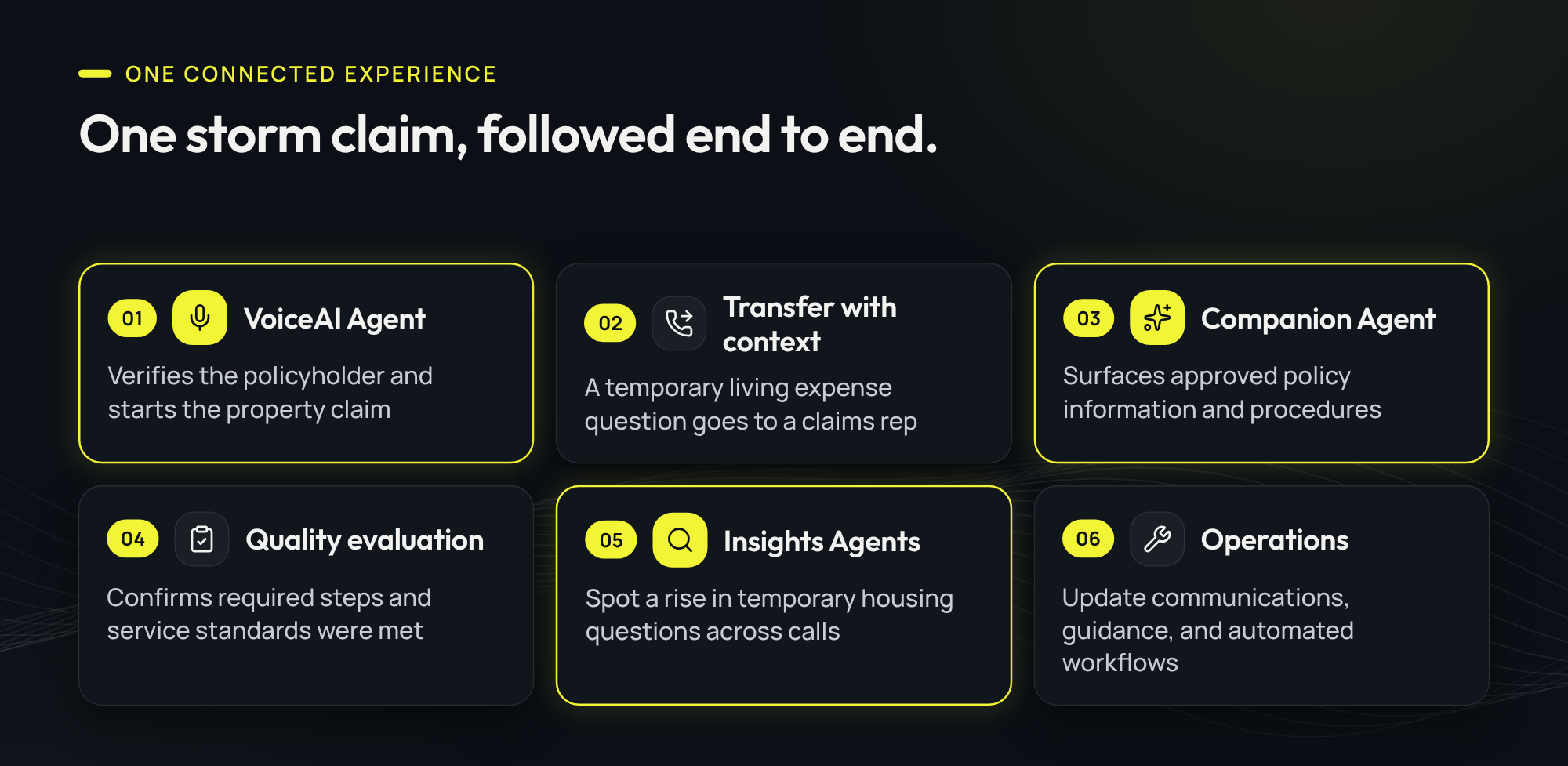
Consider a policyholder contacting an insurer after a severe storm.
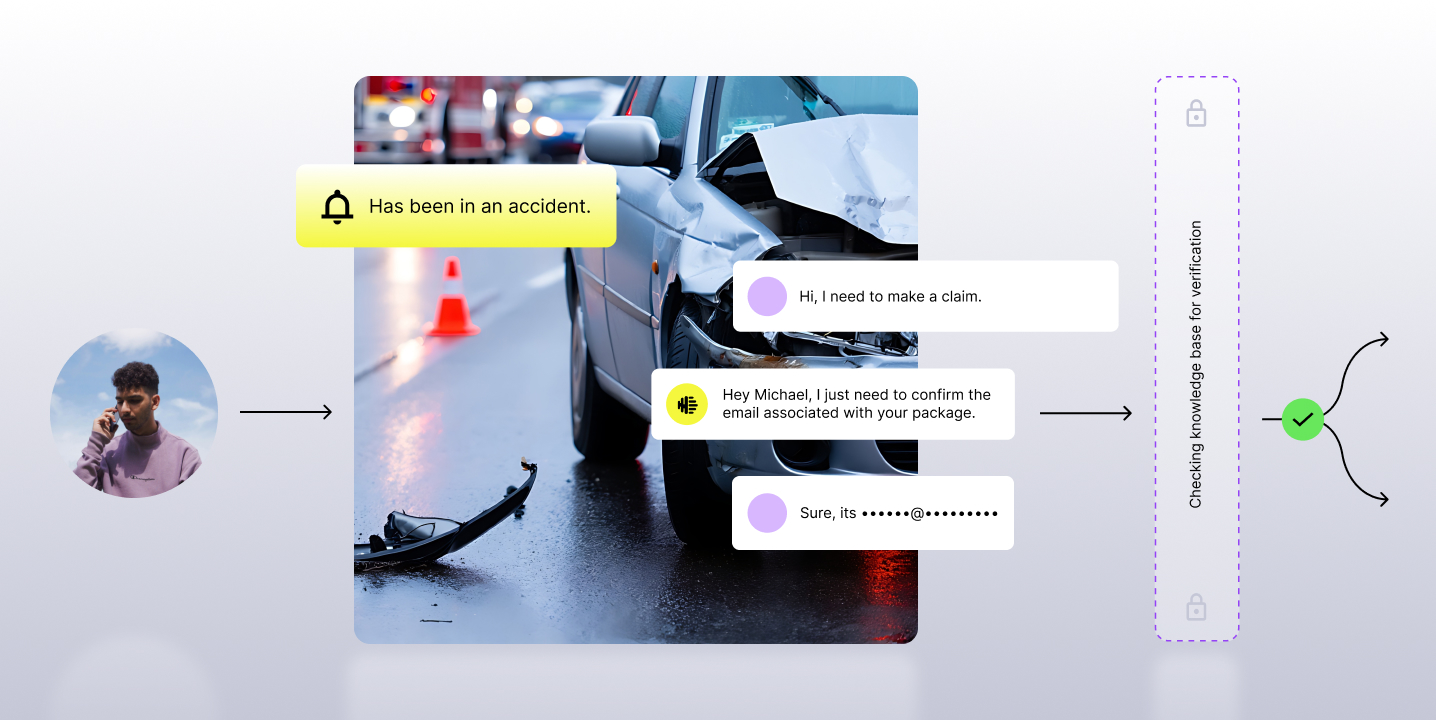
They begin with a VoiceAI Agent to report property damage. The agent collects initial information, verifies the policyholder through approved processes, and helps initiate the claim through connected systems.
During the conversation, the policyholder asks a complex question about temporary living expenses.
The AI Agent recognizes that the request requires additional assistance and transfers the interaction to a claims representative.
Because the systems share context, the representative receives the conversation history, relevant information, and reason for escalation.
Companion Agent then provides real-time assistance, helping the representative locate approved policy information and follow appropriate procedures.
After the interaction, AI-powered quality evaluation helps determine whether required steps were followed and the conversation met defined service standards.
Across many similar interactions, Insights Agents identify a growing number of policyholders asking about temporary housing coverage.
Operations leaders can use those findings to improve customer communications, update guidance, or refine automated service workflows.
This is the difference between having multiple AI tools and operating a connected AI platform.
Connecting Customer Experience With Employee Performance
The value of connected AI also extends to workforce development.
When quality evaluations and operational insights identify recurring areas for improvement, Performance Agents can help managers develop targeted coaching plans.
Companion Agent can reinforce approved practices during subsequent customer interactions.
The organization can then evaluate whether the changes are producing better results.
This creates a direct relationship between what insurers learn from customer conversations and how they help employees improve.
It also makes employee development more responsive to changing insurance products, policies, and customer needs.
Creating a Foundation for Continuous Improvement
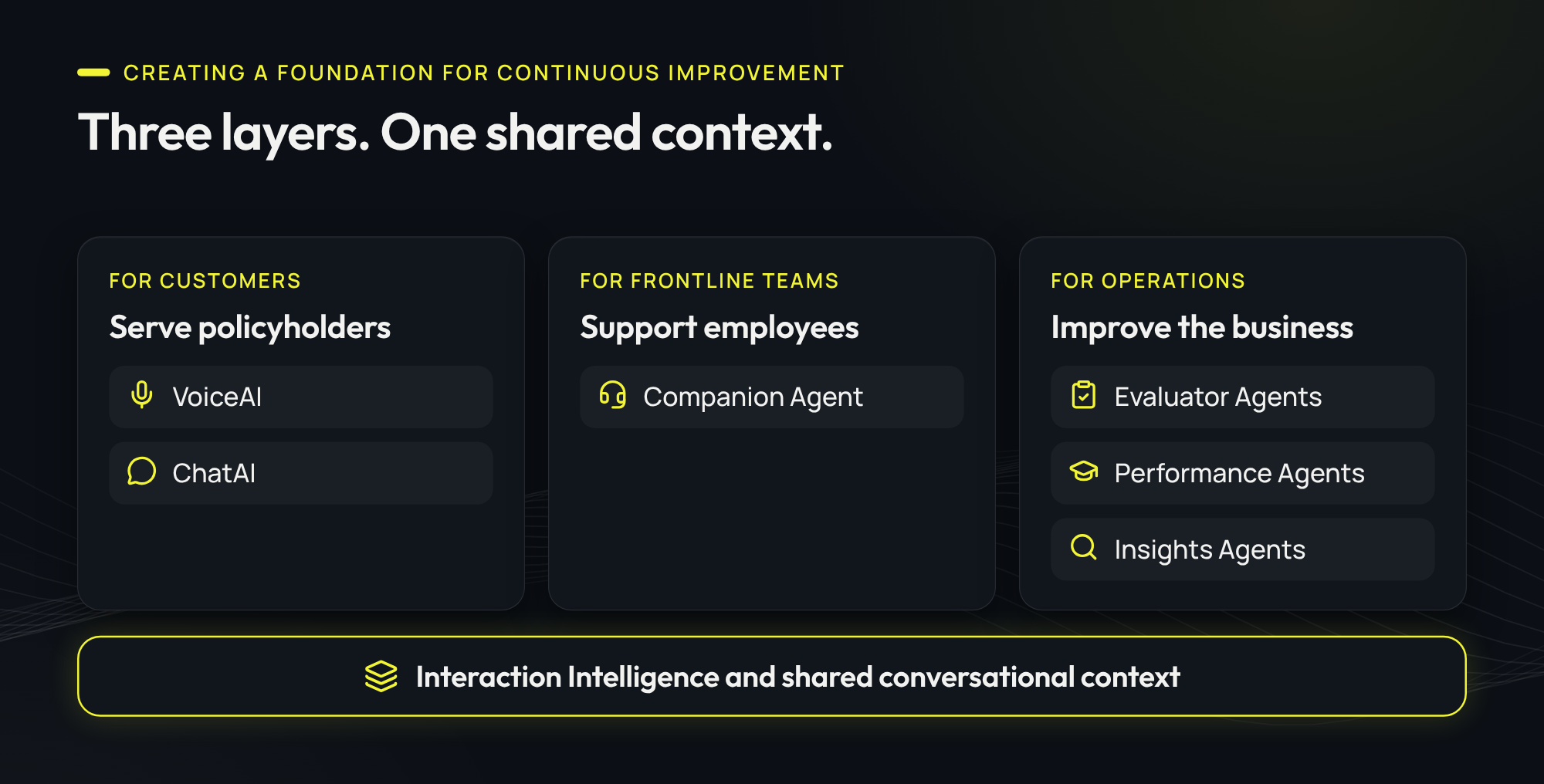
Connected AI provides an opportunity to link three activities that are often managed separately: serving customers, supporting employees, and improving operations.
Customer-facing AI Agents help resolve routine requests and collect relevant context.
Frontline assistance helps employees manage interactions requiring human expertise.
Interaction Intelligence evaluates conversations and identifies broader trends, while operational AI Agents help teams investigate findings and improve performance.
As these capabilities work together, each interaction can contribute to improving future experiences.
The system becomes more than a collection of productivity tools. It becomes an important source of operational learning.
Building the Next Generation Insurance Operation
Deloitte’s 2026 Global Insurance Outlook emphasizes the importance of scaling practical AI use cases while strengthening data foundations, modernization, security, and workforce readiness.
For insurers, these priorities point toward an approach that connects technology investments with how the organization actually operates.
Observe.AI brings together VoiceAI and ChatAI Agents for customers, Companion Agent for frontline teams, and Interaction Intelligence with Evaluator, Performance, and Insights Agents for operations.
Together, these capabilities support connected service experiences and a continuous process for understanding and improving performance.
The opportunity is not to automate every step of the policyholder journey.
It is to ensure that automation, human expertise, and business intelligence work together to deliver the right experience at the right moment.
The next generation insurance contact center will not be defined by how many AI tools it uses, but by how effectively those tools work together to serve policyholders and improve the business.
Subscribe to our newsletter.
Frequently Answered Questions