From Compliance Checklists to Continuous Risk Management in Insurance Contact Centers
Insurance organizations operate in an environment where accuracy, transparency, and regulatory compliance are essential to maintaining customer trust.
From required disclosures and policy representations to claims communications and complaint handling, frontline conversations can create meaningful regulatory and operational exposure.
For many insurers, quality assurance programs play a central role in managing these risks. Yet traditional programs often rely on manual evaluations of a limited selection of interactions.
Artificial intelligence creates an opportunity to expand monitoring, identify potential issues earlier, and make quality management a more continuous part of insurance operations.
The Growing Complexity of Insurance Oversight
Insurance contact centers must balance customer experience with regulatory requirements that vary by product, jurisdiction, and interaction type.
A licensed representative discussing coverage options may need to follow different requirements than a service employee answering billing questions or a claims specialist explaining the status of an investigation.
Organizations also need to ensure that employees provide accurate information, follow established procedures, and escalate situations appropriately.
As AI becomes more prevalent in insurance operations, oversight responsibilities are expanding.
The National Association of Insurance Commissioners has established expectations for insurers’ responsible use and governance of AI, including compliance with applicable insurance laws.
This creates an important consideration for insurance leaders: AI adoption must be accompanied by appropriate controls, monitoring, and accountability.
Why Traditional Quality Programs Have Limitations
Manual quality assurance remains valuable, particularly for complex judgment-based evaluations.
However, reviewing a small sample of interactions can leave significant portions of customer conversations unexamined.
A critical disclosure may be missed during an otherwise routine call. A recurring misunderstanding about policy coverage may appear across hundreds of conversations. A new servicing procedure may be interpreted inconsistently by different teams.
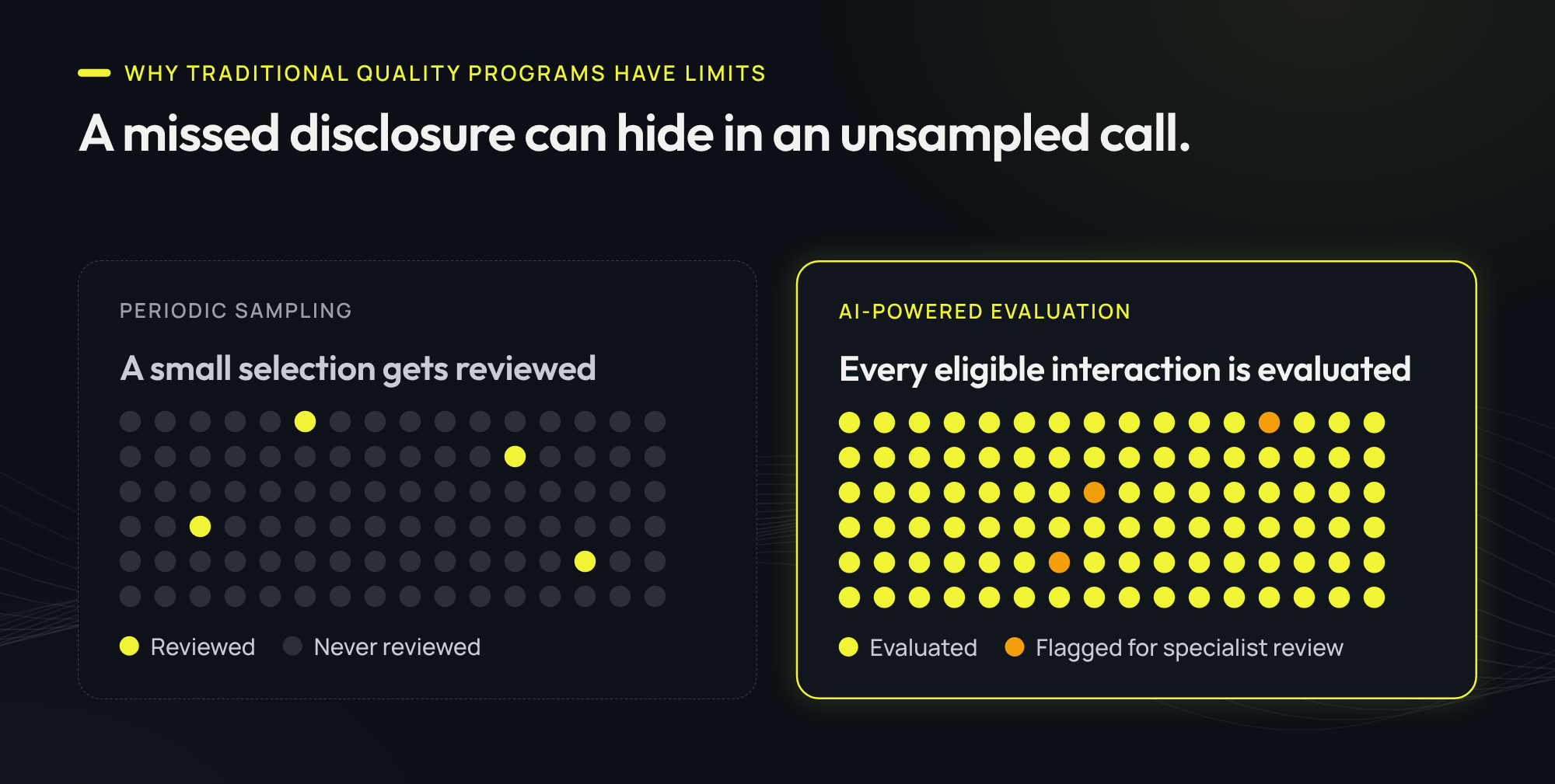
When evaluation depends primarily on periodic sampling, organizations may not identify these patterns quickly.
AI-powered quality evaluation can help expand coverage across eligible interactions and apply consistent criteria at scale.
Rather than replacing human quality specialists, this gives them more information about where their expertise is needed.
Moving Toward Continuous Evaluation
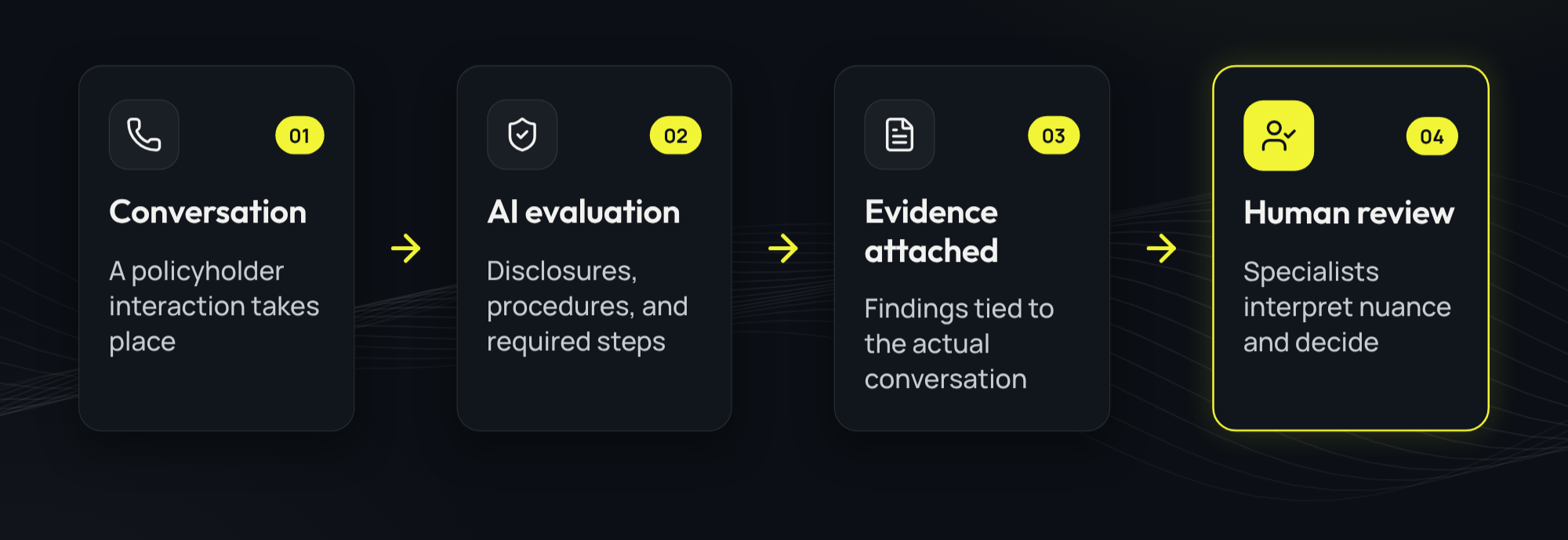
Modern insurance quality programs can use AI to evaluate interactions against defined requirements, identify potential concerns, and direct attention to conversations requiring review.
For example, an insurer could evaluate whether representatives followed required authentication procedures, communicated specified disclosures, or handled customer complaints according to established guidelines.
Results can be tied to supporting conversational evidence, helping quality teams investigate findings and understand the basis for an evaluation.
Human reviewers remain essential for interpreting nuanced situations, validating findings, and making consequential decisions.
This combination supports a more comprehensive approach to quality management while maintaining appropriate oversight.
Connecting Quality Findings to Action
Identifying a potential issue is only the first step.
If quality evaluations reveal that representatives frequently struggle to explain a new coverage exclusion, an insurer needs a way to respond.
Managers may need to update training materials, refine guidance, review communications, or change operating procedures.
This is where connected quality and performance capabilities become particularly valuable.
AI-powered evaluations can inform coaching, while interaction analysis can help determine whether an issue is isolated or widespread.
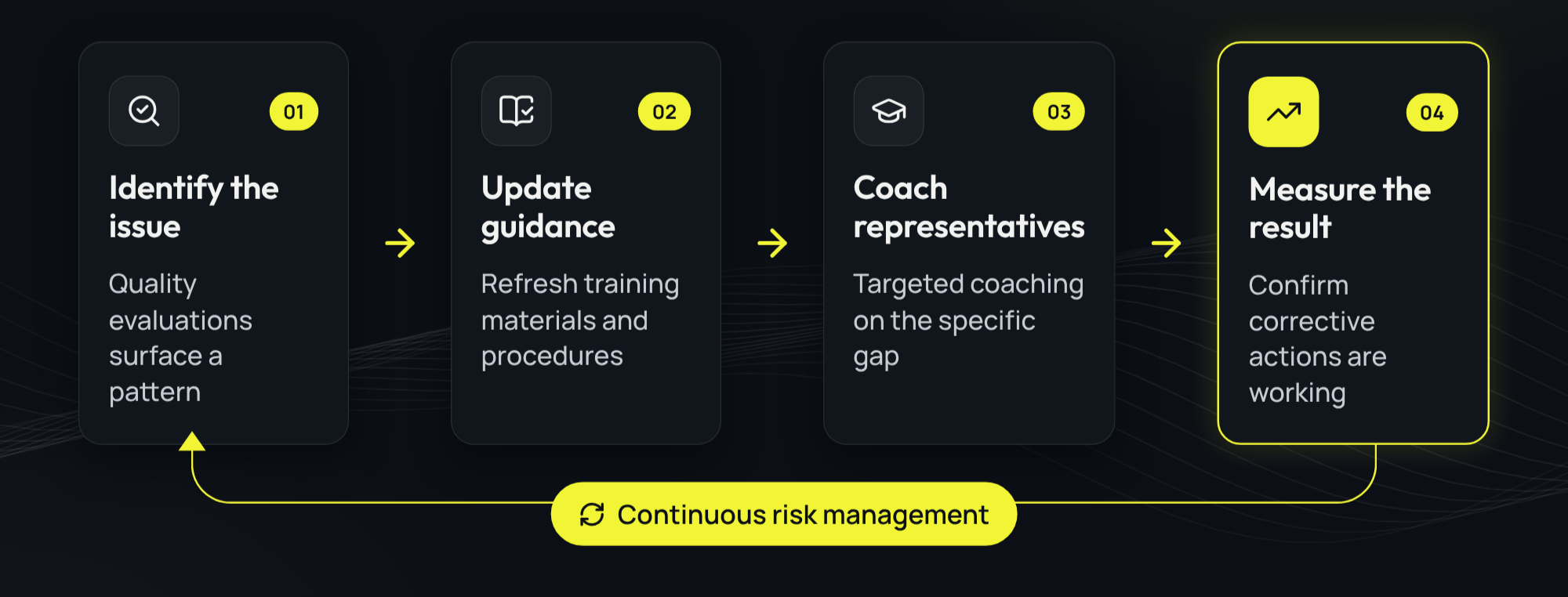
Over time, insurers can assess whether corrective actions are improving outcomes.
Building Confidence in AI-Enabled Operations
Observe.AI brings together AutoQA, Evaluator Agents, Insights Agents, and Performance Agents to help insurance organizations evaluate interactions, investigate potential issues, and improve employee performance.
These capabilities support operational monitoring and quality management. They do not replace legal interpretation, regulatory oversight, or the insurer’s responsibility for compliance.
The opportunity is to give risk, quality, and operations teams more comprehensive information and a more direct path from identifying concerns to addressing them.
For insurers, the next generation of quality management is not simply about evaluating more conversations. It is about identifying risks earlier and creating a continuous process for improvement.
Subscribe to our newsletter.
Frequently Answered Questions