Utility Customer Experience: How to Improve It When Bills and Call Volumes Keep Rising
Utility customer experience is the sum of every interaction a customer has with their electric, gas, or water provider: starting service, reading and paying a bill, reporting an outage, setting up a payment arrangement, or calling to ask why their bill doubled. Improving it today comes down to three things: resolving high-volume billing and account requests faster, communicating proactively during outages, and giving live agents the support they need on the hard conversations.
That sounds simple. The numbers say it is not.
Why utility customer experience is under pressure
Customer satisfaction with utilities is falling, and cost is the main reason.
In the J.D. Power 2025 U.S. Electric Utility Residential Customer Satisfaction Study, overall satisfaction averaged 499 on a 1,000-point scale, the lowest score across J.D. Power's residential utility studies. The average monthly residential electric bill reached $189 for 2025, up 34% since 2020.
McKinsey's 2025 CX Utility Survey of more than 10,000 customers points in the same direction. Dissatisfied customers rose to 29%, up from 18% in 2018, and 70% of customers said they are concerned about affordability.
More rate pressure is coming. According to PowerLines, electric and gas utilities requested $30.5 billion in rate increases in 2025, more than double the 2024 total, affecting roughly 81 million customers.
Every one of those increases eventually becomes a phone call. Customers want to know why their bill went up, whether they qualify for assistance, and what happens if they cannot pay. That puts the utility call center at the center of the customer experience, whether or not it was designed for that role.
Where utility customer experience breaks down
Most problems with customer experience in utilities show up in a small number of moments. If you fix these, you fix most of what customers feel.
Billing and payment calls
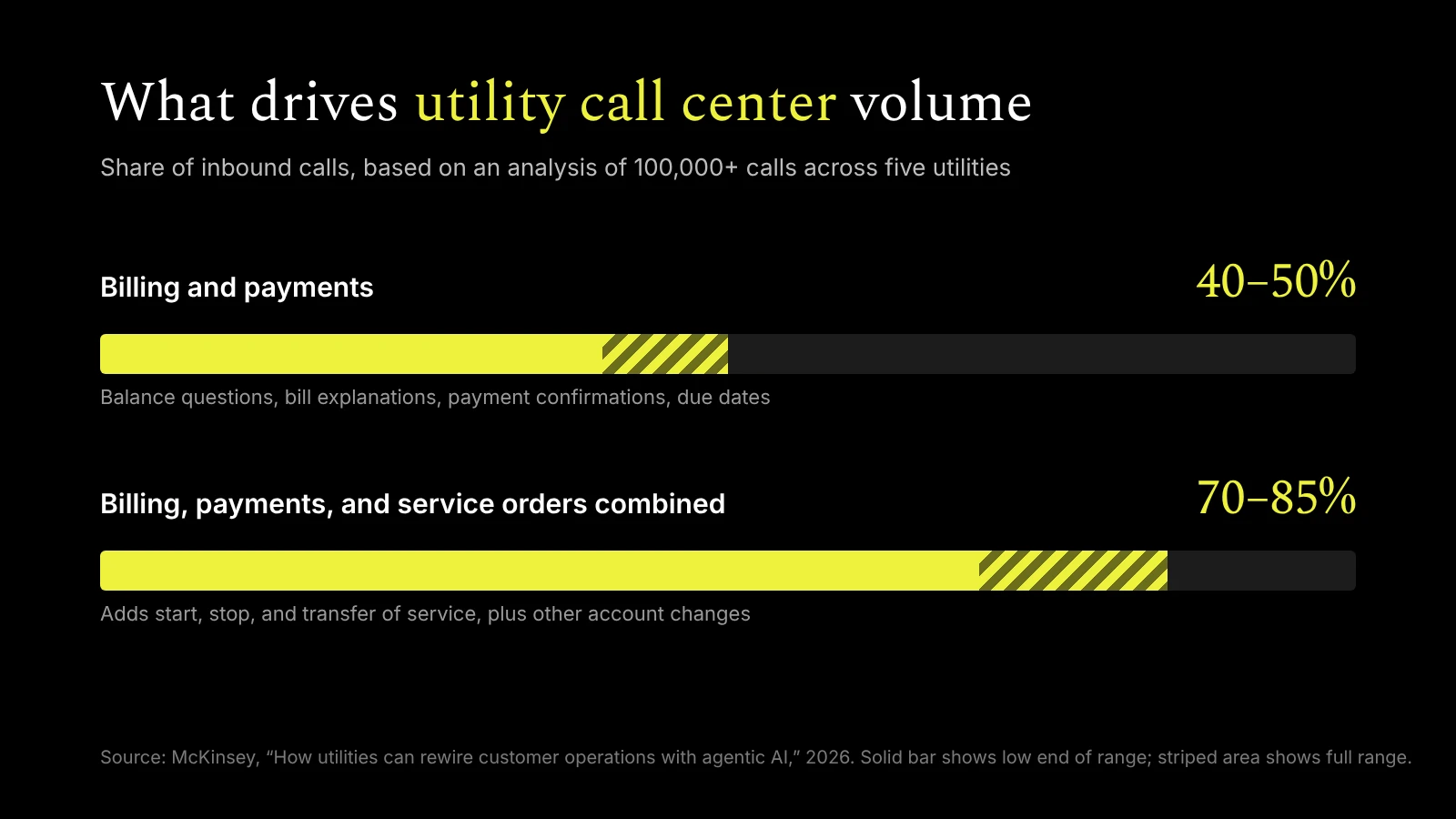
Billing is the biggest driver of contact volume by a wide margin. McKinsey's analysis of more than 100,000 calls across five utilities found that billing, payments, and service orders make up 70% to 85% of calls, and billing and payments alone account for 40% to 50%.
Many of these calls are repetitive: balance inquiries, due dates, payment confirmations, and bill explanations. They are also the calls where tone matters most, because a confused customer can quickly become an angry one.
Outage communication
During an outage, customers judge the utility on how well it keeps them informed, not just on how fast power comes back. McKinsey found that communication accounts for 54% of outage-related satisfaction, nearly as much as the outage itself.
When updates are slow or inconsistent, customers call. Call volume spikes at exactly the moment the contact center has the least capacity to absorb it.
Digital channels that do not resolve the issue
Utilities have invested in web portals and apps, but many customers still end up on the phone. The J.D. Power 2025 U.S. Utility Digital Experience Study scored utility digital experiences at 611 on a 1,000-point scale, well below industries like wealth management (738). Only 16% of utilities provided proactive guidance, personalized usage data, and bill-reduction strategies.
When self-service does not answer the question, the call center does.
Surges that staffing cannot match
Storms, heat waves, billing cycle changes, and rate increases all create sudden demand. Hiring and training seasonal agents takes months. The result is long hold times, abandoned calls, and repeat contacts that make the next surge worse.
How AI improves utility customer experience
AI does not replace the people who handle a customer facing a disconnection notice. It takes on the repetitive work so those people have time for it, and it gives them better information while they work. Here is how that plays out in practice.
1. Resolve routine billing and account requests with AI agents
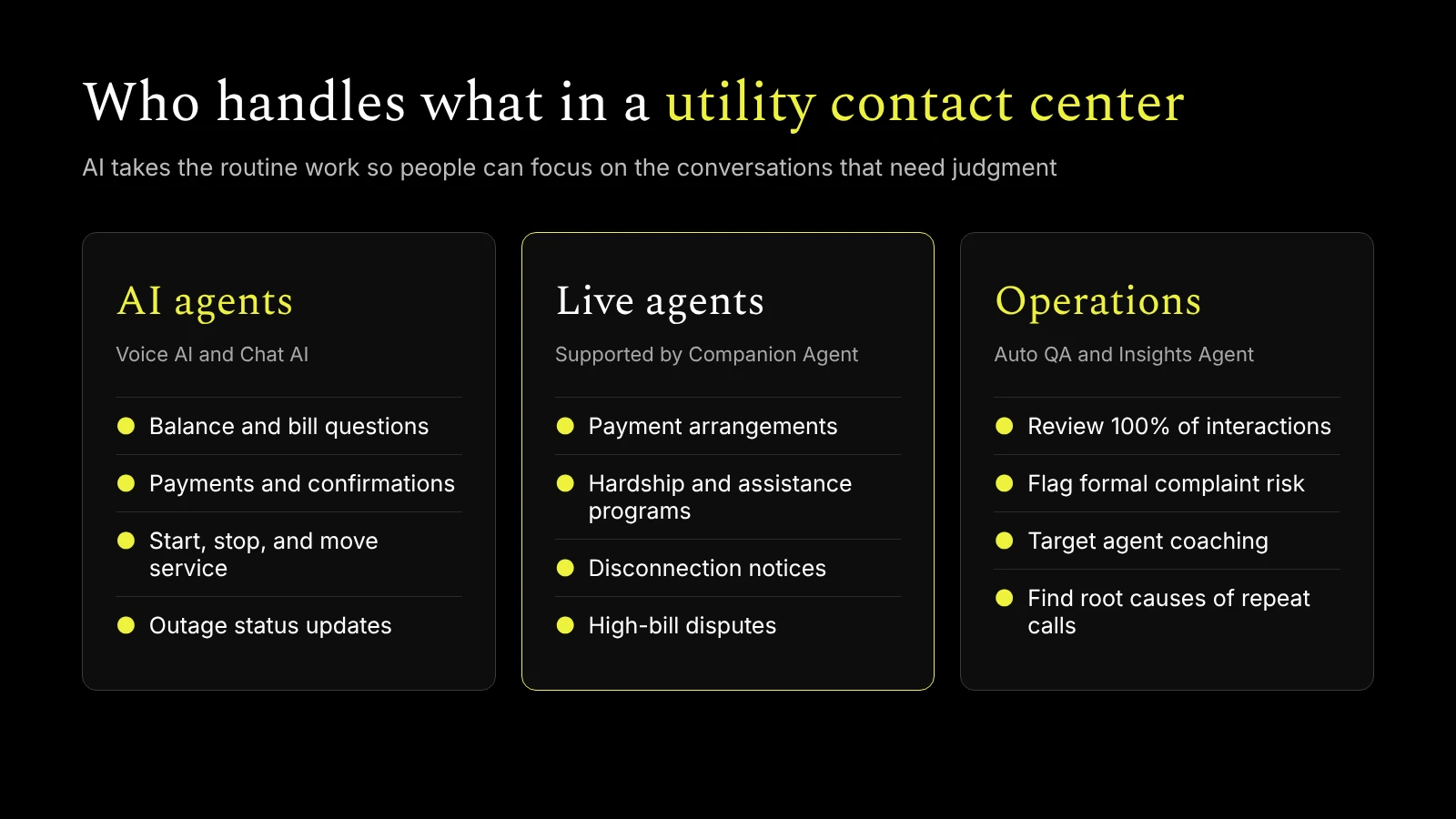
Voice and chat AI agents can handle high-volume requests end to end: checking a balance, explaining a bill, taking a payment, starting or stopping service, or updating an address. They can authenticate callers, connect to billing and CIS systems, and answer around the clock.
McKinsey reports that E.ON Next, which handles more than 7 million service calls a year, deployed an AI voice assistant for billing calls and saw inbound calls fall by about 50% while satisfaction rose 6 points.
Observe.AI's Voice AI and Chat AI are built for this kind of work, with guardrails that keep conversations on approved policy and a clean handoff to a live agent when the customer needs one.
2. Communicate proactively during outages
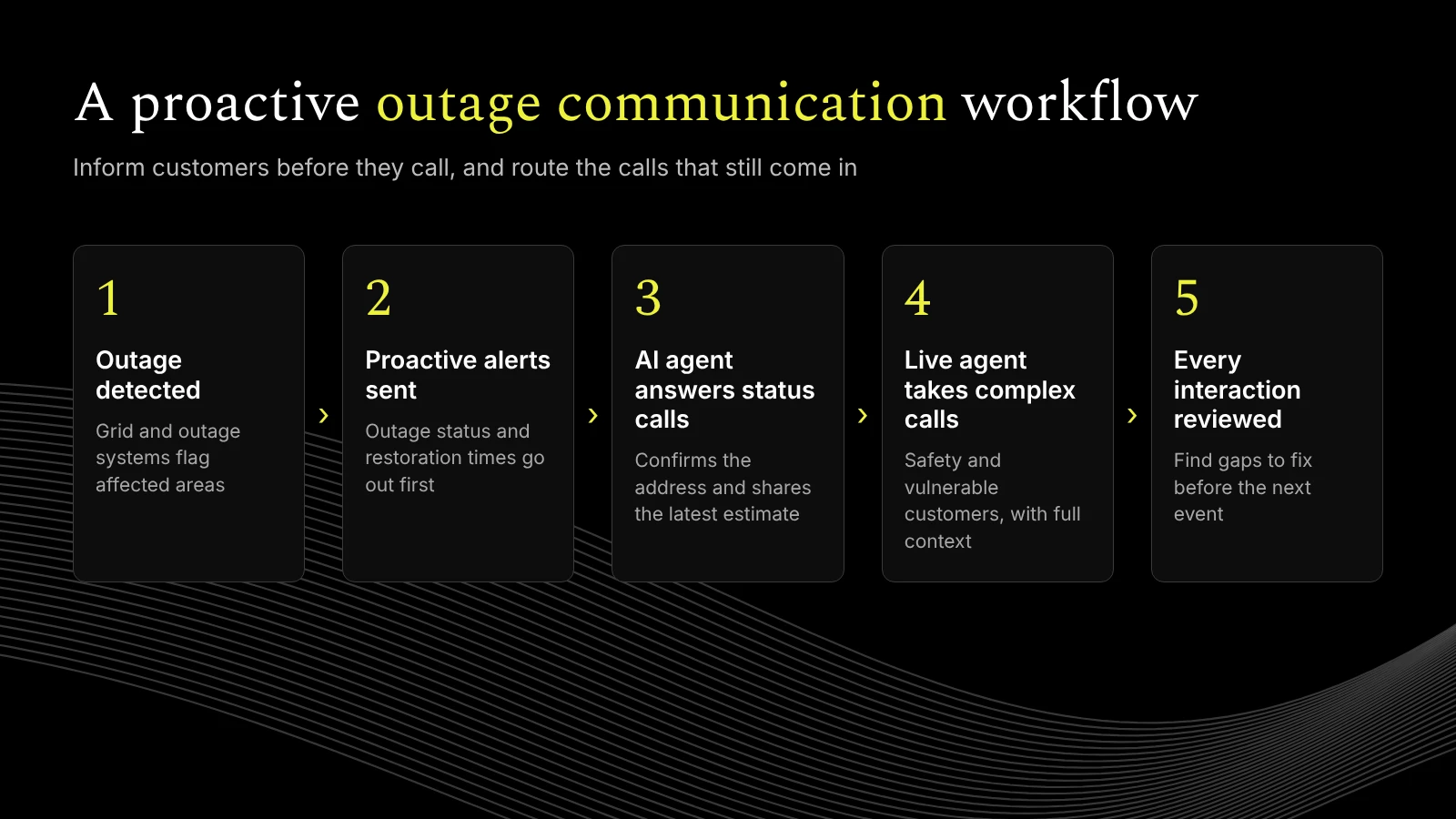
The best outage call is the one the customer never has to make. Outbound voice and messaging can share outage status, estimated restoration times, planned maintenance notices, and severe weather alerts before customers start dialing.
McKinsey found that proactive updates reduced outage-related calls by up to 50%. When customers do call, an AI agent can confirm whether their address is affected and give the latest restoration estimate, which frees live agents for safety issues and medically vulnerable customers.
3. Support live agents on the difficult conversations
Payment arrangements, hardship programs, disconnection notices, and high-bill complaints require judgment and empathy. These are the calls where real-time support makes the biggest difference.
A real-time assistant like Observe.AI's Companion Agent can surface the right policy, assistance program eligibility, or next step while the agent is still on the call. It can also handle note-taking and after-call summaries, so agents spend less time on paperwork and more time with customers.
4. Review every interaction, not a sample
Most utility QA teams review a small fraction of calls by hand. That leaves blind spots on compliance, complaint triggers, and agent coaching needs.
With automated quality assurance, every call and chat, whether handled by a human or an AI agent, can be evaluated against the same criteria. Supervisors can see which calls show signs of a formal complaint, which agents need coaching on payment arrangement scripts, and where AI agents are escalating more than expected.
5. Use conversation data to fix the root cause
Every call is a signal. If thousands of customers call about the same line item on a new bill, that is a bill design problem, not a contact center problem.
Tools like Observe.AI's Insights Agent let CX and operations leaders ask questions of their interaction data in plain language, such as "What drove the increase in high-bill calls last month?" The answers can inform bill redesign, website content, and outbound messaging, which reduces future calls.
What to measure
Utility CX programs need metrics that reflect both efficiency and the customer's experience. A practical starting set:
- Containment rate: The share of interactions an AI agent resolves without transfer to a live agent.
- First contact resolution: Whether the customer's issue was solved on the first interaction, across both AI and live channels.
- Repeat calls during outages: A direct measure of how well proactive communication is working.
- Customer satisfaction by call reason: Billing, outage, start or stop service, and payment arrangements often perform very differently.
- Formal complaint rate: Especially important for regulated utilities that report complaints to state commissions.
- After-call work time: A clear indicator of how much administrative load agents are carrying.
Track these by call reason rather than as blended averages. A strong overall CSAT can hide a billing experience that is getting worse.
A practical way to get started
Utilities that see results tend to start narrow and expand.
Begin with one high-volume, well-defined call type, such as balance and payment inquiries. Connect the AI agent to the systems it needs, define clear escalation rules, and review every interaction for the first several weeks.
Next, add proactive outage notifications and AI-handled outage status calls ahead of storm season.
Then extend real-time agent assist and automated QA across the live agent team, and use what you learn from conversation data to improve bills, digital content, and outbound messaging.
Each step builds on the one before it, and together they shift utility customer engagement from reactive to proactive. By the time the next rate case or major storm arrives, the contact center has capacity it did not have before.
Frequently asked questions
What is utility customer experience?
Utility customer experience is how customers perceive every interaction with their electric, gas, or water provider, including billing, payments, service changes, outage communication, and support through the contact center and digital channels.
Why is utility customer satisfaction declining?
Rising costs are the main factor. J.D. Power found that the average monthly residential electric bill reached $189 in 2025, up 34% since 2020, and overall residential electric satisfaction fell to the lowest level across its residential utility studies.
How can utilities reduce call volume during outages?
Proactive outbound updates on outage status and restoration times are one of the most direct ways to reduce outage calls. McKinsey reports that proactive updates reduced outage-related calls by up to 50%. AI agents can also answer outage status calls so live agents can focus on safety and vulnerable customers.
Can AI handle utility billing calls?
Yes, for many routine requests. AI voice and chat agents can explain bills, check balances, take payments, and set up service changes, then hand off to a live agent with full context when a customer needs help with hardship, disputes, or disconnection.
How do I improve customer experience in utilities without adding staff?
Automate the highest-volume routine requests, communicate proactively during outages, give live agents real-time support on complex calls, and use conversation data to remove the root causes of repeat contacts.
See how Observe.AI supports utility customer experience
Observe.AI helps utilities handle billing and outage surges with AI agents, support live agents in real time, and review every interaction for quality and compliance. Explore Observe.AI for utilities or request a demo to see it with your own call types.
Subscribe to our newsletter.
Frequently Answered Questions









G2
High Performer
AI agent 2026

G2
Leader
Conversation Intelligence

MetriStar
Top Provider 2026
