Best AI Insurance Agents And Agent-Assist Tools For Contact Centers
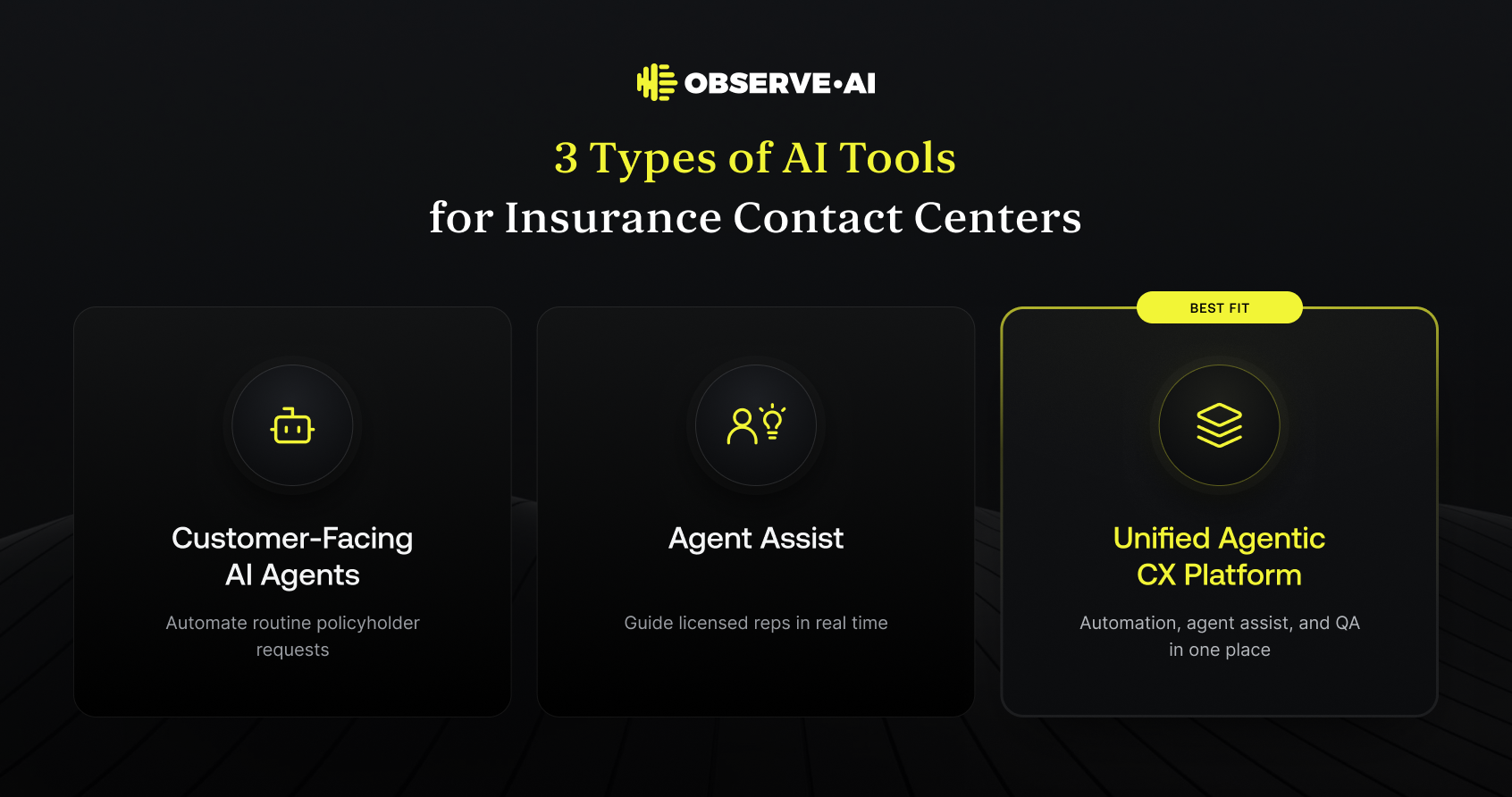
Insurance contact centers evaluating AI insurance tools now face three broad categories of platforms:
- Customer-facing AI agents
- Agent-assist tools for insurance customer service representatives and agencies
- Unified agentic CX platforms that combine automation, agent assist, and quality assurance
When assessing the “best” AI insurance agent tools, insurers increasingly favor this third category. A unified platform lets teams deploy automation where it is safe and valuable, while still improving human-led conversations and keeping governance centralized.
Customer-Facing Automation, Agent Assist, Or Both
Insurance leaders rarely choose between AI agents and agent assist. Instead, they pick the right tool for each workflow.
Customer-facing AI agents work best when:
- Teams set clear rules and workflows.
- Reliable data and policy rules ground the AI.
- The AI can safely act in back-end systems, such as creating claims, updating contact details, or sending documents.
- Speed matters more than empathy, such as checking status, uploading files, or sending payment reminders.
AI agent-assist tools work best when:
- The conversation is complex, emotional, or high-stakes, like major property losses or coverage denials.
- Reps must balance underwriting rules and multiple guidelines.
- Legal risk is high, requiring a licensed agent to run the call.
- Teams want consistent quality while keeping human judgment in control.
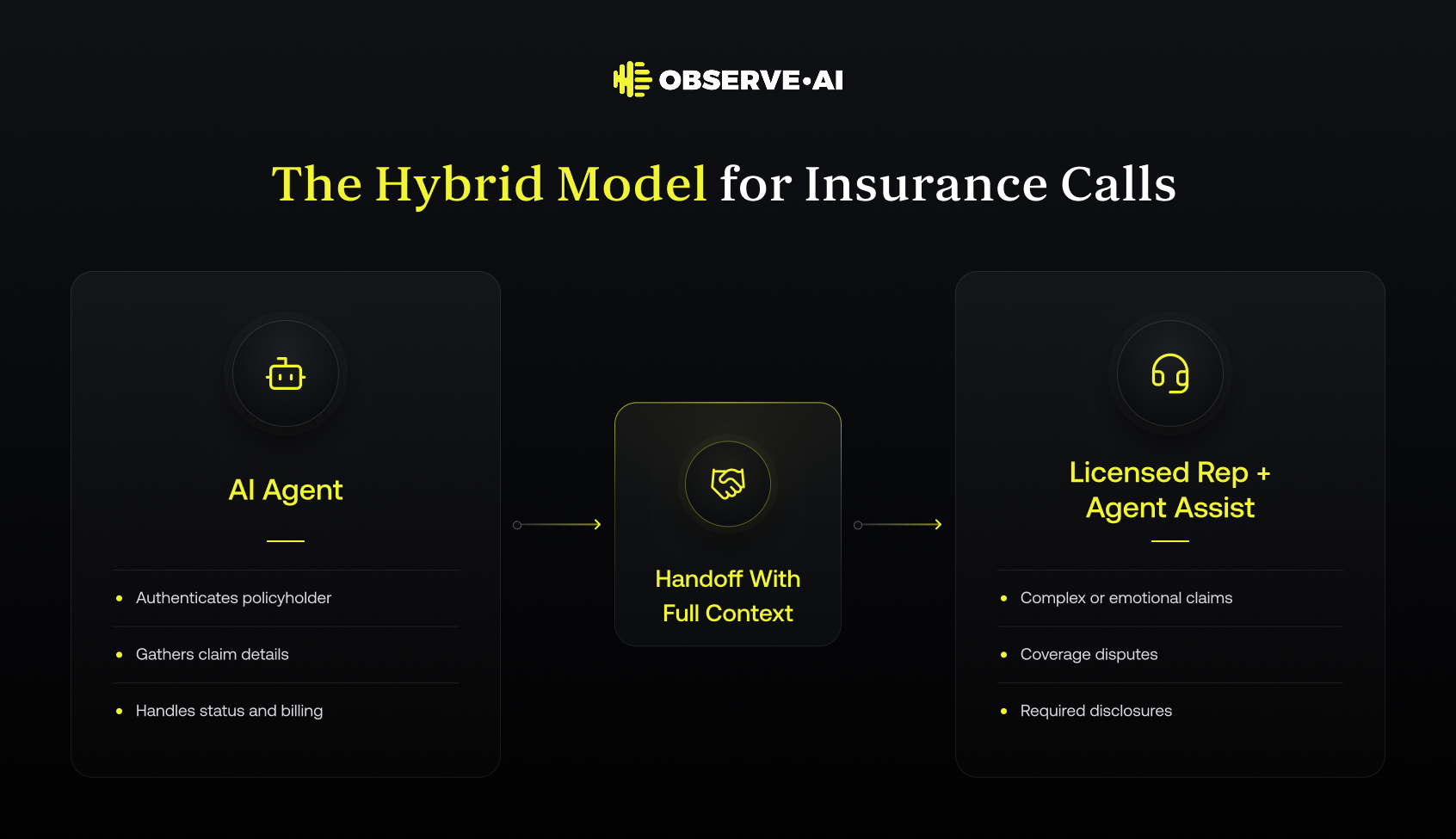
Most insurance carriers use a hybrid model. AI agents handle routine tasks like authenticating policyholders and gathering details. Then, they hand off the call to human reps who use real-time agent assist.
How To Compare AI Tools
When you compare insurance AI platforms, ask three practical questions:
- Does the AI complete work, or just answer questions? Strong platforms run entire workflows. They look up data, update records, and trigger actions in core insurance systems.
- Is it one platform or a stack of point tools? A unified platform for automation, agent assist, and QA cuts integration headaches, simplifies compliance, and lets you track human and AI performance in one view.
- Can it handle live, high-volume calls? Test the AI in real contact centers. Check how it handles background noise, accents, customer interruptions, domain terms like deductible and actual cash value, and volume spikes during major storms.
How AI Agents And Agent Assist Differ
AI Agents Complete Workflows
Evaluate AI agents on the work they finish, not just their chat replies. In production contact centers, strong AI agents:
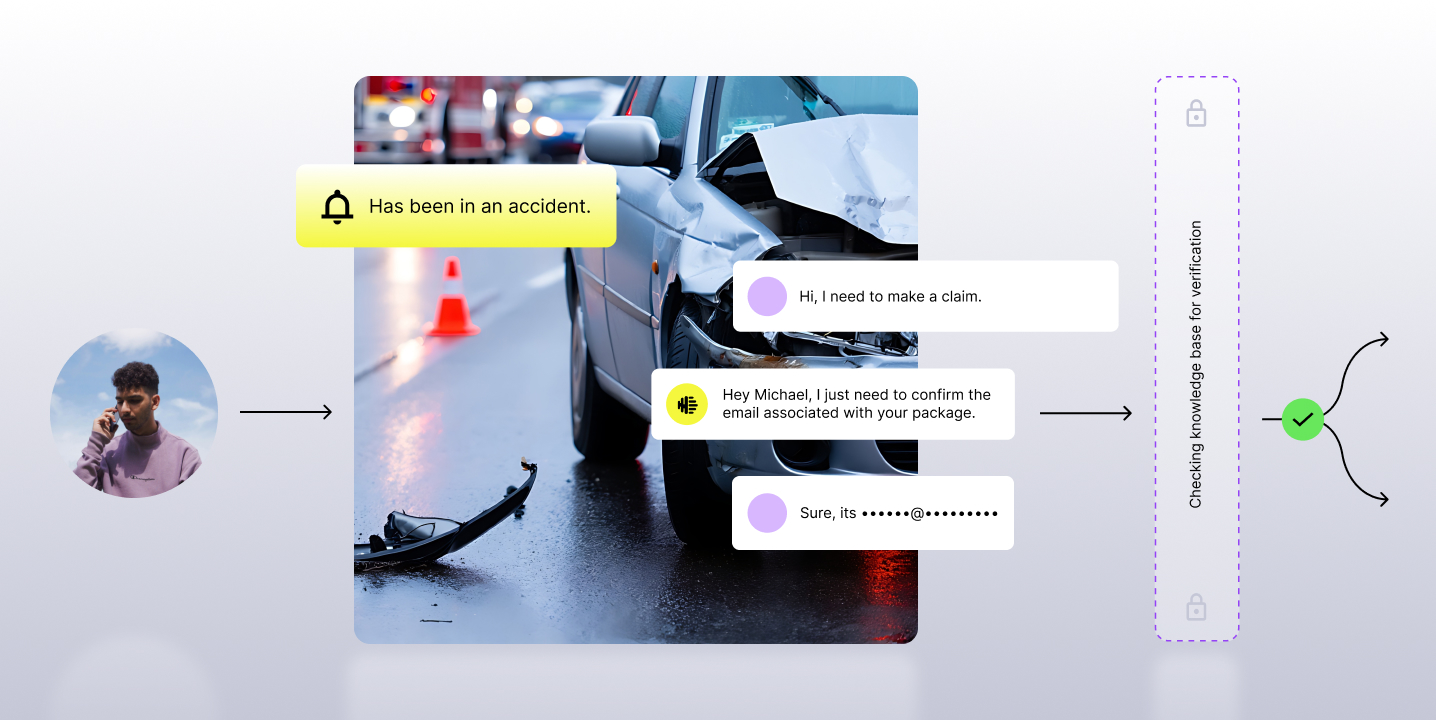
- Take initial claims (FNOL): Collect loss dates, damage details, and photos, then create the claim in your core system.
- Give accurate, policy-grounded answers: Pull data directly from policy systems and explain coverage in plain language within set guardrails.
- Trigger next steps: Send forms, schedule inspections, and update billing preferences.
- Escalate safely: Spot complex or emotional cases, transfer the customer to a licensed rep with a summary, and log the interaction for QA.
Agent Assist Supports Frontline Reps
Agent-assist tools support human representatives during high-stakes property calls. These tools:
- Guide calls in real time: Surface policy guides, suggest questions to uncover damage causes, and check underwriting limits without putting callers on hold.
- Enforce compliance: Flag restricted language, prompt mandatory disclosures, and mark calls for supervisor review.
- Cut after-call work: Write interaction summaries, recommend claim codes, and log notes directly into your CRM.
Agent assist acts as a second set of eyes and ears. It boosts speed and accuracy while keeping licensed reps accountable.
Connect Both With Shared Context and Integrations
Leading insurers run customer AI and agent assist on one agentic CX platform:
- Shared context: Pass transcripts, customer intent, and collected data directly from the AI agent to the human rep. This stops customers from repeating themselves.
- Shared integrations: Connect both AI and human tools to the same policy, billing, and claims systems.
- Controlled handoffs: Set strict rules to transfer calls during high-dollar claims, fraud alerts, or coverage disputes.
Core Insurance Workflows to Evaluate
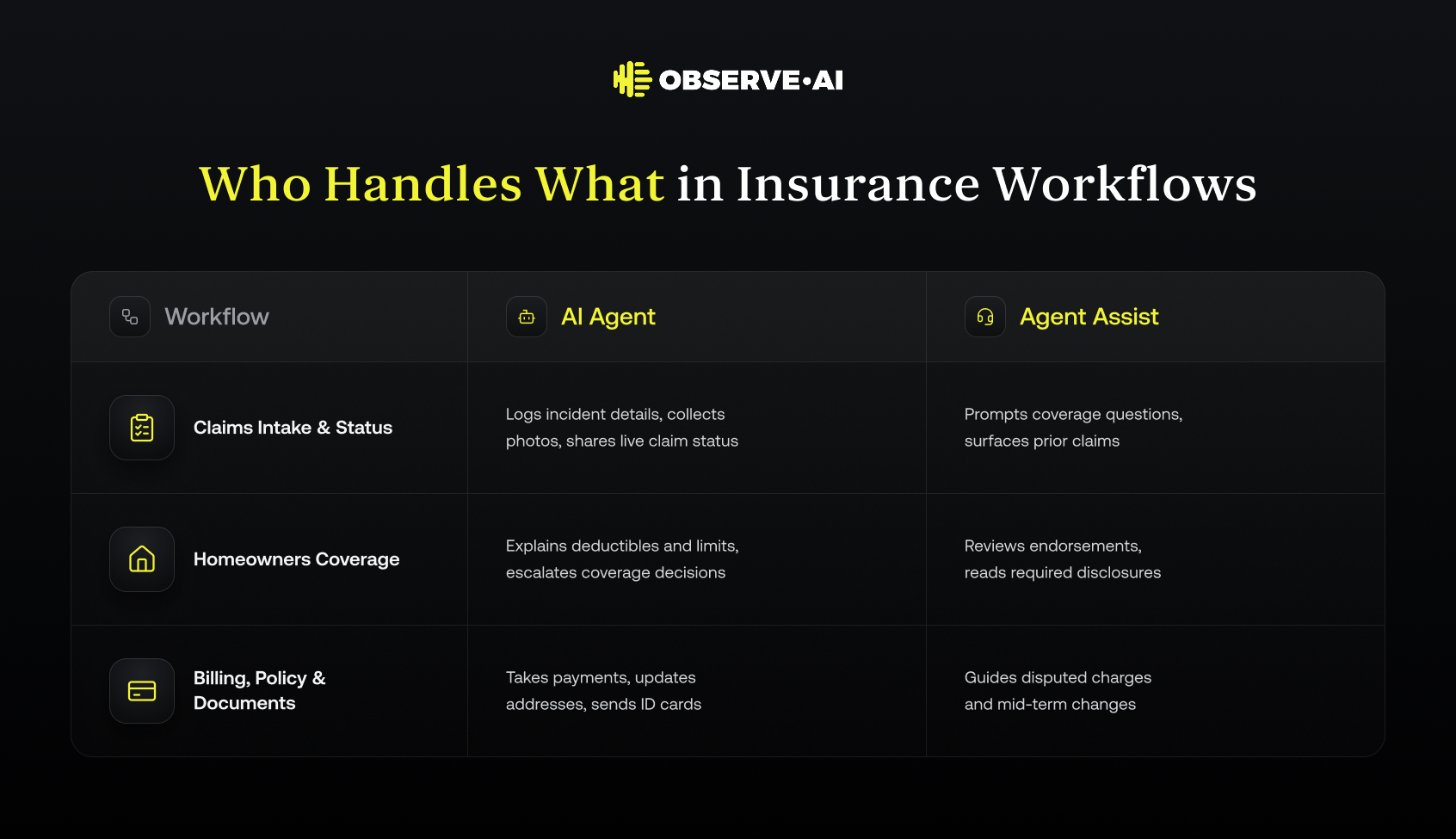
Claims Intake and Status Updates
Customer-facing AI agents can:
- Walk policyholders through structured claim intake.
- Verify identity, check coverage, and log incident details.
- Collect and sort damage photos.
- Share live claim updates directly from the claims system.
Agent assist then helps adjusters manage complex claims by:
- Prompting reps with key coverage questions.
- Surfacing prior claims and risk signals.
- Recommending next steps based on loss type and severity.
Homeowners Coverage and Property Inquiries
Property damage claims carry heavy financial and emotional weight. Policyholders want fast answers about coverage, payouts, and rate hikes.
- AI agents explain basic terms like deductibles and limits, share educational details, and escalate whenever coverage decisions arise.
- Agent-assist tools help reps review endorsements, follow damage checklists, and read required legal disclosures.
Billing, Policy Updates, and Document Requests
Routine servicing is ideal for full automation. AI agents can:
- Authenticate policyholders.
- Look up billing records and accept payments securely.
- Update mailing addresses and lienholders.
- Send proof-of-insurance cards and policy forms.
For disputed charges or mid-term changes, agent assist guides human reps through approval rules and logs notes automatically.
What to Look For in a Contact-Center Platform
Conversation Understanding and Integrations
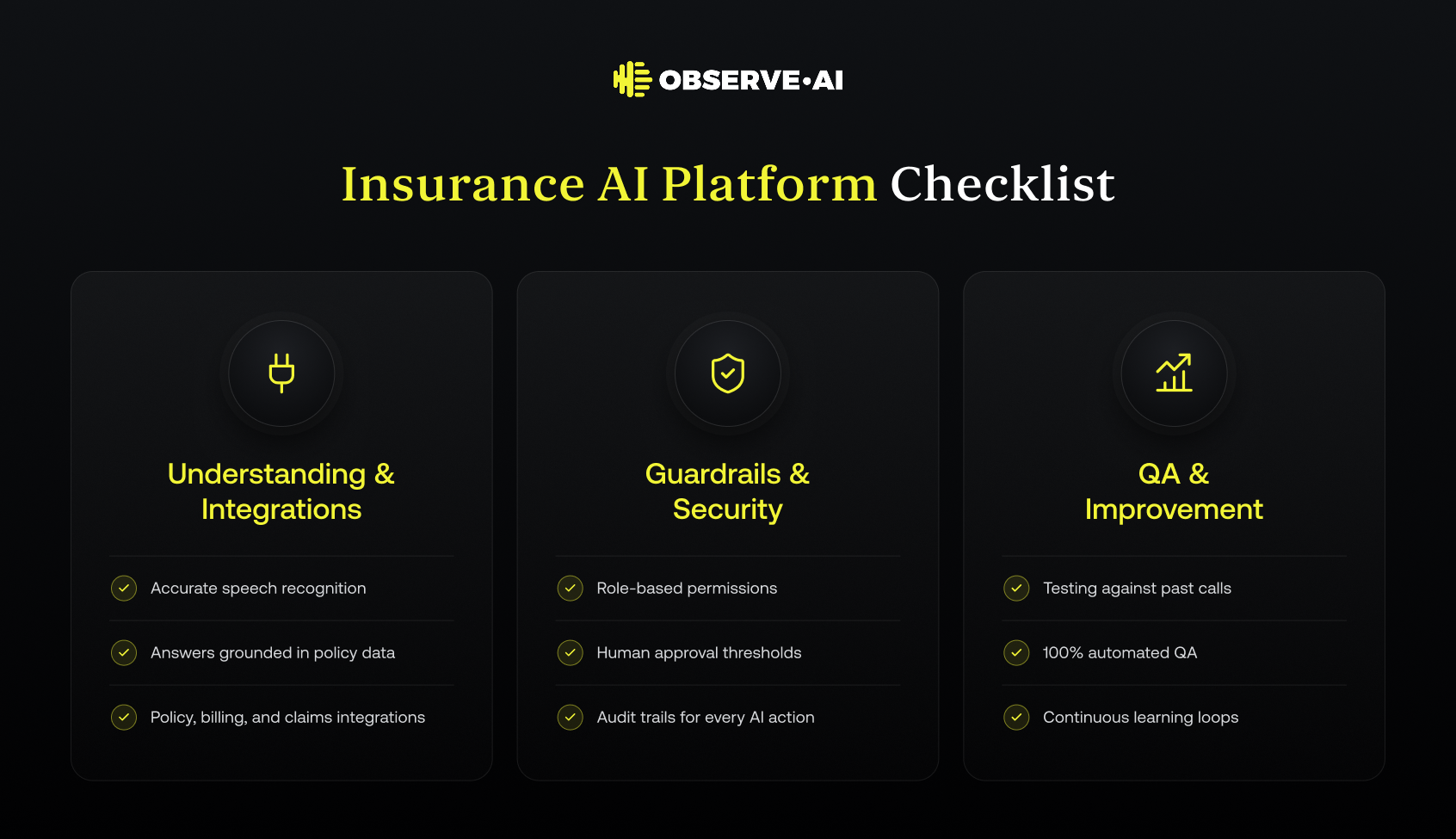
Skip basic bots. Choose platforms that provide:
- High-accuracy speech recognition that parses complex customer stories in loud environments.
- Grounding that pulls facts straight from policy systems and knowledge bases with clear source citations.
- Deep integrations with policy admin, billing, claims, and CRM tools to trigger end-to-end workflows.
Guardrails, Governance, and Security
Protect your business with strict enterprise controls:
- Role-based permissions: Restrict what AI can edit versus what it can only read.
- Approval thresholds: Require human sign-off for high-risk actions.
- Safety filters: Stop AI agents from offering unapproved legal or underwriting advice.
- Compliance standards: Require data encryption, regional data controls, and complete audit trails for every AI action.
Evaluation, QA, and Continuous Improvement
Insurance rules change constantly. Your platform must support ongoing lifecycle management:
- Testing and simulation: Test AI agents against thousands of past customer calls before launch.
- 100% automated QA: Audit every AI and human conversation to catch compliance gaps and coach reps.
- Continuous learning loops: Feed QA insights back into the system to refine prompts, update guardrails, and improve resolution rates over time.
Observe.AI gives contact centers a native platform to build, trust, deploy, and improve AI agents across every customer conversation.
Quick Answers
How do AI agents differ from agent-assist tools?
AI agents talk directly to customers and complete entire tasks on their own. Agent-assist tools listen in on human-led calls to prompt reps, look up policies, and log notes. Both work best when unified on one platform.
How does AI help homeowners insurance teams?
AI agents take initial loss reports and answer basic billing questions around the clock. Agent-assist tools guide adjusters through technical property damage rules, local building codes, and compliance disclosures.
How should teams measure AI success?
Look beyond basic deflection. Track first-contact resolution, completed workflows, shorter handle times, and higher QA scores. The best AI platforms resolve customer issues safely while supporting human agents.
Subscribe to our newsletter.
Frequently Answered Questions