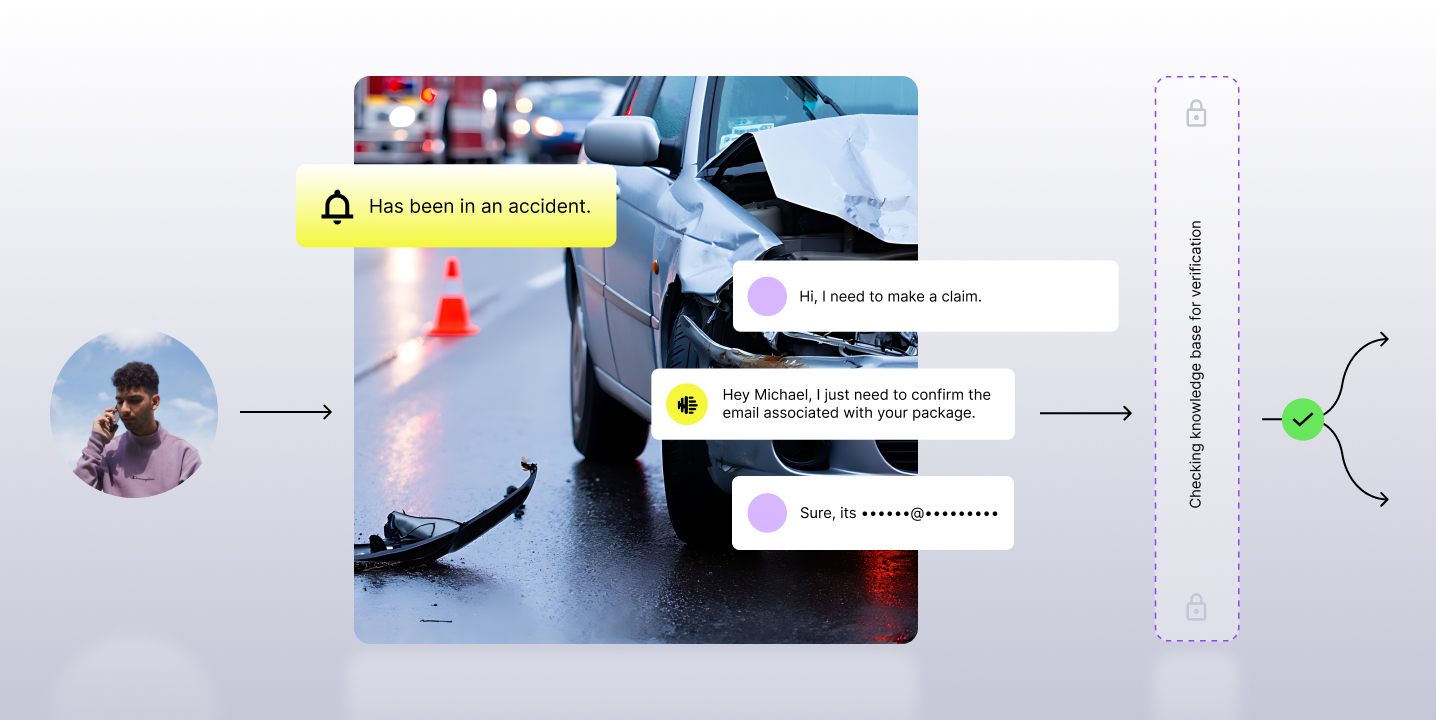
.png)
Customer Calm Is a Necessary Delivery Skill
The Forward Deployed Team (FDT) works directly with customers to bring AI voice agents to life within their specific environments. At the center of each deployment is an Engagement Manager, who embeds within the customer’s workflows and teams, sets project timelines, gathers requirements, and coordinates every phase from initial configuration through acceptance testing, go-live, and ongoing refinement.
The Engagement Manager serves as both a technical translator and the human through-line for the customer. That means managing expectations and building trust are just as important as understanding the technology.
Nobody tells you this when you join an AI agent delivery team: one of the most important skills you will need is not listed in the job description. It is the ability to keep a customer calm when the product surprises them.
The question in AI agent delivery is not whether something unexpected will happen. It is how well you prepare the customer for that moment and how you respond when it arrives.
The Predictability Problem
Traditional software delivery follows a rhythm that customers understand. You define the scope, gather requirements, build to specification, test, and launch. There may be bugs, but the system generally behaves as configured. A button works or it does not. A form submits or returns an error. The outcomes are largely deterministic.
That expectation of predictability does not disappear when a customer begins an AI deployment. But AI agents are fundamentally different from traditional software.
AI is probabilistic by nature. Voice AI agents must interpret language, context, and intent, none of which are clean or consistent inputs. They operate in real conversations with people who interrupt, change direction, go off the expected path, and say things no test case anticipated.
An agent that performs well in controlled testing may still behave unexpectedly when it encounters a live caller in a high-stakes situation.
The consequences are especially serious in regulated industries and sensitive conversations involving patient information, benefits, claims, or payment details. The tolerance for unexpected behavior is low. The trust required to deploy AI into these workflows is difficult to earn and easy to lose.
The gap between the predictability customers expect and the reality of how AI operates is where delivery teams prove their value. Keeping customers calm through that process is not simply a soft skill. It is a core delivery capability.
Education Before Anything Else, and Then Again, and Again
The most effective thing a delivery team can do is establish honest expectations before development begins.
Most customers approach an AI agent implementation with experience from traditional software deployments. They know how to read a project plan. They have participated in user acceptance testing. They have a mental model of what “done” looks like.
That model does not translate directly to AI. Unless the difference is addressed early, every unexpected response can become a source of anxiety.
We explain how AI works in clear terms from the beginning. We discuss why choosing the right use cases matters. We explain that evaluation is continuous rather than a one-time approval gate. We also prepare customers for post-launch tuning and make clear that refinement does not mean the deployment has failed. It is part of how the agent improves.
But that message lands differently at each phase of a project.
In the first week, customers may understand the concept intellectually. Then acceptance testing begins, the agent handles a scenario in an unexpected way, and the uncertainty becomes real. When the customer experience and the company’s reputation are at stake, that moment can be unsettling.
That is when the real education happens. Not in the kickoff presentation, but in the room, as the delivery team explains what occurred, why it occurred, and how it will be addressed.

The delivery team must prepare for that moment before it arrives. Weeks earlier, the customer should already have heard: “When we encounter something unexpected in testing, this is how we will evaluate it and respond together.”
Naming the uncertainty in advance does not eliminate it. It changes how the customer interprets it when it appears.
Identifying What Actually Has to Work
Every interaction handled by an AI agent reflects the customer’s brand and affects the trust of the people it serves. That is why the design phase matters so much.
The delivery team must work with the customer to determine the right scope, identify the most important use cases, and understand where the risks are highest. That allows the agent to be designed and tested with the appropriate level of care.
In regulated environments, some imperfections may be manageable. Others are unacceptable. The team must identify those distinctions explicitly, name high-risk scenarios early, and build deliberate test coverage around them.
This makes the testing process more rigorous. It also demonstrates that the delivery team understands the realities of the customer’s environment and is not asking them to overlook legitimate concerns.
The goal is not to treat every unexpected response as equally severe. It is to create a shared understanding of what matters most, what requires immediate intervention, and what can be addressed through normal refinement.
When the Agent Surprises the Room
When an AI agent behaves unexpectedly, the question is whether the delivery team has built enough trust and shared understanding to treat the incident as a data point rather than a crisis.
The risks are real. An agent may mishear a caller, route them incorrectly, produce an unclear response, hallucinate information, or mishandle a step in the conversation. In a sensitive environment, that is not simply a technical bug. It can shake the customer’s confidence in the entire program.
It is the kind of moment that makes a room go quiet. Stakeholders look at one another, then at the delivery team.
The right response is not to minimize what happened or bury the customer in technical detail. The team should clearly state what occurred, explain the type of risk it represents, and then move directly into the plan to address it.
When the customer has already been prepared for this possibility, the incident has context. It is an identified, documented edge case added to the system’s testing and evaluation process.
The customer remains calm because the delivery team remains calm. The delivery team can remain calm because the preparation is already complete.
That is not crisis management. It is the nature of delivering AI systems.
There will not always be perfection, particularly during the early stages of a deployment. AI systems will have edges that need to be identified and refined. What a delivery team can provide is a clear process for finding those edges, assessing their severity, and resolving them quickly.
Over time, confidence is built through visibility, honest communication, and consistent follow-through.
The Skill Nobody Told Me I'd Need
When I entered this role, I expected the primary challenge to be technical. I needed to understand the platform, learn the configuration, and become fluent in evaluations, reporting, and integration architecture. Those skills matter. They are table stakes.
The challenge I did not anticipate was the human one.
Customers in regulated industries are not simply purchasing technology. They are trusting a delivery team to introduce AI into environments where employees have been trained to follow exact, auditable processes.
Now, part of that process involves a system that interprets and reasons rather than simply executing fixed instructions. That is a significant change from a traditional software implementation. It requires change management as much as technical implementation.
Delivery teams sit at the center of that change. Their role extends beyond tracking timelines and managing a backlog. They must help customers understand what the system is doing, establish how its performance will be evaluated, and build the confidence required to move forward when the technology behaves in an unexpected way.
The customers who remain calm during difficult moments are not the ones who were promised that nothing would go wrong.
They are the ones whose delivery teams prepared them for what would happen when it did.
Subscribe to our newsletter.
Frequently Answered Questions
.png)


.png)

.jpg)