.jpg)
Healthcare Call Center Software: AI Agents for Patient Access
Modern healthcare call center software is shifting from simple telephony and routing to AI-powered contact center platforms that can understand intent, access systems, and complete work. In a healthcare AI contact center, AI agents handle high-volume, repetitive requests so human agents can focus on complex, emotional, or high‑risk interactions.
Instead of trying to replace staff, AI agents reduce healthcare contact center calls by absorbing routine conversations across voice and digital channels. Common examples include benefits questions, payment status, appointment reminders, prescription refills, and basic registration updates. When AI is built on a healthcare-ready agentic architecture, it can:
- Recognize when a patient is asking for something routine versus something clinically sensitive.
- Pull context in real time from scheduling, CRM, payer, and billing systems.
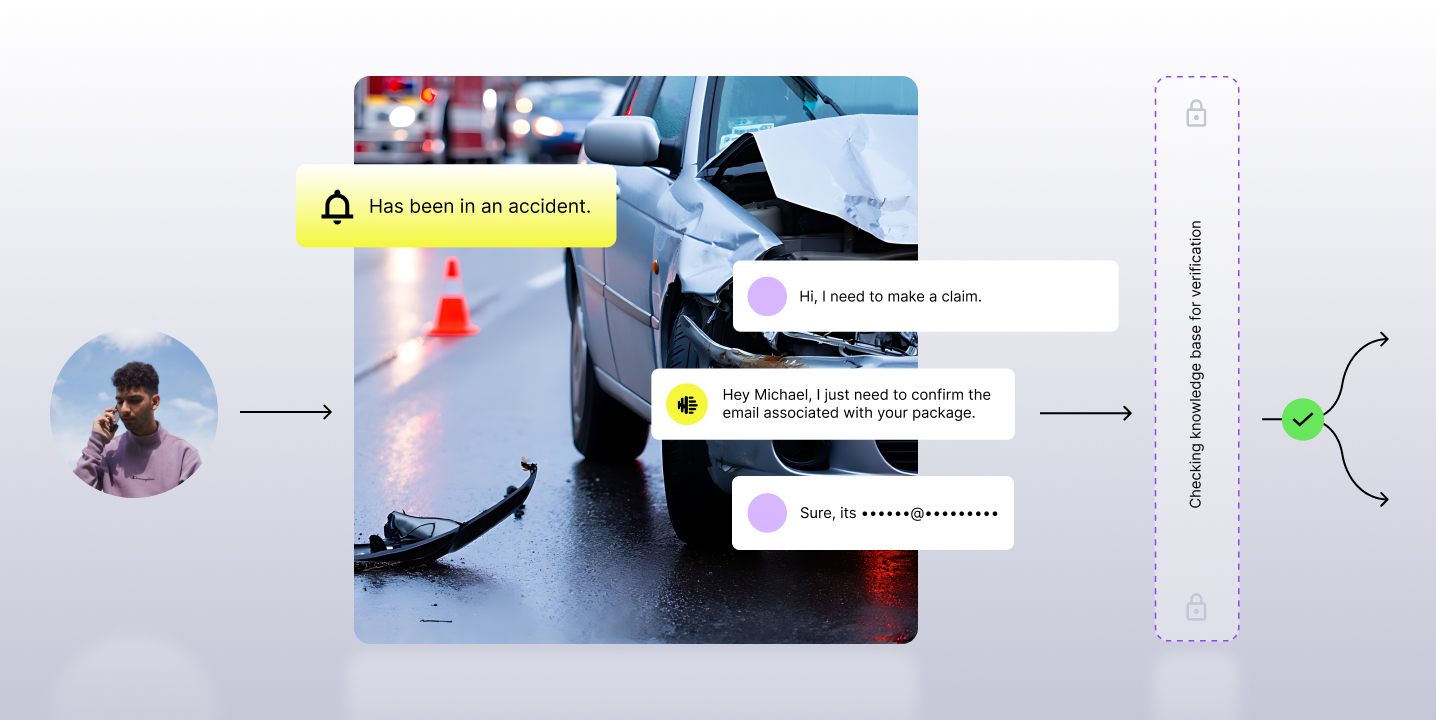
- Complete the workflow safely or transfer the call with a full summary if human support is needed.
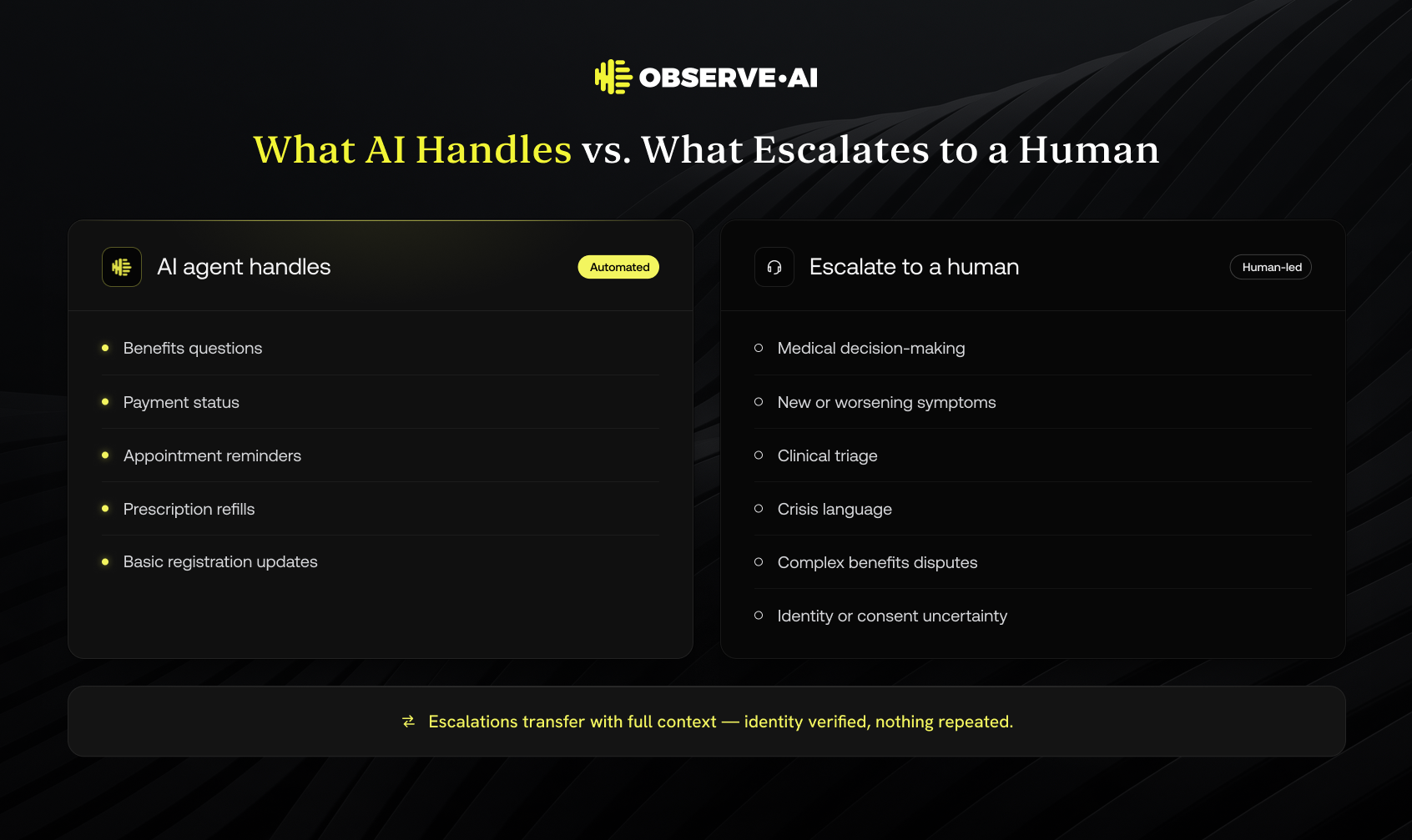
Healthcare leaders need clear escalation rules. A healthcare AI agent should escalate to a human when conversations involve medical decision-making, new or worsening symptoms, clinical triage, crisis language, complex benefits disputes, or any uncertainty about identity or consent. In these cases, the system must move the patient to a live agent or nurse line with full context, not just pass the call through.
Build, Deploy, Evaluate, And Improve AI Agents Across Contact-Center Workflows
Enterprise healthcare centers require more than a single bot. They need a contact-center-native platform that supports the full lifecycle of AI agents:
- Building workflow-specific agents for scheduling, registration, benefits, billing, and member services.
- Connecting those agents to relevant systems so they can look up information and take action, not just answer FAQs.
- Evaluating responses, escalations, and workflow completion across large volumes of interactions.
Observe.AI’s agentic CX platform is an example of this approach. Teams can design AI agents for multiple healthcare service lines, simulate performance before going live, and use evaluation and QA to continuously tune behavior. Over time, this continuous learning loop lets AI agents safely take on more work while keeping patient experience and compliance at enterprise standards.
Complete More Healthcare Contact-Center Work With AI
Automate Scheduling, Reminders, And Routine Administrative Requests
One of the most immediate ways AI contact centers support providers and payers is by automating administrative workflows that currently drive high call volume. Healthcare call center software with AI can:
- Handle inbound appointment scheduling and rescheduling, within rules defined by access teams.
- Confirm, cancel, and update appointments via outbound reminders and two-way SMS or voice.
- Collect pre-registration information, verify demographics, and update simple fields in existing records.
- Answer eligibility, coverage, and copay questions by grounding responses in payer and benefit data.
By treating these as end-to-end workflows rather than scripted responses, AI agents reduce healthcare contact center calls that would otherwise route to human agents or generate repeat contacts. They also help patients self‑serve outside business hours, without adding staffing cost.
Connect Agents To Systems So Interactions Can Trigger Workflow Actions
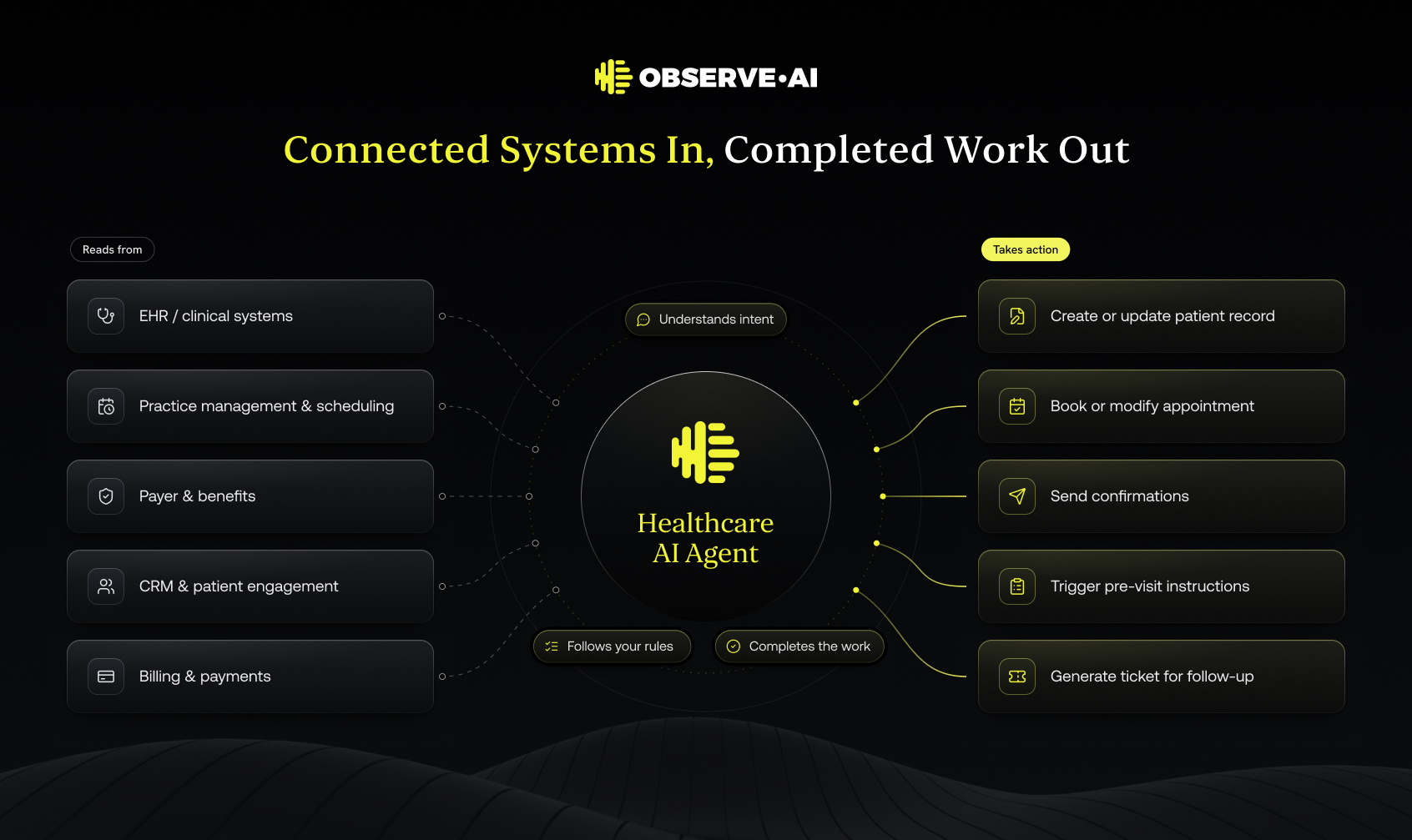
To move beyond deflection, healthcare AI agents must integrate with the same systems human agents use. Core integrations for healthcare contact center software typically include:
- EHR or clinical systems for visit context and orders (with strict permissions).
- Practice management and scheduling tools for appointments and provider calendars.
- Payer and benefits systems for eligibility, coverage limits, and authorization status.
- CRM and patient engagement platforms for communication preferences and history.
- Billing and payment platforms for balances, statements, and payment plans.
In a mature healthcare AI contact center, an interaction can trigger workflow actions directly: creating or updating a patient record, booking or modifying appointments, sending confirmations, triggering pre-visit instructions, or generating a ticket for manual follow‑up when AI cannot complete the task.
This is where an agentic platform stands apart from basic chatbots. AI agents are orchestrated to understand context, follow routing rules, coordinate with other agents or services, and complete discrete units of work while maintaining audit logs for compliance.
Escalate Sensitive Or Complex Conversations With Context
Escalation is central to healthcare AI safety oversight. When a conversation reaches a threshold of clinical, emotional, or regulatory risk, the AI agent should:
- Immediately transfer the patient to the appropriate human queue or specialty center.
- Provide a structured summary of what the patient said, what data was accessed, and which steps were attempted.
- Preserve authentication and verified identity so patients do not repeat sensitive information.
Healthcare organizations typically define escalation rules for symptoms that suggest clinical risk, behavioral health needs, medication issues, coverage denials, grievances, and complaints. A well-governed healthcare AI contact center platform makes those rules explicit, testable, and auditable, so that contact center leaders, clinical governance, and compliance teams can review behavior and outcomes.
Bring Automation, Frontline Teams, And Operations Together
Give Frontline Teams Real-Time Assistance And Interaction Summaries
AI in healthcare contact centers is not only for patient-facing automation. The same platform can provide real-time assistance to human agents, surfacing:
- Policy and benefits guidance based on the live conversation.
- Next-best actions for specific payer, provider, or program workflows.
- Prompts for disclosures, consent language, and compliance-related statements.
After every call or chat, AI agents can generate structured summaries that tie directly to the systems of record. This reduces after-call work, improves documentation, and gives staff more time to focus on empathy and problem‑solving rather than note‑taking.
Use QA And Operational Intelligence To Identify Patterns And Improve Service
High-performing healthcare call center software should include quality management, analytics, and operational intelligence built for AI and human interactions. Leaders need to see:
- Why patients are calling, chatting, or messaging across lines of business.
- Where AI agents are completing work successfully and where they escalate.
- Which scripts, policies, or workflows drive repeat contacts or long handle times.
- How payer and provider experience differ across networks or regions.
Observe.AI, for example, applies conversation understanding across 100% of interactions, not just samples. This lets QA and operations teams quickly identify patterns—such as repeated scheduling barriers, denial codes that create confusion, or benefits explanations that cause avoidable calls—and then update both human training and AI agent behavior in one place.
Connect Customer Interactions With The Systems Teams Already Use
For AI to help rather than fragment operations, it must sit inside the existing healthcare center ecosystem. A healthcare AI compliance integration strategy typically includes:
- Secure, governed connections to EHR, CRM, ticketing, and billing platforms.
- Role-based access and data minimization to limit PHI exposure.
- Logging, encryption, and retention controls aligned with enterprise policies.
When implemented well, AI becomes a layer that connects patient interactions with operational systems, rather than yet another disconnected tool. Staff see the same context, regardless of whether an AI agent or human handled the prior step, which improves continuity of service and reduces errors.
Deploy Healthcare AI Agents With Control
Test Agent Behavior And Evaluate Performance Before And After Launch
Enterprise healthcare centers cannot deploy AI agents into production without rigorous testing. A healthcare AI contact center platform should support:
- Simulation and testing of scripted and unscripted scenarios before go‑live.
- Evaluation against guardrail tests—such as how the agent responds to symptom descriptions, medication questions, or attempts to share sensitive data.
- Versioning and A/B testing of different agent configurations and prompts.
Testing continues post‑launch. Leaders need tools to replay interactions, inspect model decisions, and compare performance across versions. This lifecycle management approach lets teams build, trust, deploy, and improve AI agents as live conditions, policies, and clinical guidelines change.
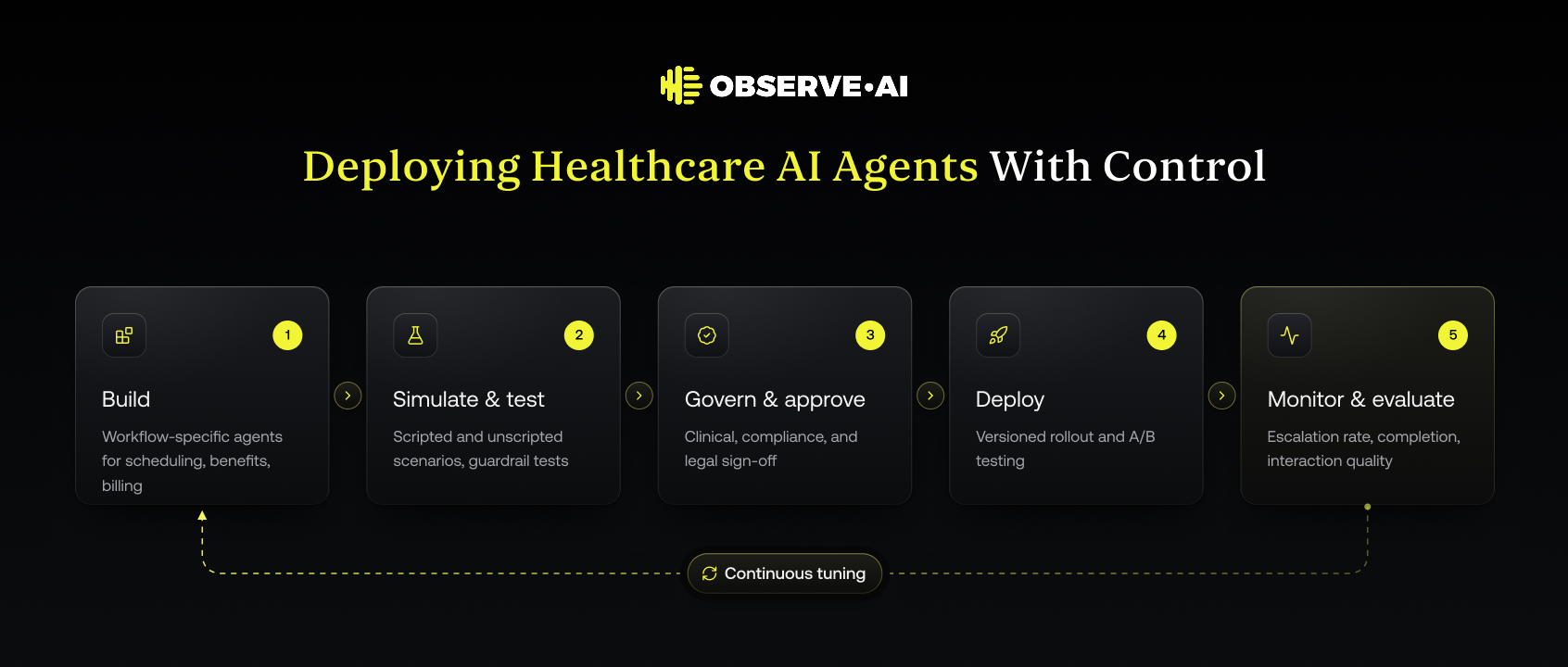
Apply Guardrails, Governance, Compliance Practices, And Human Oversight
In healthcare, guardrails are non‑negotiable. Essential practices for healthcare AI safety oversight include:
- Strict separation between administrative workflows and clinical advice; agents should not provide diagnosis, treatment recommendations, or triage outside predefined scripts.
- Clear, enforced rules for when to stop the automation and escalate to licensed staff.
- Grounding responses only in approved, up-to-date knowledge sources and systems.
- Human review of edge cases, sensitive workflows, and new agent capabilities before and after deployment.
Governance bodies—combining contact center leadership, compliance, legal, data protection, and clinical stakeholders—should oversee the AI lifecycle. The platform must make it easy to document policies, monitor adherence, and demonstrate compliance with HIPAA and related requirements.
Monitor Escalations, Workflow Completion, And Interaction Quality
Once AI agents are in production, ongoing monitoring is essential. Healthcare leaders need real-time and historical visibility into:
- Escalation rates by workflow, service line, and time of day.
- Workflow completion rates—how often AI agents fully resolve a scheduling, registration, or benefits request.
- Interaction quality, including sentiment, effort, and adherence to required language.
This monitoring helps organizations decide when to expand automation, when to change routing, and where additional training or policy changes are needed. It also supports enterprise control, letting teams roll back or adjust AI behavior quickly if a risk is identified.
Measure Call Reduction And Contact-Center Performance
Track Resolved Interactions, Call Volume, Routing, And Agent Workload
To understand how AI agents reduce healthcare contact center calls, teams must measure more than deflection. Key metrics include:
- Fully resolved interactions by AI, across voice and digital channels.
- Changes in total call volume and repeat-contact rates for targeted workflows.
- Average handle time and wrap-up time for human agents, especially after AI has automated portions of the journey.
- Routing patterns, including how quickly escalated interactions reach the right human queue.
- Agent workload and staffing efficiency, particularly during peak seasons.
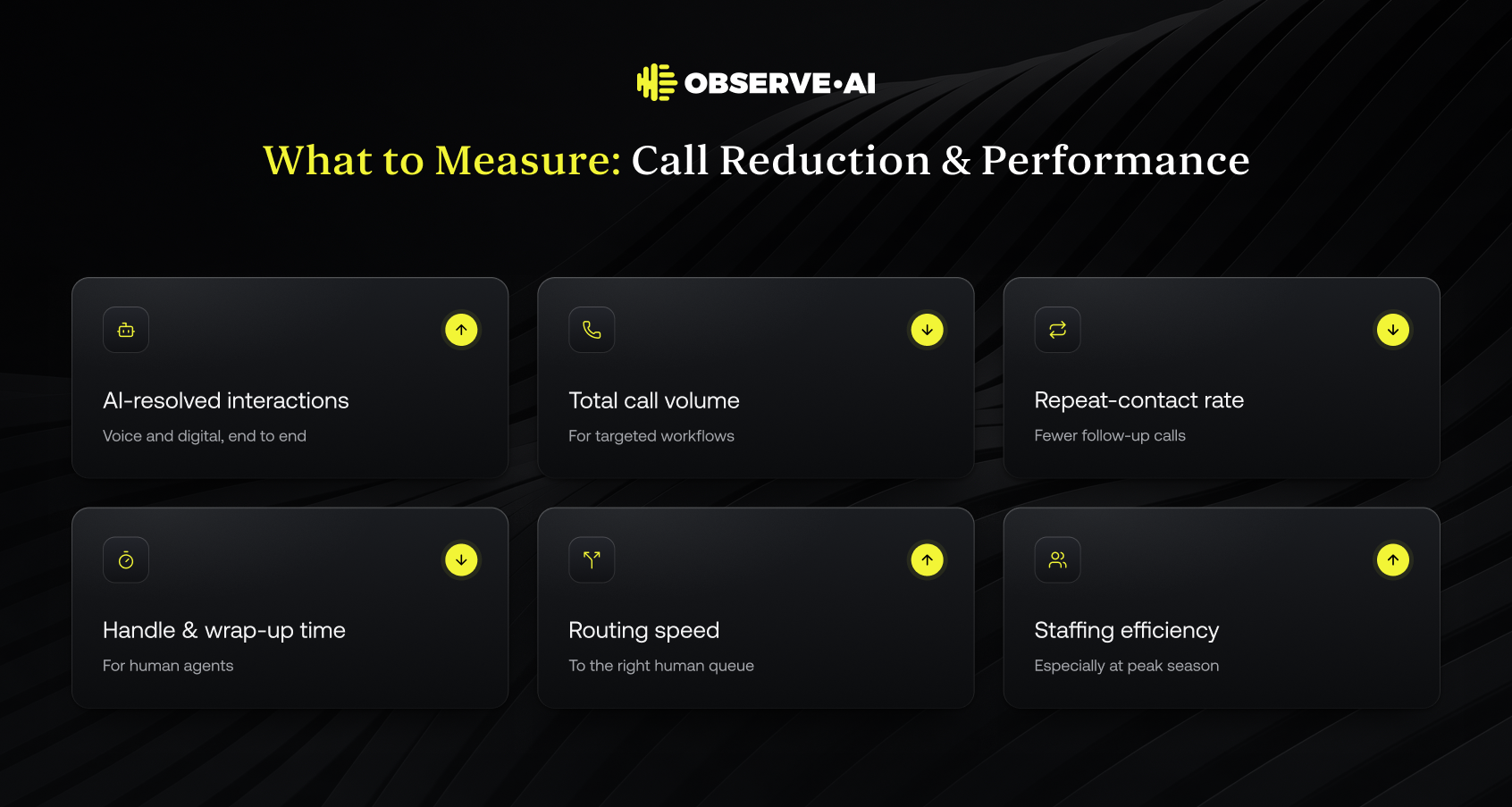
When healthcare call center software brings automation and analytics together, leaders can attribute cost savings, capacity gains, and patient experience improvements to specific AI agents and workflows, rather than making broad assumptions.
How Can AI Agents Reduce Healthcare Contact-Center Calls?
AI agents reduce healthcare contact center calls by doing more than answering questions. They complete work that would otherwise generate new contacts. For example, an AI agent that reschedules an appointment, updates contact information, sends a confirmation, and triggers a pre‑visit instruction message prevents multiple follow‑up calls that would have hit the center.
Similarly, when AI contact centers in healthcare are connected to benefits, claims, and billing systems, they can provide accurate, personalized answers that reduce confusion and repeat inquiries. Over time, operational intelligence from these interactions can drive upstream improvements—clearer member materials, better portal flows, and more proactive outreach—that further lower call volume while improving service.
How Should Healthcare Teams Evaluate Integrations And Compliance?
When evaluating healthcare call center software with AI, leaders should assess integrations and compliance as first‑class requirements, not add‑ons. Key questions include:
- Which systems can the platform integrate with today—EHR, CRM, scheduling, billing, payer systems—and how are those connections secured?
- How is PHI handled across voice, chat, transcripts, and analytics?
- What controls exist for data residency, retention, redaction, and access logging?
- How are guardrails, escalation rules, and allowed workflows defined, tested, and enforced?
- Can compliance, security, and clinical governance teams independently review and approve AI agent behavior?
A modern healthcare AI contact center platform, such as Observe.AI, is built with these requirements at the core. It connects AI agents, frontline staff, and operations on one contact-center-native platform, enabling healthcare centers to automate safely, reduce cost and call volume, and complete more work—all with the oversight, governance, and continuous optimization that enterprise healthcare demands.
Subscribe to our newsletter.
Frequently Answered Questions


.png)
.jpg)