.jpg)
Enterprise AI Contact Center Software And AI Agents For Support Teams
Build, Deploy, Govern, And Improve AI Agents
AI contact center software for enterprise is no longer just an IVR upgrade or a simple chatbot; it is Contact Center AI built to automate and improve customer service at scale. It lets enterprises build, deploy, govern, and continuously improve AI agents that handle real customer work across voice and digital channels in the cloud. These AI agents serve as always‑on support teammates: they understand requests, look up information, take approved actions in connected systems, and know when to involve a human agent, helping each user get consistent responses.
An AI agent for support teams is best understood as part of an “agentic” architecture within Contact Center AI. Instead of following a fixed script, this AI powered approach uses conversation understanding, enterprise context, and workflow orchestration to complete tasks such as updating an address, checking an order, scheduling a service appointment, or processing a simple claim—while providing accurate responses. Observe.AI’s agentic CX platform is built specifically for the contact center, combining customer‑facing automation, agent assist, quality management, analytics, and lifecycle management in one cloud contact‑center‑native system with Contact Center AI capabilities.
For enterprises, the difference is operational. AI contact center software must plug into existing CCaaS platforms, telephony, CRM, billing, ticketing, knowledge, and workflow systems through secure cloud integrations. It must support high volumes, complex journeys, and regulatory requirements—while giving operations teams clear controls to configure policies, guardrails, routing, and escalation paths for every user group. Modern enterprise deployments also assume cloud reliability and cloud scale, with controls for data residency, encryption, and access management. Instead of a one‑time bot deployment, enterprises need a cloud platform where teams can design use cases, test models, monitor performance, and roll out new versions with confidence, supported by Contact Center AI governance.
Governance and measurement sit at the center of this Contact Center AI model. Enterprises track KPIs such as automated resolution rate, contact containment that still delivers completed work, handle time, routing accuracy, transfers, compliance adherence, and customer sentiment. Observe.AI places testing, evaluation, and analytics alongside AI deployment so operations, QA, and data teams can see how Contact Center AI agents behave, where they succeed, and where they need improvement—before and after going live.
Connect Customer Interactions, Frontline Teams, And Operations
In most large organizations, support operations span multiple systems, cloud apps, channels, and teams. Calls, chats, emails, and ticket queues move between human agents, self‑service, back office, and specialized teams, often requiring consistent routing and shared context. Enterprise AI contact center software becomes the connective tissue across these touchpoints, ensuring that customer requests, frontline actions, and operational insights stay aligned through Contact Center AI.
A contact‑center‑native AI platform such as Observe.AI uses Contact Center AI to Connect customer interactions across systems. It sits on top of CCaaS and collaboration tools and connects to CRM and case systems via cloud integrations. It listens to and analyzes every interaction, whether handled by an AI agent, a human agent, or a mix of both, and it captures customer interactions for analytics and coaching. It can then trigger automation, provide real time assistance to support agents, summarize calls, improve responses, and feed interaction data into QA and analytics. This creates a continuous learning loop where every conversation informs future automation and coaching, improving employee performance.
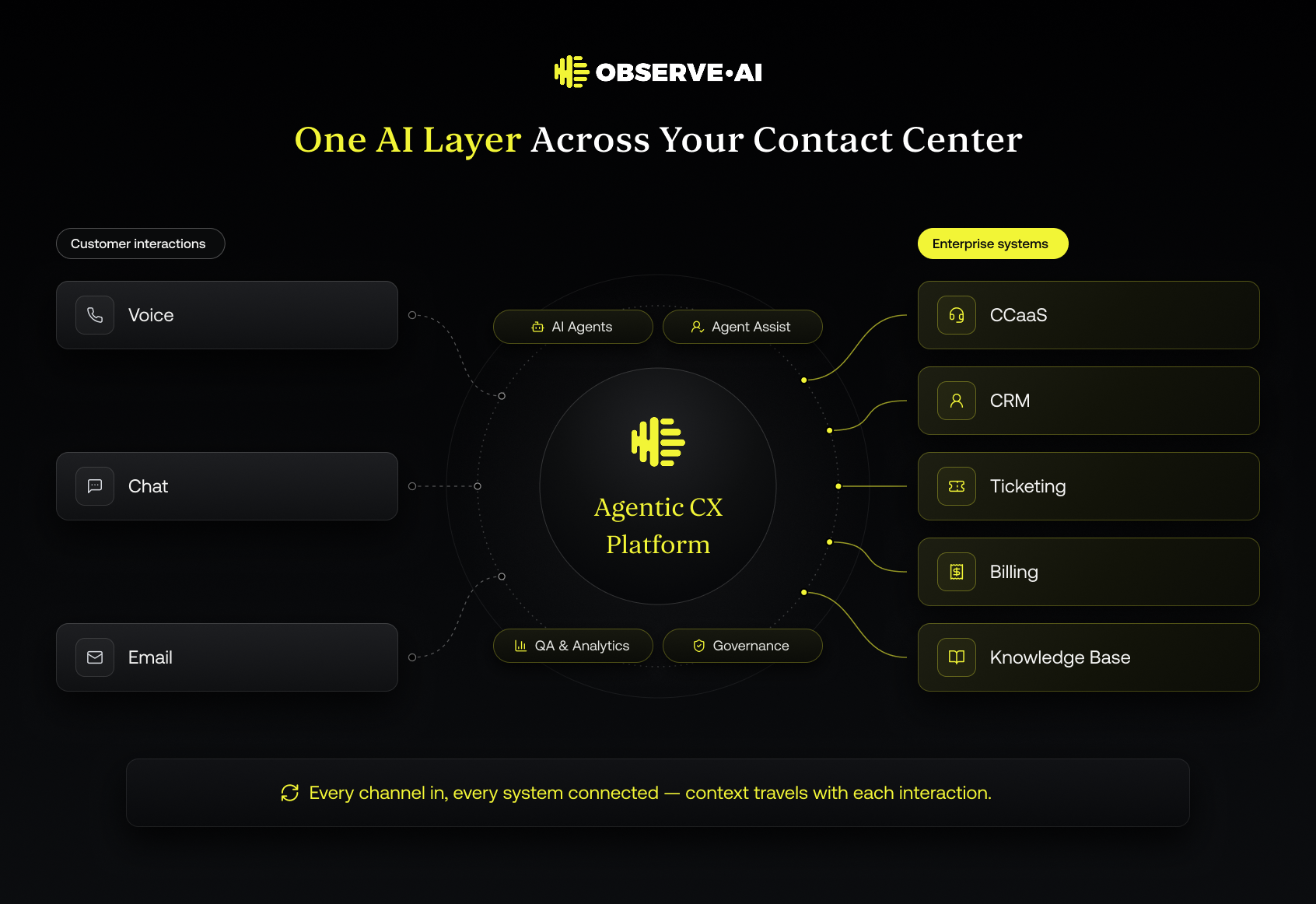
For support teams, this means AI agents do not operate in isolation. Customer‑facing agents can resolve common customer service requests end‑to‑end, while agent‑assist capabilities guide human agents through complex or regulated interactions with AI powered suggestions. Operations leaders gain a unified view of conversations, outcomes, and behavior across AI and humans, rather than separate reports from isolated tools, enabling better management decisions. This also supports employee coaching at scale: managers can use interaction analytics to provide targeted coaching, track progress, and standardize best practices across teams.
This connected approach is especially important when enterprises evaluate CCaaS platforms, cloud migration, and Contact Center AI readiness. Consider replacing a legacy contact-center platform when it cannot meet required routing, channel, integration, cloud reliability, or operational needs. If the current environment supports the integrations and workflows the business needs, teams can layer Contact Center AI onto it instead, often with simpler pricing and faster time to value. Many organizations modernize in phases, using CCaaS alongside Contact Center AI for automation, real time assistance, analytics, and coaching. Observe.AI integrates with leading CCaaS platforms, helping leaders improve automation, routing, and customer service quality while preserving cloud flexibility for future infrastructure decisions. When comparing options, enterprise buyers should also review Contact Center AI features, cloud architecture, and pricing to understand total cost, rollout effort, and ongoing management needs.
AI Agents That Move Customer Work Forward
Resolve Interactions With Context And Approved Actions
AI support agents are valuable only when they can move work forward, not just answer questions; Contact Center AI must drive accurate responses and completed tasks. Enterprise AI contact center software must ground each interaction in accurate context—who the customer is, which products or services they use, their current status—and then take permitted actions across cloud systems.
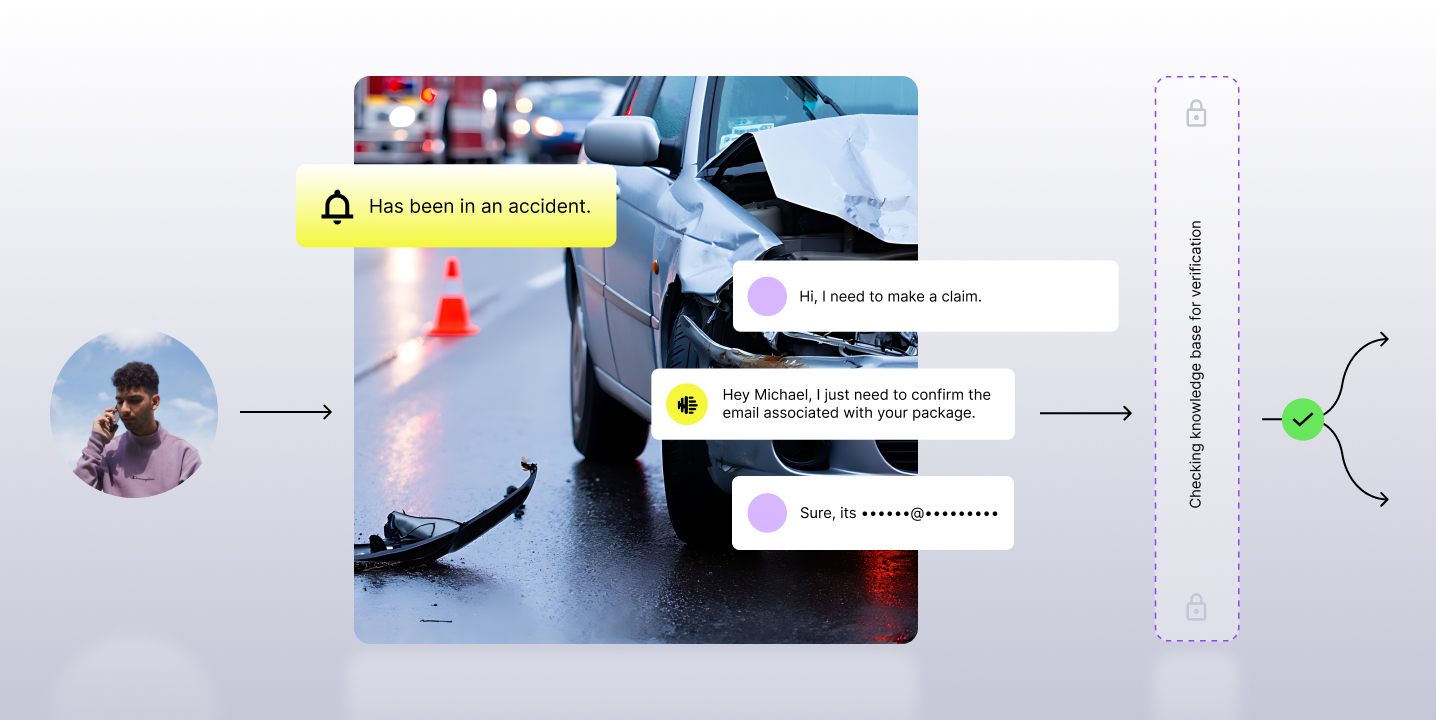
Observe.AI’s AI agents combine LLM‑based conversation understanding with cloud integrations and guardrails, bringing Contact Center AI into daily operations. They can: identify the customer; authenticate if configured; retrieve the latest account, order, claim, or case data; decide which steps to take within approved workflows; and provide clear responses in real time. For example, an AI agent might check a payment status, update a mailing address, reschedule an appointment, or open a support ticket with the right fields already populated for the user and employee handling the case. All of this is driven by clear business logic and permissions defined by the enterprise.
Automation in this context is not just “deflection.” It is about completed tasks and accurate resolutions that improve customer service outcomes. AI agents can handle full interactions on their own, guide customers through multi‑step workflows, follow up with confirmations via SMS or email when connected systems allow, and improve routing when handoffs are needed. When a request exceeds their scope or violates guardrails, they escalate—rather than guessing—protecting both the customer and the business.
Because these capabilities run on a single cloud platform, every automated interaction feeds analytics, insights, and coaching. Teams can review transcripts, see which paths lead to successful outcomes, and identify friction points with Contact Center AI insights. They can then adjust flows, tuning prompts, integrating additional systems, refining routing, or tightening guardrails—using tools built for enterprise management. Over time, the automation footprint grows from simple FAQs to high‑value, repeatable customer service workflows that deliver real business impact, backed by cloud scale and predictable pricing. For many enterprises, the best results come from AI powered workflows that provide consistent responses, integrate with ticket systems, and reduce repetitive employee work.
Escalate To Frontline Teams With Conversation History
Even the most capable AI contact center software will not—and should not—handle every scenario, and the best Contact Center AI programs define clear boundaries. Complex, emotional, high‑value, or exception‑driven interactions still require human expertise. The role of enterprise Contact Center AI agents is to recognize these cases early, capture rich context, and transition the customer cleanly to frontline teams with the right routing.
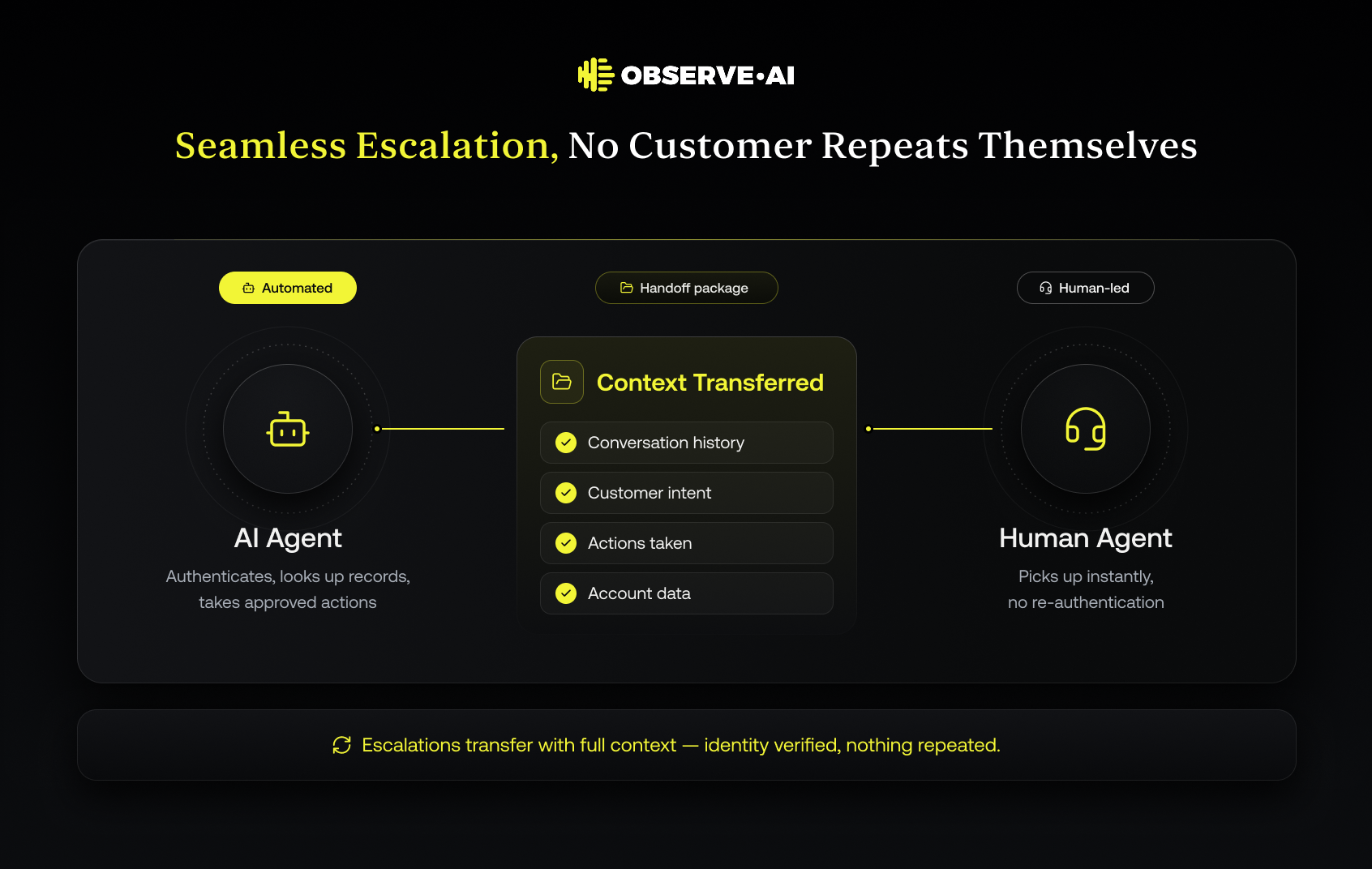
When an AI agent escalates to a live agent on a CCaaS platform, Observe.AI transfers conversation history, intent, actions taken so far, and relevant customer data from cloud systems. The human agent does not need to re‑ask basic questions or repeat authentication steps. This reduces handle time and frustration for both customers and agents while improving first‑contact resolution and employee experience.
The same cloud platform that powers customer‑facing automation can also assist human support teams in real time with Contact Center AI. During a live call or chat, agent‑assist capabilities can surface key knowledge, procedures, and next‑best actions based on what is actually being said, helping the user and employee stay aligned. For regulated industries, real‑time prompts can remind agents about required disclosures or verification steps. After the interaction, AI can summarize the conversation, fill in disposition codes, update CRM records, create a ticket, and generate case notes, freeing employees to move quickly to the next customer.
In this model, the decision is not “AI agents or human agents,” but “which parts of the journey each handles best.” Enterprises use automation for well‑defined workflows and high‑volume tasks, while agent assist strengthens frontline performance on complex work through coaching and real time guidance. Observe.AI enables both styles of AI support on one cloud platform with Contact Center AI features, so operations teams can evolve their mix of automation and human service over time without swapping tools or pricing models. A single Contact Center AI layer can also unify routing policies across voice and digital channels, with real time decisions that balance automation, agent availability, and customer priority.
One Platform For Assistance, QA, And Improvement
Give Frontline Teams Real Time Assistance
Support teams succeed when they have the right context and guidance at the right moment. Traditional knowledge bases and scripts often lag behind evolving policies and products, especially in large contact centers. AI contact center software with real time assistance helps frontline teams stay aligned with the latest information and processes during live interactions, improving customer service quality.
Observe.AI’s agent‑assist capabilities listen to live voice calls and digital conversations—within the guardrails and privacy controls defined by the enterprise—and interpret what the customer and agent are discussing using Contact Center AI intelligence. Based on this context, the platform can surface relevant knowledge articles, suggest next questions, propose compliant phrasing, guide the agent through a step‑by‑step workflow, and provide consistent responses. The goal is not to replace employees, but to reduce cognitive load and variability so more agents can perform like top performers, supported by Contact Center AI coaching.
Real time assistance also affects downstream work and user experience. After a conversation, AI can generate summaries, capture customer requests, update CRM or ticket fields, and recommend follow‑up actions, with cloud sync back to systems of record. This reduces after‑call work, improves data quality for analytics, and provides clearer insights for back‑office management. By embedding agent assistance into the same platform that powers automation and QA, enterprises ensure that improvements in one area benefit the others. For employee enablement, the best platforms include coaching tools that turn QA findings into coaching plans, with insights that show which behaviors correlate with better outcomes.
Evaluate Interactions And Monitor Agent And Employee Performance
AI contact center software for enterprises must include strong analytics and QA capabilities, not just automation, and the best Contact Center AI options make this measurable. Leaders need to understand what happens across every interaction—whether handled by an AI agent, a human agent, or a mix—and how those interactions affect business outcomes, customer service, and employee performance.
Observe.AI applies conversation intelligence across voice and digital channels to categorize calls, detect topics, flag potential issues, score interactions against QA criteria, and provide actionable insights. QA teams can review a much larger share of interactions, using AI powered scoring to focus human attention where it matters most and to target coaching. At the same time, operations and analytics teams can track trends in customer requests, reasons for contact, routing patterns, escalation patterns, and policy adherence.
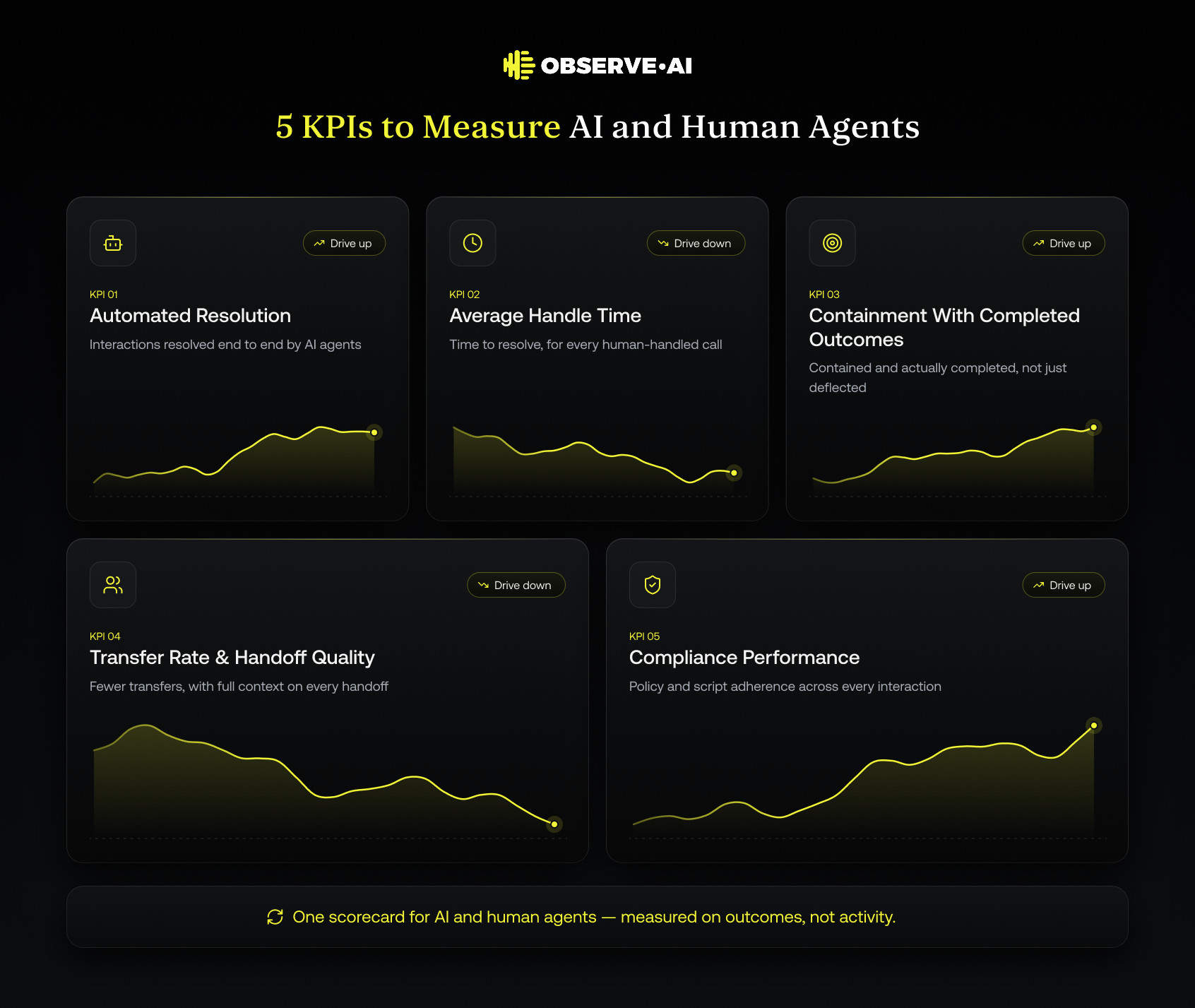
For Contact Center AI agents and agent assist, measurement is equally critical for management and pricing justification. Enterprises typically monitor KPIs such as:
- Automated resolution and completion of defined workflows.
- Average handle time and time to resolution across AI and human interactions.
- Containment that still results in successful outcomes, not just call or chat abandonment.
- Transfer rates to humans and handoff quality.
- Compliance performance and error rates for both agents and AI.
By centralizing analytics and QA in one cloud platform, Observe.AI allows teams to compare performance across channels and modalities and standardize coaching. They can see when a workflow is better suited to automation, when agent assist should be expanded, or when a process change is needed upstream, using real time insights. This supports data‑driven decisions rather than assumptions about where Contact Center AI should be used, and it helps teams prioritize features and routing changes. To choose the best fit, teams often compare pricing models, cloud deployment options, and Contact Center AI reviews across vendors, focusing on features that match their enterprise workflows.
Use Governance And Continuous Optimization Across The Lifecycle
Enterprise AI contact center deployments are not static projects. They require ongoing governance, testing, versioning, cloud operations, and performance monitoring across the lifecycle—from initial design through production and subsequent optimization.
Observe.AI treats AI agents and assistance as governed assets within Contact Center AI, with tools for enterprise management and coaching readiness. Teams can design and configure agents, connect them to cloud systems with clearly scoped permissions, define business rules, routing and escalation paths, and guardrails. Before deployment, they can simulate conversations and workflows using realistic contact‑center scenarios, checking how agents behave under interruptions, accents, ambiguous requests, or edge cases.
Once in production, the platform provides continuous monitoring and evaluation with Contact Center AI analytics, insights, and coaching workflows. Operations, QA, and governance teams can review transcripts and outcomes, compare versions, and use built‑in evaluation tools to assess behavior against policies and expected results, helping each employee improve. With this feedback loop, enterprises can update prompts, expand supported requests, refine grounding strategies, adjust routing, and tune guardrails without losing control or visibility.
This lifecycle approach is central to enterprise requirements. It addresses the need for governance, compliance, and enterprise control over AI behavior, while still enabling continuous optimization. Teams can adopt AI support agents with confidence, knowing they can test, measure, and iterate instead of accepting a black‑box solution. This is where Contact Center AI becomes operational: it provides governance, analytics, and coaching in one place so every employee can improve without adding tool sprawl.
Enterprise Readiness And Platform Evaluation
Assess Integrations, Security, Compliance, And Operational Control
Selecting AI contact center software for an enterprise support organization requires more than a feature checklist; it also requires comparing Contact Center AI features, cloud fit, pricing, and user impact. Leaders must evaluate whether a platform can operate as part of a broader customer service and CCaaS ecosystem, and whether it meets security, compliance, and control requirements for every user and employee group.
Integrations sit at the center of this evaluation, especially for cloud deployments. Effective AI agents depend on access to accurate data and the ability to trigger workflows. Observe.AI connects to CCaaS platforms, CRM, ticketing, billing, and other core cloud systems so AI agents and agent assist can look up records, update fields, orchestrate tasks, and provide consistent responses while respecting business rules. This level of integration turns Contact Center AI from a passive listener into an active participant in customer service operations, improving routing and employee efficiency.
Security, privacy, and compliance expectations vary by industry and geography, but the platform must support enterprise‑grade controls. This includes robust authentication and authorization models, encryption in transit and at rest, configurable data retention, and access controls that limit who can see which conversations and analytics. For regulated environments, the ability to define and enforce policies, generate audit trails, and keep AI behavior within approved guidelines is essential.
Operational control is the final pillar of enterprise management. Enterprises should own routing logic, escalation rules, compliance prompts, and the scope of AI actions, including which features are available to each user role. Observe.AI gives operations and governance teams configuration‑level control without requiring them to build their own cloud AI infrastructure from scratch, supporting Contact Center AI at scale. This balance of flexibility and control is particularly important when AI agents are allowed to modify customer data or initiate financial or clinical workflows. For enterprise security teams, cloud controls and clear pricing terms for data processing, storage, and model usage matter as much as product features and integrations.
Test AI Behavior With Realistic Contact-Center Scenarios
Before expanding AI automation or assistance across support teams, enterprises need high‑confidence validation that Contact Center AI will behave as expected under real‑world conditions. Contact centers are noisy, dynamic environments with overlapping intents, interruptions, and emotionally charged situations. Testing AI only on clean demo scripts is insufficient.
Observe.AI enables teams to test AI agents and assistance features against realistic voice call and chat scenarios, including variations in language, accents, background noise, and incomplete information, using cloud test environments. Teams can simulate different entry points—IVR, chat widgets, callbacks—and observe how the AI handles authentication, clarifies ambiguous requests, applies routing, and escalates complex cases in real time.
This simulation and evaluation step supports structured decision‑making about where to deploy AI and at what scale. For example, enterprises can validate that an AI support agent consistently handles balance inquiries and address changes before expanding it to handle payment disputes. They can also confirm that agent‑assist prompts for disclosures appear at the right moment in a sales or collections call.
By building testing and evaluation into the platform, Observe.AI helps enterprises avoid the gap between controlled pilots and production reality by providing Contact Center AI testing, analytics, and governance in one cloud platform. Teams can iterate on flows, refine grounding and guardrails, compare performance across versions, and roll out changes to all customers. In addition to testing, enterprise leaders often look at Contact Center AI reviews to validate real time performance, routing flexibility, and coaching depth before expanding to more teams.
Discuss Your Contact-Center Requirements With Observe.AI
Enterprises face strategic choices about where AI fits in their contact center roadmap:
- Should they prioritize AI agents, agent assist, or broader CCaaS transformation first?
- When does it make sense to replace a legacy contact center platform with CCaaS, versus layering AI capabilities on top of the current environment?
- Which customer journeys and workflows should be automated now, and which should remain with human experts supported by AI?
Observe.AI works as a contact‑center‑native, agentic CX platform that complements both existing and modern CCaaS deployments, bringing Contact Center AI to the center of operations. Many organizations begin by deploying AI powered support agents on specific, well‑defined workflows, while simultaneously using agent assist, QA, analytics, and coaching to improve employee performance. Over time, as interaction data and KPIs reveal where automation is most effective, they expand AI agents and refine routing and staffing strategies, guided by Contact Center AI insights.
A structured discovery and evaluation process helps clarify the right path. By discussing requirements with Observe.AI, enterprises can map their current systems and constraints, identify priority customer requests and tasks, compare features and pricing, and define KPIs that matter—such as completed work, compliance, customer satisfaction, and cost‑to‑serve. From there, they can design a phased plan that aligns AI deployment with CCaaS migration, workforce planning, and broader CX goals. A practical evaluation also includes Contact Center AI pricing, cloud requirements, and user adoption plans so operations teams can forecast ongoing management and employee training effort.
Questions About AI Contact Center Software
What Does AI Contact Center Software Do?
AI contact center software brings intelligence, automation, analytics, routing, and coaching directly into the contact center stack, often delivered via the cloud. In an enterprise context, it typically includes:
- Customer‑facing AI agents that handle voice and digital interactions, resolve common customer service requests, complete defined workflows, and provide consistent responses.
- Agent‑assist capabilities that provide real time guidance, knowledge, and after‑call support to frontline agents, improving employee confidence and user experience.
- QA and analytics tools that evaluate interactions at scale, monitor agent and employee performance, and expose operational insights through Contact Center AI.
- Governance, testing, and lifecycle management that allow teams to build, trust, deploy, and improve AI agents in a controlled, measurable way, with cloud operations and pricing transparency.
In practice, the best Contact Center AI solutions provide cloud deployment, flexible pricing, and features for routing, coaching, and analytics that enterprise operations teams can manage.
Together, these capabilities help support teams automate repetitive tasks, improve response quality, and gain visibility into every customer interaction—without losing enterprise control, and with tools for management and coaching.
How Do AI Agents Differ From Chatbots?
Traditional chatbots follow scripted flows and handle a narrow set of FAQs or form‑like tasks, often with limited access to enterprise systems. They struggle when customers deviate from expected paths or when requests span multiple steps and systems.
Enterprise Contact Center AI agents, by contrast, operate within an AI powered agentic architecture. They combine conversation understanding with context and workflow orchestration. With a platform like Observe.AI, Contact Center AI agents can: interpret natural language across channels; ground responses in current customer and account data; follow multi‑step procedures; enforce business rules and compliance requirements; apply routing policies; and decide when to escalate or transfer to a human.
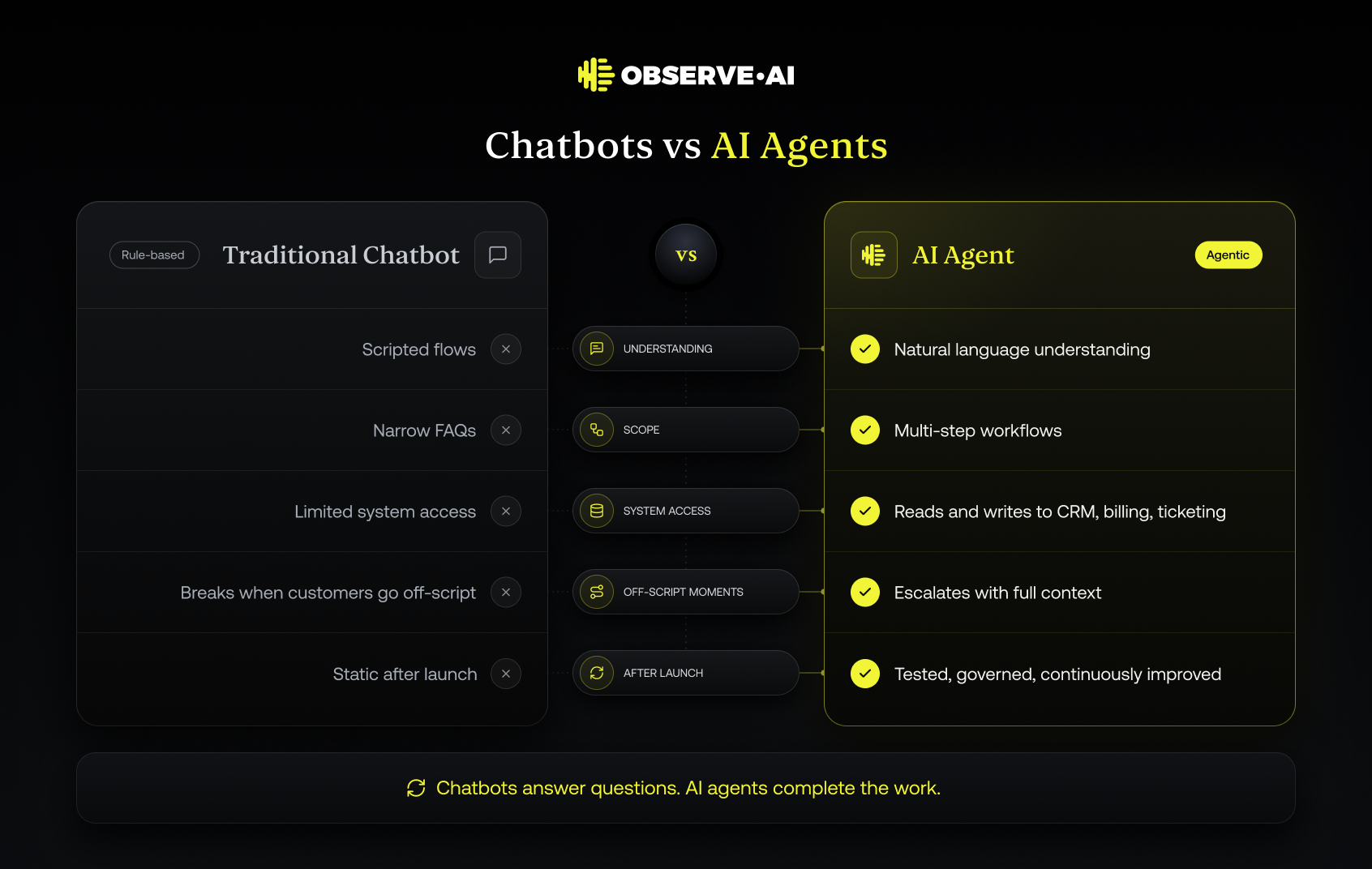
In practical terms, this means Contact Center AI agents support both customers and support teams more like digital coworkers than static bots, improving employee effectiveness. They can handle voice interactions in a contact center, support agents in real time, and integrate with analytics, reviews, and QA to keep improving. The result is automation that focuses on completed work and reliable customer service, not just quick answers, with pricing and cloud scale that work for enterprise operations. Compared with a basic chatbot, Contact Center AI agents are AI powered, workflow based, and designed to provide reliable responses across voice and digital channels in a contact center.
How Can Enterprises Test And Govern AI Agents?
Testing and governance are central to deploying Contact Center AI agents at enterprise scale. Before allowing AI to engage customers or modify records, leaders need clear answers to how it behaves, how it is evaluated, and how it will be monitored over time.
With Observe.AI, governance begins with design in the cloud. Teams define what each AI agent can do, which systems it can access, and what guardrails and escalation rules apply. They then use simulation and testing to expose the agent to realistic contact‑center scenarios, including edge cases and compliance‑sensitive situations. Evaluation tools compare expected and actual behavior, highlighting gaps to address before rollout.
In production, governance shifts toward measurement and control. Enterprises monitor KPIs such as resolution rates, containment with completed tasks, handle time, routing accuracy, transfer and escalation patterns, compliance performance, and customer sentiment to measure Contact Center AI value and pricing ROI. They review transcripts when thresholds are exceeded or anomalies appear, adjust prompts and policies, and deploy new versions through structured lifecycle management.
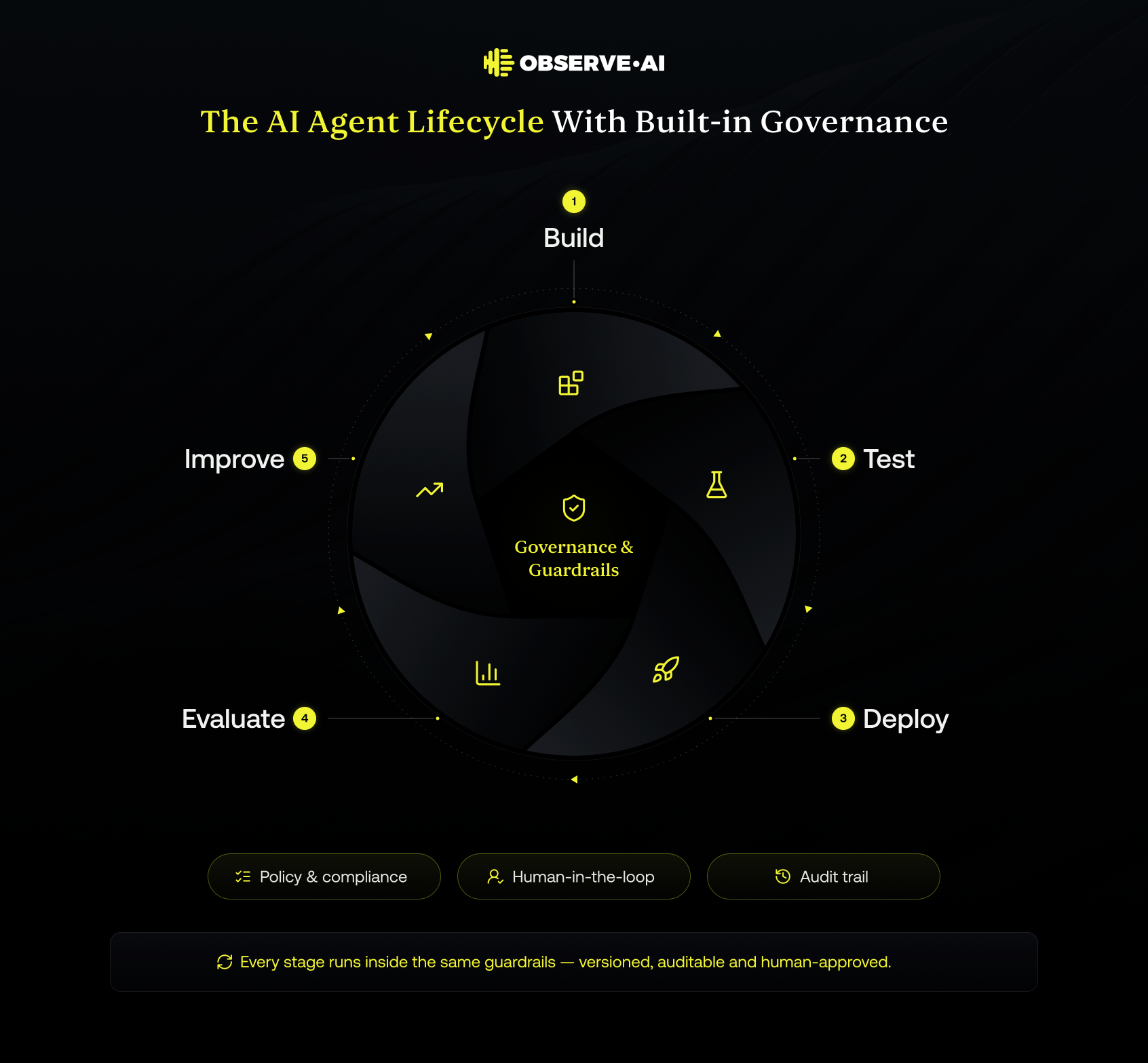
This continuous learning loop—build, test, deploy, evaluate, and improve—allows enterprises to expand AI contact center software confidently, using Contact Center AI features and cloud management. AI agents evolve under oversight from operations, QA, and governance teams, ensuring they remain aligned with business objectives, regulatory requirements, and evolving customer expectations, while giving each user and employee clearer coaching and better responses. Over time, Contact Center AI programs combine analytics insights, coaching workflows, cloud operations, and clear pricing governance so each employee and user group benefits from continuous improvement.
Ready to map your first AI agent workflow? Schedule a custom demo and we'll build a phased plan around your systems and KPIs.
Subscribe to our newsletter.
Frequently Answered Questions


.jpg)
.png)
.jpg)