.jpg)
AI Support Agents for Banking: Compliance, Use Cases, and Implementation Strategies
What Banking AI Agents Do
An AI agent for banking is a software agent powered by advanced AI models that can understand context, take actions across your banking systems, and coordinate end‑to‑end workflows with minimal human input. Unlike a simple chatbot, an AI banking agent does not just answer questions; it can execute tasks, call internal APIs, read and write to core systems, and collaborate with human teams.
An AI support agent for financial services is focused on customer‑facing and operations‑support scenarios. It can handle inbound queries, collect documents, validate data, route cases, and trigger automated processes such as KYC, card replacement, dispute handling, or loan status checks. It acts as a digital team member embedded into your banking processes.
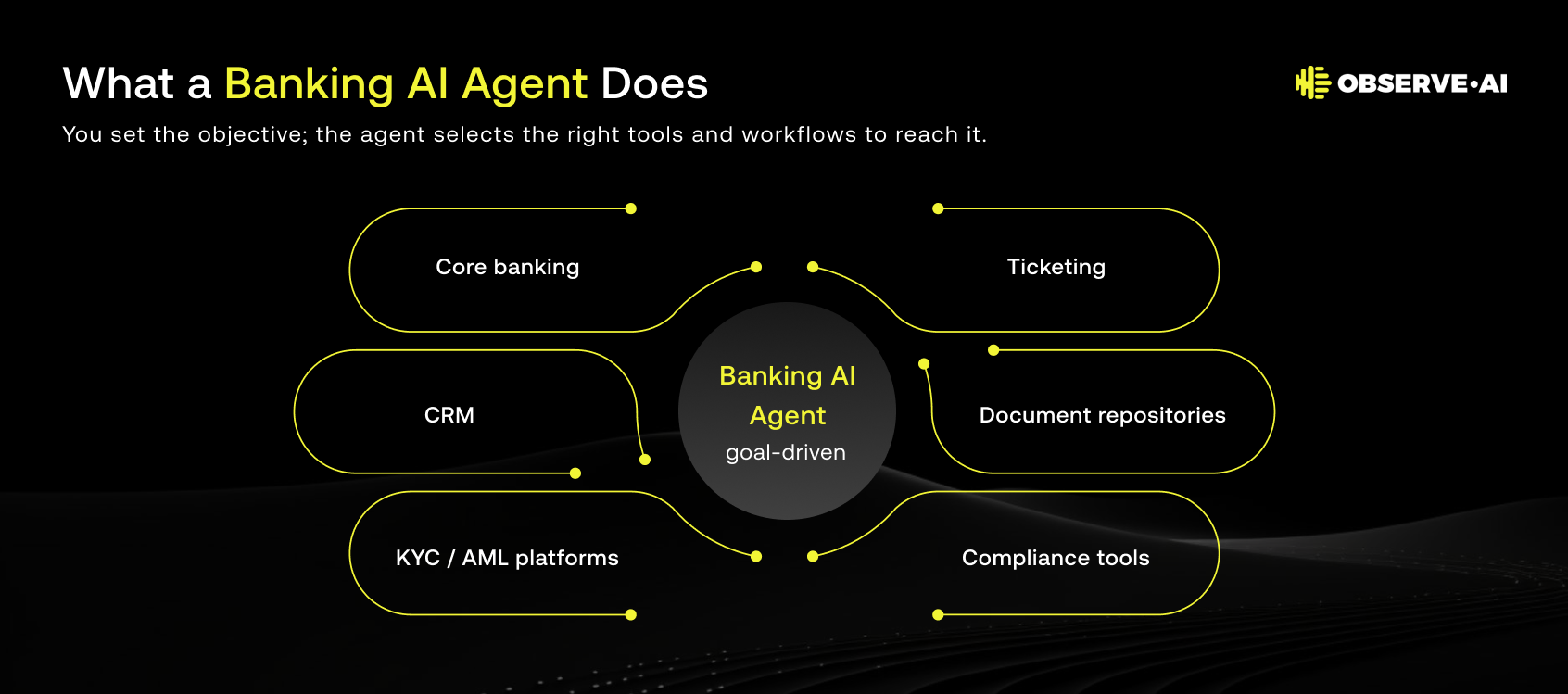
In practical terms, banking AI agents can:
- Access and interpret customer data from CRM, core banking, and ticketing platforms.
- Trigger automated workflows, such as opening an account, escalating a fraud alert, or generating a regulatory report draft.
- Maintain context across channels, so a customer can start on web, continue in the app, and finalize via email or chat.
Because these agents are “agentic AI” systems, they are goal‑driven: you specify the objective (e.g., “complete onboarding,” “resolve this support ticket within policy”), and the agent chooses which tools and workflows to use to achieve it.
Why Compliance Matters in Regulated Finance
In banking and broader financial services, every interaction is governed by strict regulations: KYC, AML, consumer protection, data privacy, operational resilience, and more. When you introduce AI agents into these environments, you extend your regulated perimeter.
Compliance matters for three main reasons:
- Regulatory expectations. Supervisors are increasingly explicit that use of AI does not reduce a bank’s accountability. You are responsible for the outcomes of AI‑driven decisions, including any biased offers, mis‑sold products, or incorrect denials.
- Consumer protection and trust. A banking AI agent may influence a customer’s credit decisions, disclosures they see, or the complaints path they follow. Misleading explanations, opaque decisions, or mishandled disputes can expose you to customer harm and regulatory action.
- Data protection and secrecy. AI agents rely on large volumes of sensitive data. Without strong controls, there is risk of data leakage, unauthorized access, or improper use of model outputs for secondary purposes.
Because agentic AI systems are more autonomous than traditional software, you must treat them as part of your regulated processes: subject to approval, risk assessment, monitoring, and audit. Compliance is not just a checkbox; it shapes how you design, deploy, and operate AI agents in banking.
What AI Agents Mean in Banking
How They Differ From Chatbots and RPA
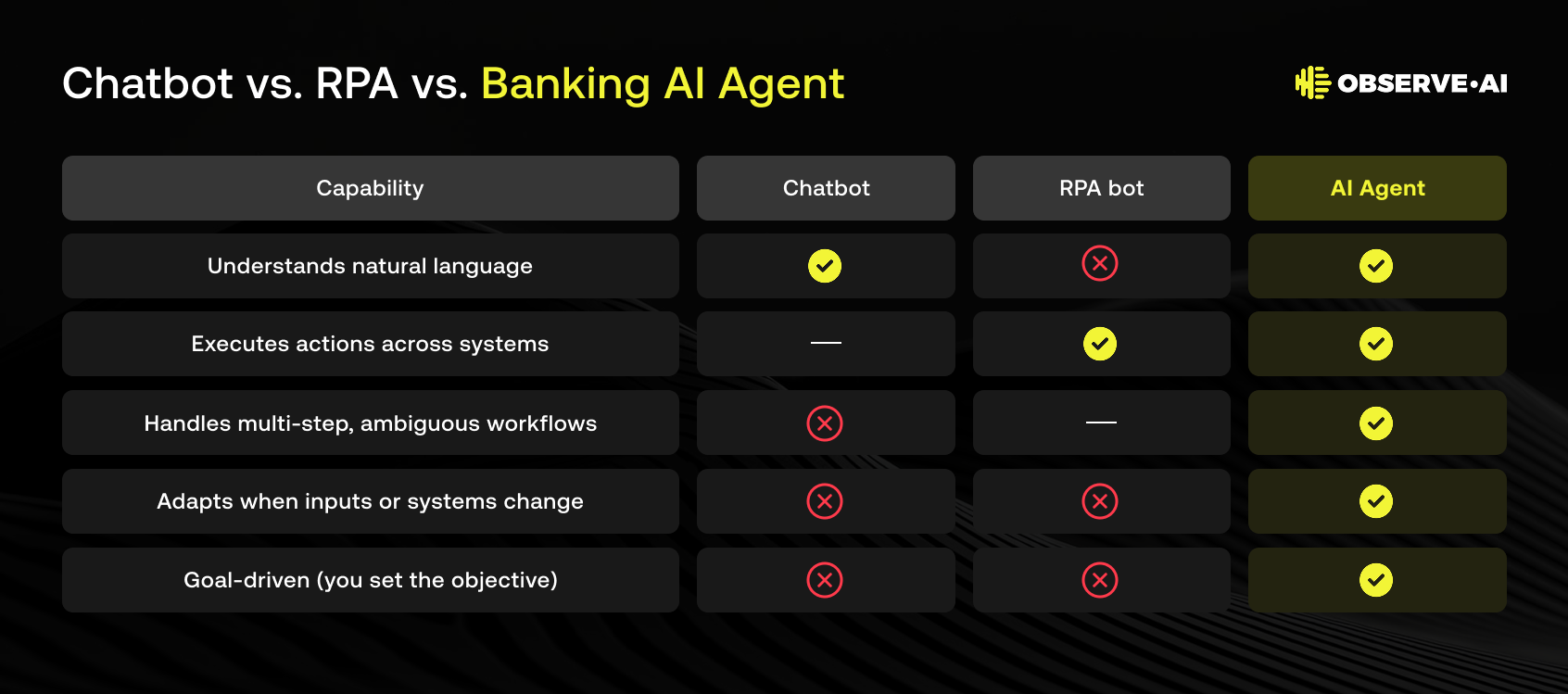
Many banks already use basic chatbots and robotic process automation (RPA). Banking AI agents are different in three key ways.
First, chatbots are usually conversational interfaces tied to a limited knowledge base or set of scripted flows. They can answer FAQs or perform simple lookups but struggle with complex, multi‑step processes or ambiguous queries. An AI agent for banking, by contrast, can reason over multiple data sources, call internal tools, and adapt its approach based on real‑time feedback.
Second, RPA bots execute predefined scripts—clicking buttons, filling forms, or transferring data between systems. They are brittle when interfaces change and cannot easily adapt to new scenarios. Agentic AI can select from a range of tools and APIs, handle edge cases by asking clarifying questions, and update its strategy within defined policy constraints.
Third, banking AI agents integrate both language understanding and action. They interpret natural‑language instructions from customers or staff (“open a savings account and set up a monthly transfer”), break them down, and orchestrate the necessary internal processes without requiring rigid scripting.
Core Capabilities Across Banking Systems
To be useful in production, AI agents must integrate with your existing banking systems and data. Typical capabilities include:
- Secure data access. Reading and writing customer and account data from core banking, CRM, KYC/AML platforms, ticketing tools, and document repositories, under strict access controls.
- Workflow orchestration. Driving multi‑step processes such as onboarding, dispute resolution, loan origination, and regulatory reporting by coordinating across teams and tools.
- Contextual reasoning. Using transaction history, previous interactions, risk scores, and policy rules to tailor support and decisions for each customer.
- Omnichannel support. Operating across chat, email, web, mobile, and internal tools so the same AI banking agent logic underpins every channel.
- Policy‑aware responses. Applying internal policies, product terms, and regulatory rules embedded into the agent’s knowledge and guardrails.
These capabilities make AI agents powerful levers for automating banking support, reducing manual workload, and improving consistency. But they also mean the agents are deeply entangled with regulated data and processes, which is why robust governance is essential.
Why Autonomy Changes the Control Model
Traditional software does exactly what you code. Agentic AI systems, by design, have more autonomy: they decide which tools to call, how to interpret ambiguous information, and how to sequence actions to reach a goal.
This autonomy changes your control model in several ways:
- From rule‑by‑rule to objective‑based. Instead of scripting every step, you define objectives and constraints. Control shifts toward guardrails, policies, and post‑hoc monitoring.
- From static to adaptive behavior. AI agents can learn from historical interactions or be updated with new models and prompts. Each update can subtly change behavior, which must be re‑assessed for compliance.
- From system logs to decision logs. Because there may not be a single hard‑coded rule for each decision, you need richer logging of context, rationale, and tool calls to explain what the agent did and why.
For regulated financial services, this means the AI agent must operate within a governance framework that treats it similarly to a human staff member with delegated authority: defined responsibilities, limits, training (in the AI sense), supervision, and periodic review.
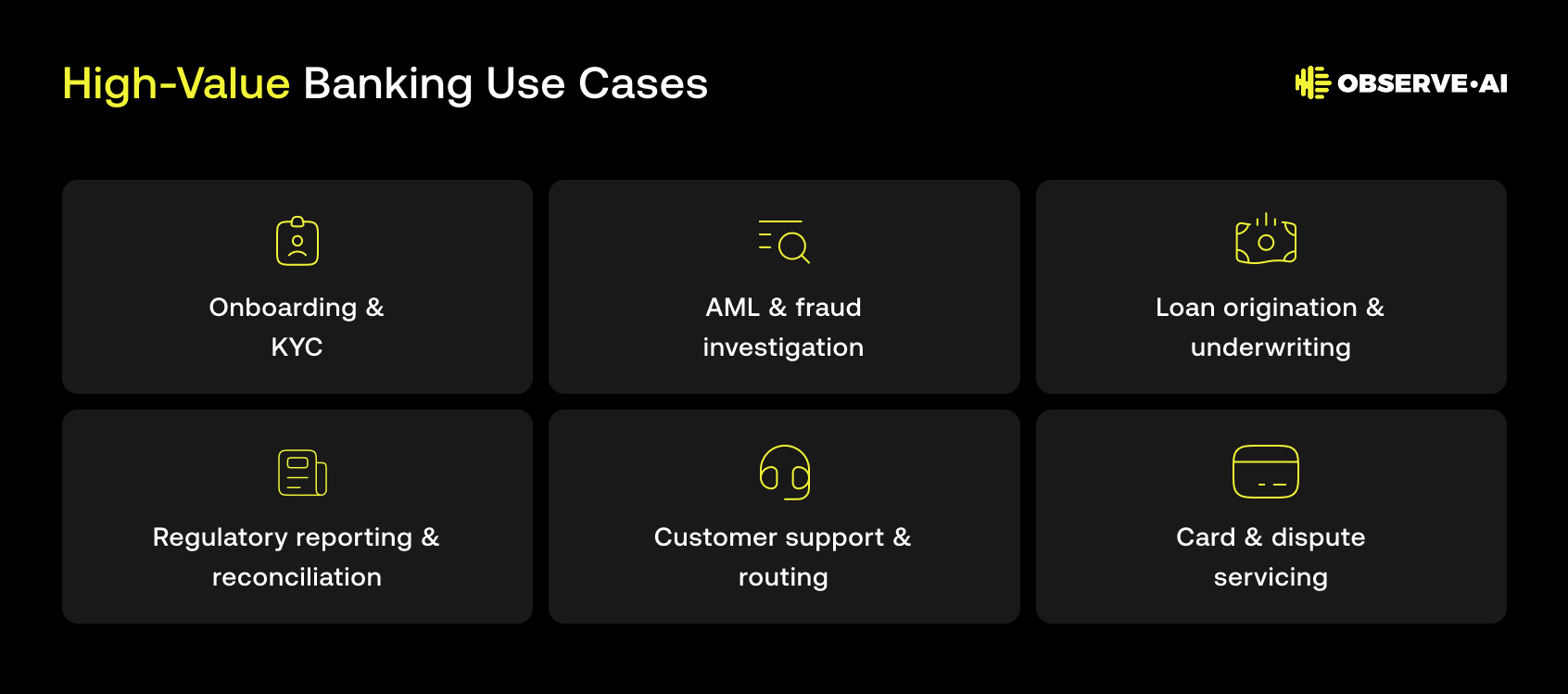
High-Value Banking Use Cases
Customer Onboarding and KYC
Customer onboarding is one of the highest‑value areas for AI agents in banking. The process is complex, data‑heavy, and highly regulated.
An AI support agent can guide applicants through onboarding, collecting information, explaining required disclosures, and answering detailed product questions. It can automatically extract data from identity documents, compare it against application details, and trigger KYC checks.
To handle KYC with an AI agent safely:
- The agent orchestrates identity verification tools and sanctions/Pep screening engines rather than making unverified judgments.
- It applies predetermined policies for risk ratings and document requirements.
- Any exceptions or high‑risk cases are routed to human analysts with full context and an auditable trail of the agent’s steps.
This improves speed and reduces manual data entry while maintaining compliance with KYC regulations.
AML and Fraud Investigation
Anti‑money laundering (AML) and fraud processes produce large volumes of alerts that human teams struggle to review quickly. AI agents can help by triaging alerts, gathering relevant data, and preparing cases for analysts.
For example, an AI banking agent can pull transaction histories, customer profiles, network relationships, and previous alerts into a structured summary. It can highlight patterns aligned with predefined risk typologies and suggest next steps based on internal playbooks.
However, AI agents should not autonomously clear or close high‑risk AML cases. Instead, they:
- Operate as an assistant to AML investigators, reducing time spent on data collection.
- Follow strict decision rules for low‑risk, well‑defined scenarios where regulators allow straight‑through processing.
- Provide clear explanations and references when recommending actions, supporting audit and model‑risk management requirements.
Loan Origination and Underwriting
Loan origination involves multiple data sources, eligibility rules, and customer interactions. AI agents can streamline this workflow while preserving responsible‑lending standards.
An AI agent for banking can:
- Pre‑qualify applicants by checking basic criteria and collecting supporting documentation.
- Explain product options, terms, and risks in language suited to the customer’s profile.
- Compile structured loan files summarizing income, obligations, collateral, and risk indicators for underwriters.
Underwriting decisions themselves should remain under well‑governed models and human oversight, especially for complex or higher‑risk products. The AI agent can assist by preparing analyses, checking completeness, and flagging anomalies, but final credit decisions must follow documented processes and regulatory guidance.
Regulatory Reporting and Reconciliation
Regulatory reporting remains a largely manual burden for many institutions. AI agents can automate data gathering and reconciliation across systems, helping teams prepare accurate, timely reports.
Typical contributions include:
- Extracting relevant data from multiple internal systems into a normalized format.
- Identifying missing or inconsistent fields and prompting teams to correct them.
- Drafting narrative sections (e.g., risk descriptions) using approved templates and language.
Because regulatory reporting errors can trigger enforcement, any AI‑generated outputs must go through human review and established approval workflows. The agent’s role is to reduce manual data wrangling and improve consistency, not to replace accountable sign‑offs.
Customer Support and Service Routing
Customer support is often the first use case leaders consider for an AI support agent in financial services. When properly governed, this can deliver faster service and better experiences without sacrificing compliance.
An AI banking agent can:
- Answer common queries on balances, payments, card issues, and basic product information, based on approved content and real‑time account data.
- Authenticate customers via secure flows and then perform permitted actions such as card lock/unlock, address updates, or payment scheduling.
- Detect complaints or vulnerable‑customer signals in language and route these cases to specialized teams with the right priority.
Routing is just as critical as response automation. The agent can categorize tickets by product, risk, and customer segment, ensuring that complex or sensitive issues reach the right human experts quickly.
To measure ROI and performance here, banks typically track resolution time, first‑contact resolution, containment rates (issues resolved without human intervention), and quality metrics such as complaint volumes and post‑interaction satisfaction—always ensuring that efficiency gains do not come at the expense of fair outcomes.
How to Ensure AI Agent Compliance
Governance and Approval Workflows
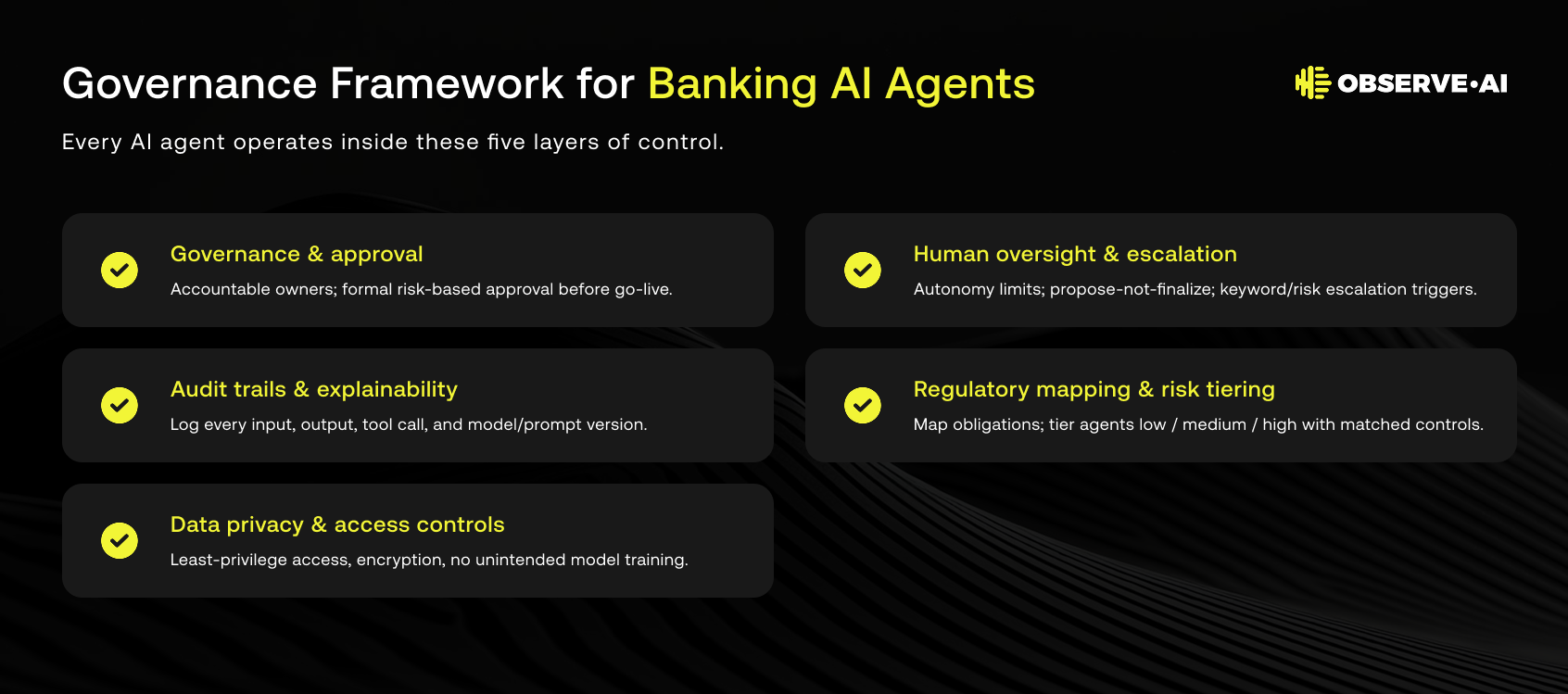
Compliance for AI agents starts with governance. Treat each AI agent as a controlled component of your operating model, not an experimental side project.
Key practices include:
- Assigning clear accountability for each agent (business owner, model‑risk owner, compliance partner).
- Classifying the agent’s use case (e.g., informational support vs. decision‑making vs. execution of transactions).
- Requiring formal approval before the agent goes live, based on risk assessment, testing, and alignment with policies.
Changes to the agent—new tools, prompts, models, data sources—should go through change‑management workflows similar to other critical banking systems. This ensures that compliance, risk, and security teams can evaluate potential impacts before deployment.
Audit Trails and Explainability
To satisfy regulators and internal audit, you must be able to show what your AI banking agent did, with which data, and under what logic.
Strong auditability means:
- Logging every interaction: inputs (customer queries, system events), outputs (responses, actions), and all tool calls or system changes the agent initiated.
- Capturing context: which model version, prompts, and policies were in force at the time.
- Storing machine‑readable traces that can be reconstructed and reviewed during investigations or model validations.
Explainability is about making these logs understandable. For agents that influence decisions (e.g., suggesting a fraud conclusion or recommending a product), you should be able to provide a human‑readable rationale tied to documented rules, risk indicators, or policy references. This can be generated automatically from the agent’s internal reasoning steps while still conforming to your documentation standards.
Data Privacy and Access Controls
Because AI agents rely heavily on data, privacy and confidentiality controls are central to compliance.
Key measures include:
- Least‑privilege access. The agent should only access data needed for each workflow. Different agents may have different access scopes based on their role.
- Segregation of environments. Production, test, and training environments must be separated, with strict controls on movement of real customer data.
- No unintended training. Ensure that customer data processed by the agent is not automatically used for open‑ended model training beyond what your privacy notices and legal basis allow.
- Data residency and retention. Respect jurisdictional rules on where data is stored and how long logs are retained, especially for cross‑border cloud deployments.
These controls are also a key part of demonstrating to supervisors that your AI support agents for financial services do not increase the risk of data leakage or misuse.
Human Oversight and Escalation Rules
Even highly automated agents must operate under human oversight, especially in high‑risk banking processes.
Define explicit boundaries where:
- The agent can operate autonomously within pre‑approved rules (e.g., answering basic questions, executing low‑risk updates).
- The agent can propose but not finalize decisions (e.g., AML dispositions, credit recommendations, complaint resolutions for vulnerable customers).
- The agent must escalate immediately based on triggers such as certain keywords, risk scores, or detected distress.
Escalation flows should be transparent to customers: they should know when they are interacting with an AI agent and when they have the right to speak to a human. Oversight teams should regularly review agent transcripts, decisions, and error patterns to refine guardrails and training.
Regulatory Mapping and Risk Tiering
To ensure an AI agent complies with banking regulations, you need a clear mapping between each agent use case and the regulatory obligations it touches. This often spans KYC/AML, consumer‑protection, suitability, complaints handling, e‑signatures, outsourcing, and operational‑resilience rules.
Common practices include:
- Risk tiering. Classify agents into tiers (low, medium, high) based on factors like impact on financial decisions, customer segments, and transaction criticality. Higher tiers demand stricter validation and monitoring.
- Control catalogues. For each tier, define mandatory controls (testing, dual approvals, independent model review, monitoring KPIs and KRIs).
- Regulatory engagement. For novel AI agent banking applications, engage proactively with supervisors, sharing your control framework and evidence of testing.
This structured approach helps you demonstrate that AI agents are designed and operated within a familiar, regulator‑friendly governance model.
Choosing a Banking AI Agent Platform
Integration With Core Banking and Compliance Tools
When selecting a platform for AI banking agents, deep integration with your existing systems is critical. A strong platform should:
- Support secure connectors to core banking, payments, CRM, KYC/AML tools, ticketing, and document‑management systems.
- Allow you to define and manage tools (APIs, functions, workflows) that agents can call, with fine‑grained permissions.
- Integrate with compliance tooling such as case‑management systems, surveillance platforms, and model‑risk repositories so agent activity is visible in existing oversight processes.
The goal is to embed AI agents into your existing operational and compliance stack, not create an opaque, parallel system.
Security and Deployment Requirements
Security posture is non‑negotiable in financial services. When evaluating AI agent platforms, focus on:
- Deployment options. Cloud, private cloud, or on‑premises, aligned with your regulatory and data‑residency constraints.
- Identity and access management. Integration with your IAM, SSO, and role‑based access control, so agents inherit the right entitlements.
- Network and data security. Encryption in transit and at rest, robust key management, and options for private networking and customer‑managed keys.
- Operational resilience. SLAs, disaster‑recovery capabilities, monitoring, and incident‑response processes that match banking expectations.
These foundations ensure that the AI agents, their logs, and the sensitive data they touch meet banking‑grade security standards.
Evaluation Checklist for Regulated Teams
To choose the right AI support agent platform for banking, regulated teams often use a structured checklist spanning business value and compliance. While every institution is different, core dimensions typically include:
- Use‑case fit. Can the platform support your priority workflows—onboarding, AML, lending, customer support, reporting—without excessive customization?
- Governance features. Does it provide versioning, approval workflows, and role‑based control over prompts, tools, and models?
- Monitoring and analytics. Can you track agent performance, error rates, escalation patterns, and ROI while also watching for compliance breaches or bias?
- Explainability and audit. Are decision logs comprehensive and exportable? Can you reconstruct and explain individual agent decisions for auditors and regulators?
- Compliance alignment. Does the vendor understand financial services regulations and provide documentation, certifications, and controls that align with your policies?
Institutions that evaluate platforms rigorously upfront find it easier to scale AI agents across teams and geographies while staying within risk appetite.
FAQ
What is an AI agent for banking?
An AI agent for banking is an autonomous software system that uses AI to understand instructions, access banking data and systems, and execute or support financial workflows such as onboarding, servicing, or investigations, under defined policies and guardrails.
What is an AI support agent for financial services?
It is a specialized AI agent focused on customer and operations support in financial services—answering queries, collecting information, triggering processes, and routing cases while respecting regulations and internal policies.
What banking support tasks can an AI agent automate?
AI agents can automate customer authentication, data collection, form filling, document extraction, preliminary KYC checks, ticket triage, simple account updates, status queries, and preparation of case files for AML, fraud, credit, or complaints teams.
How do you handle KYC and AML checks with an AI agent?
The agent orchestrates approved KYC and AML tools, collects and validates data, and applies your documented risk rules. It can propose risk ratings or dispositions but should escalate higher‑risk or ambiguous cases to human analysts, providing full context and an auditable trail.
What are the risks of using AI agents in banking support?
Key risks include misinformation or hallucinated answers, biased or inconsistent decisions, mishandling of vulnerable customers, data‑privacy breaches, and lack of explainability. These must be mitigated with governance, guardrails, monitoring, and human oversight.
How do you audit and monitor AI agent decisions in banking?
By logging all interactions, inputs, outputs, and actions; maintaining model and configuration versions; reviewing samples regularly; tracking KPIs/KRIs; and integrating these logs with existing audit, compliance, and model‑risk functions.
How can an AI agent protect customer data and privacy in banking?
Through strict access controls, encryption, environment segregation, clear retention policies, and ensuring customer data is not used for unintended training. The platform should support least‑privilege access and respect jurisdictional data‑residency rules.
How does an AI banking agent integrate with core banking systems?
Typically via secure APIs and connectors that expose specific capabilities—such as account lookup, transaction initiation, or case creation—as tools the agent can call. Permissions and scopes are configured so the agent operates only within authorized boundaries.
How do you measure ROI and performance of an AI banking agent?
Banks combine efficiency metrics (reduced handling time, higher containment, fewer manual tasks) with quality and risk metrics (error rates, complaint volumes, escalation patterns, audit findings). A compliant AI agent is one that improves both operational performance and risk outcomes, not one at the expense of the other.
Subscribe to our newsletter.
Frequently Answered Questions