Beyond the IVR: Rethinking Insurance Policyholder Service with AI Agents
For decades, insurance contact centers have relied on interactive voice response systems, predefined call flows, and increasingly sophisticated self-service applications to manage policyholder inquiries.
These technologies have helped insurers handle significant service volumes. But advances in conversational AI are creating an opportunity to move beyond routing customers to the right destination and toward resolving their needs within the conversation itself.
For insurance leaders, the question is no longer simply how many interactions can be automated. It is which interactions AI can resolve effectively, where human expertise remains essential, and how to connect the two.
The Changing Nature of Insurance Service
Insurance service organizations manage an exceptionally broad range of inquiries.
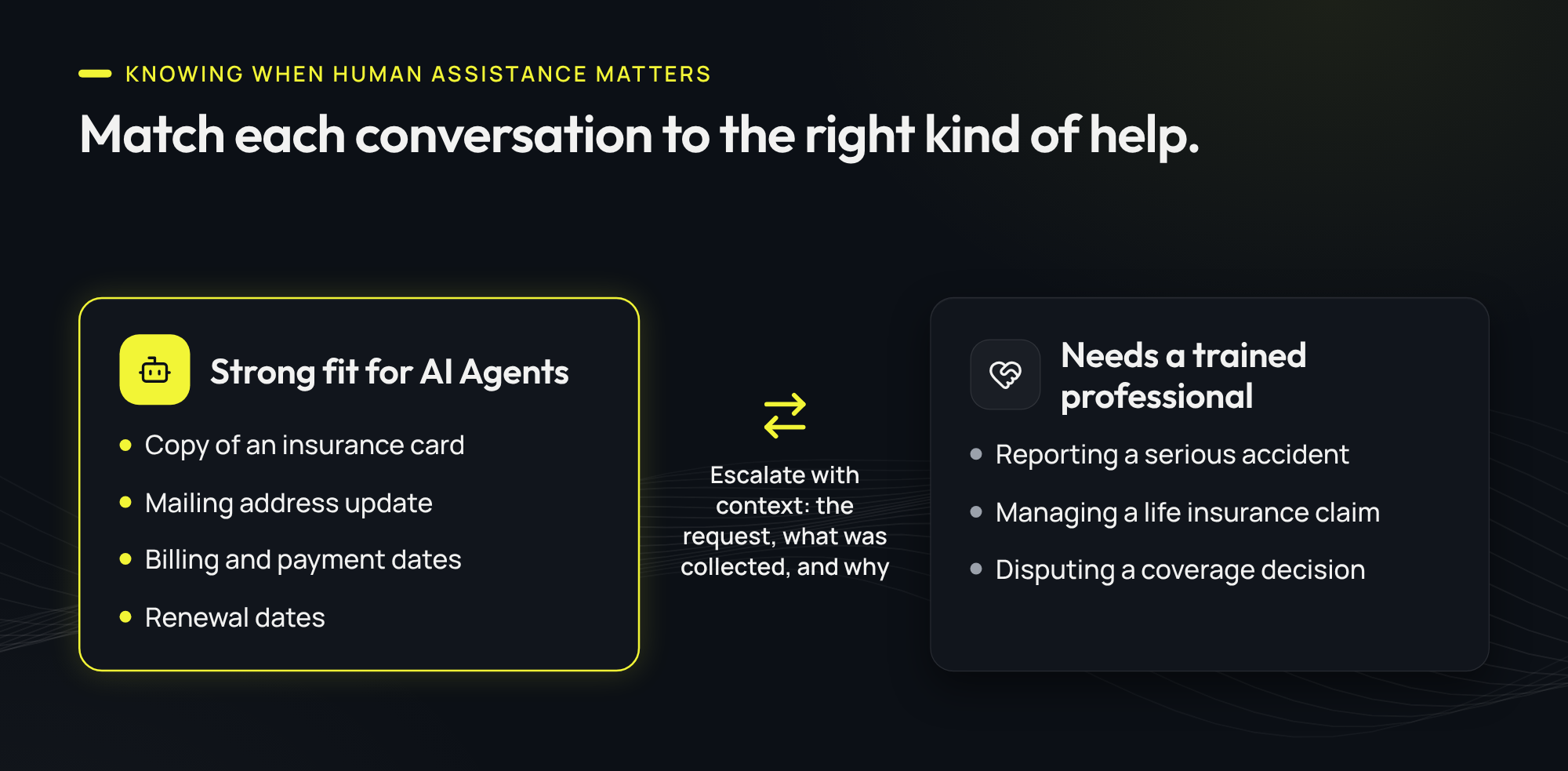
A policyholder may need a copy of an insurance card, want to update an address, request billing information, or ask about renewal dates. Another may have questions about coverage following a major life event or need assistance understanding an unexpected claims decision.
These requests vary considerably in complexity, urgency, and emotional significance.
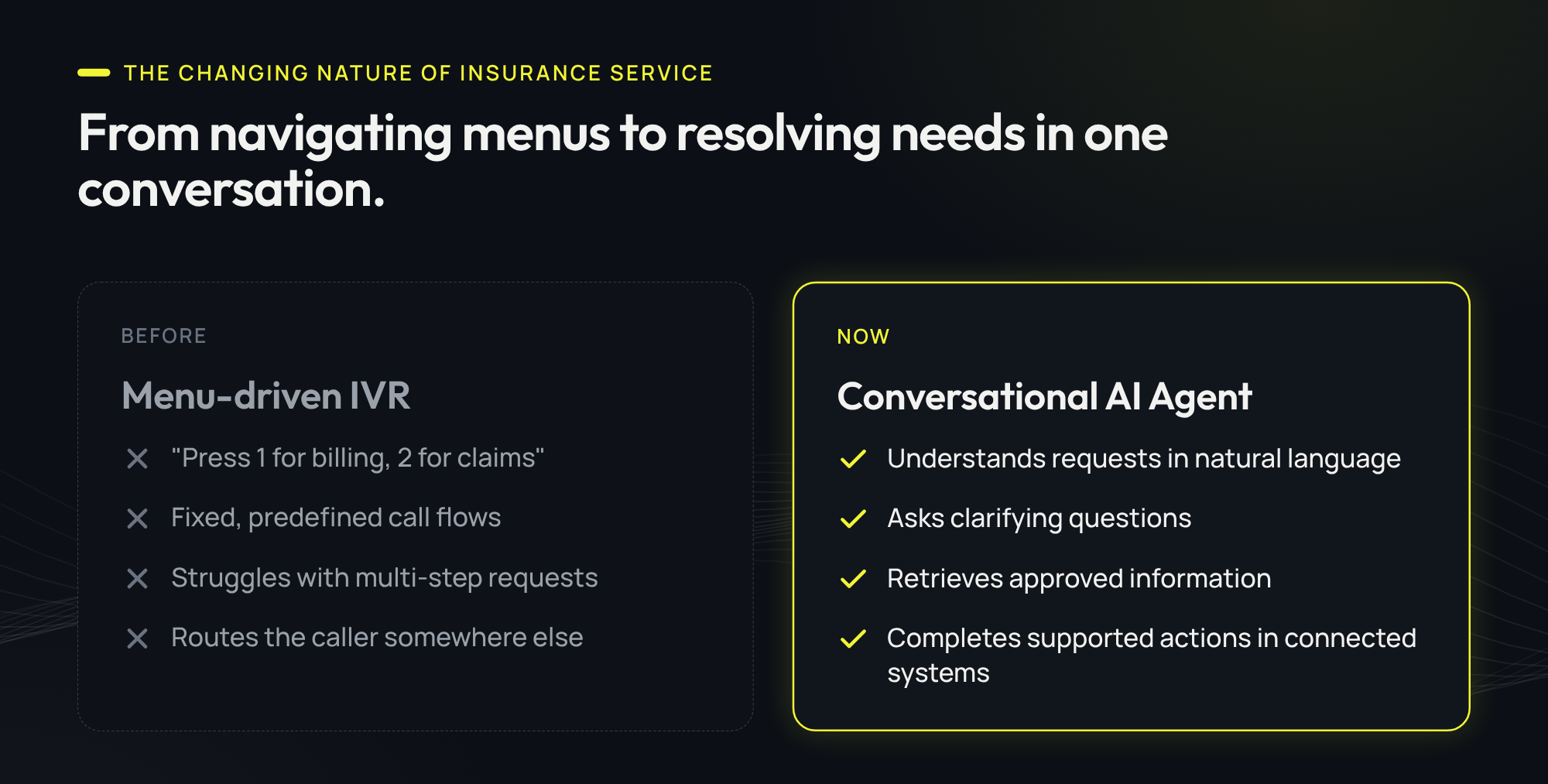
Traditional IVR systems generally rely on predefined menus and structured workflows. While effective for certain transactions, they can struggle when customers do not know which option matches their needs or when a conversation requires multiple steps.
Conversational AI Agents create a different experience.
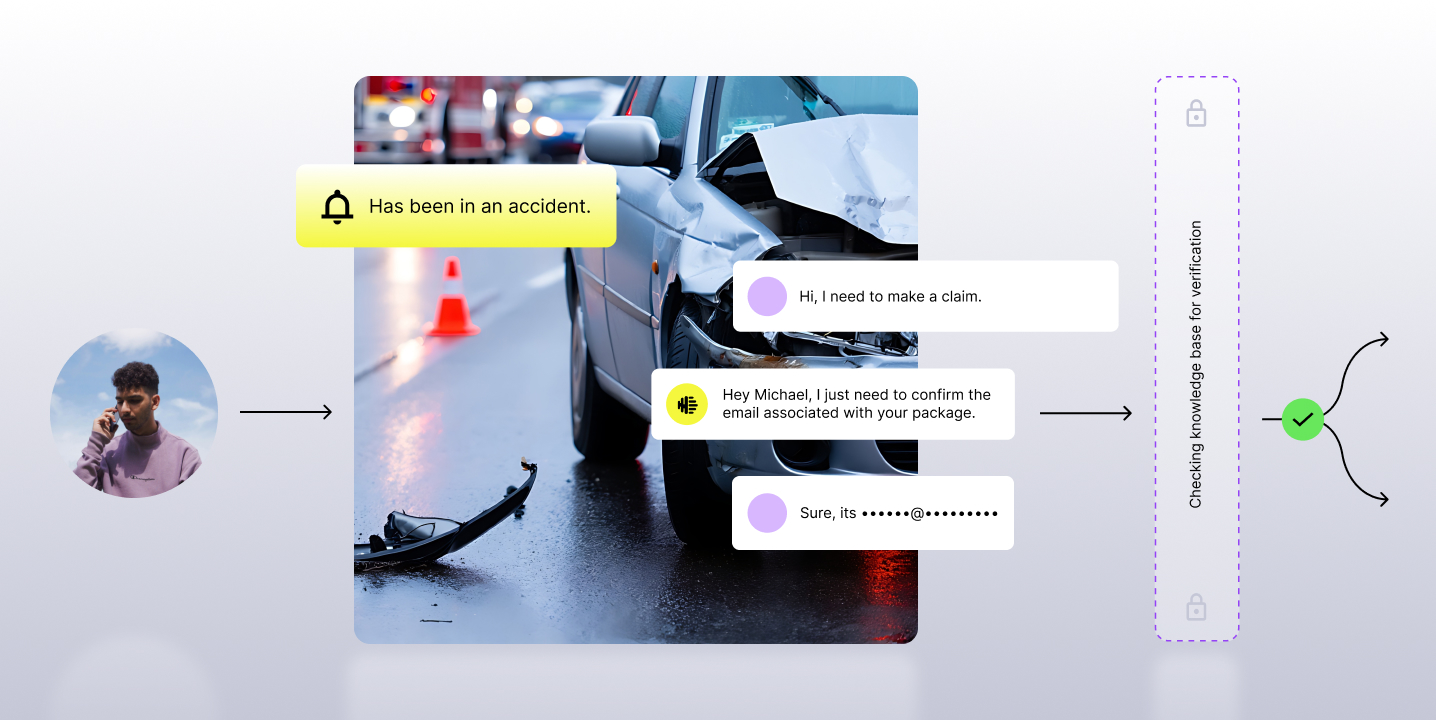
Instead of making a policyholder navigate a menu, an AI Agent can understand requests in natural language, ask clarifying questions, retrieve approved information, and complete supported actions through connected systems.
From Call Deflection to Resolution
The most meaningful measure of AI effectiveness is not whether an interaction avoids a human representative. It is whether the customer’s issue is successfully resolved.
Consider a policyholder calling to update a mailing address and confirm when their next payment is due.
With the appropriate authentication, integrations, and permissions, an AI Agent can potentially complete both requests in one conversation, rather than forcing the customer through separate menus or service queues.
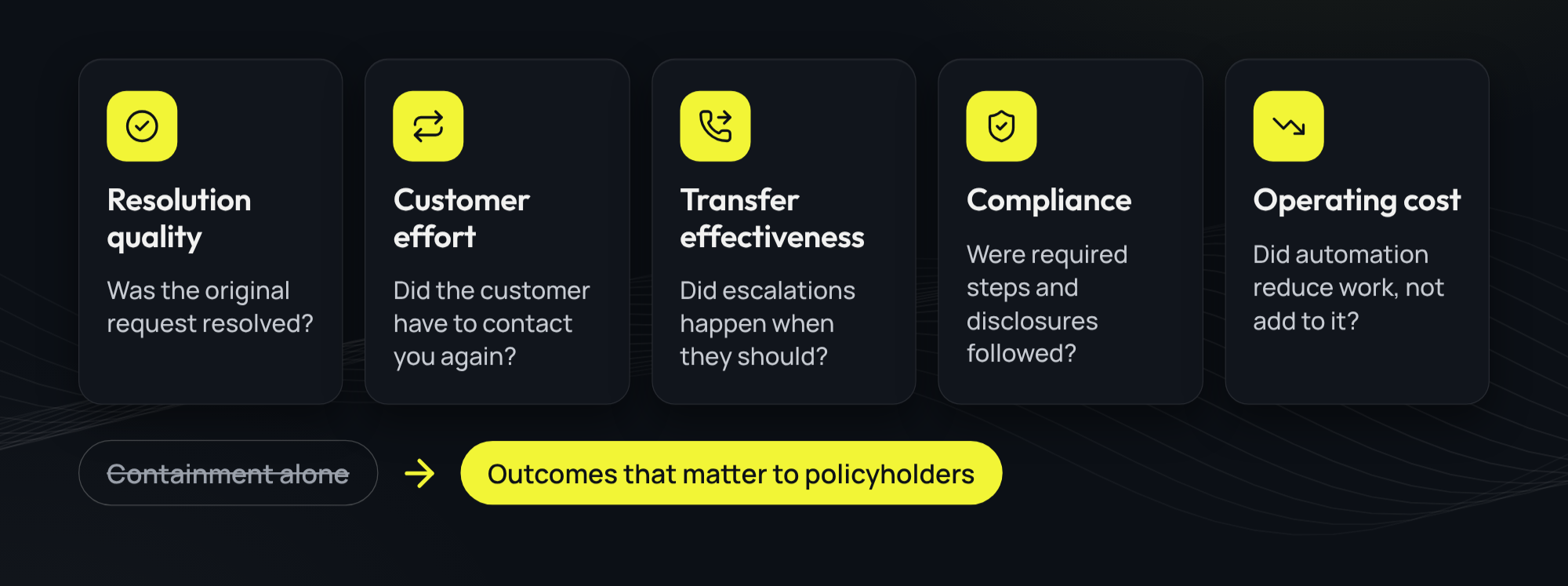
That distinction matters because containment alone does not guarantee a good outcome.
Insurers should evaluate whether AI Agents resolve the original request, whether customers contact the organization again, and whether escalations happen when they should.
An interaction that requires a second call or an unnecessary transfer may create more work rather than less.
Knowing When Human Assistance Matters
Not every insurance conversation should be automated.
A customer reporting a serious accident, a family member managing a life insurance claim, or a policyholder disputing a coverage decision may need the judgment, explanation, and empathy of a trained professional.
Effective AI systems need to recognize these boundaries.
That means identifying the customer’s intent, understanding when a request falls outside approved workflows, and transferring the interaction with relevant context.
The receiving representative should understand what the customer requested, what information was collected, and why the conversation was escalated.
This creates an experience where automation supports human service rather than becoming another obstacle to reaching it.
Building for Peak Demand
Insurance servicing also sees significant volume fluctuations.
Severe weather, open enrollment periods, premium adjustments, and renewal cycles can produce sudden increases in policyholder contact.
AI Agents can absorb routine inquiries during these periods, letting representatives focus on conversations that require specialized knowledge or judgment.
VoiceAI and ChatAI Agents can provide consistent experiences across phone and digital channels, while connected human assistance supports more complex needs.
The opportunity extends beyond traditional service hours and fixed staffing models.
A Better Measure of Insurance Automation
Insurance organizations should approach AI automation with a broader set of outcomes in mind.
Resolution quality, customer effort, transfer effectiveness, compliance, and operating cost all matter.
Observe.AI helps insurers bring these considerations together through VoiceAI, ChatAI, and connected human assistance. AI Agents can handle routine policyholder requests, while the Companion Agent provides context and support when a representative is needed.
The goal is not to automate every interaction.
It is to make every interaction more effective, using AI where it adds value and human expertise where it matters most.
Subscribe to our newsletter.
Frequently Answered Questions