AI Voice Assistants Have Reached a Turning Point — and Enterprises Need More Than Conversation Automation
A recent G2 report on the state of AI voice assistants confirms what many CX leaders are already seeing firsthand: AI voice adoption is accelerating rapidly across industries, and organizations are moving beyond experimentation into operational deployment.
In its latest research, G2 found that 88% of platforms reported rapidly increased adoption over the last 12 months, while 76% of users say they are already seeing significant or transformational operational ROI from AI voice assistants. Yet despite the momentum, enterprises still face one major challenge: proving business impact and scaling AI beyond isolated pilots.
Read the full G2 article here.
At Observe.AI, we believe this shift represents something much bigger than the rise of AI-powered conversations. It marks the transition from conversational AI to autonomous customer service.
The Industry Is Moving Beyond Simple Voice Bots
For years, customer service automation focused primarily on containment: deflecting calls, answering FAQs, or routing customers through rigid IVR flows.
But customer service is rarely just a conversation.
Resolving customer issues requires systems access, workflow execution, policy adherence, context gathering, and real operational decision-making. Enterprises no longer want AI that simply responds to customers — they need AI that can complete customer work.
That’s why we’re seeing a new category emerge: Customer-Facing AI Agents.
As referenced in the G2 report, Observe.AI sees the future of voice AI as systems that can “understand messy real-world speech, connect to enterprise systems, and work alongside human agents.”
This evolution is critical because enterprises are under increasing pressure to handle growing interaction volumes across voice and digital channels, reduce operational costs without sacrificing service quality, improve resolution speed and customer satisfaction, deliver 24/7 support experiences, and scale customer service without proportional headcount growth.
Traditional automation tools alone cannot solve these challenges.
From AI Assistants to Autonomous AI Agents
At Observe.AI, we define Customer-Facing AI Agents as autonomous AI workers that engage customers across voice and digital channels and complete service workflows end-to-end.
Unlike traditional chatbots or voice assistants that primarily generate responses, Observe.AI Automation Agents can understand customer intent, gather context from enterprise systems, reason through service workflows, execute tasks across tools and applications, update systems of record, and deliver measurable customer outcomes.
This distinction matters.
The next generation of AI in customer service is not about producing more human-like conversations. It’s about enabling enterprises to automate actual operational work.
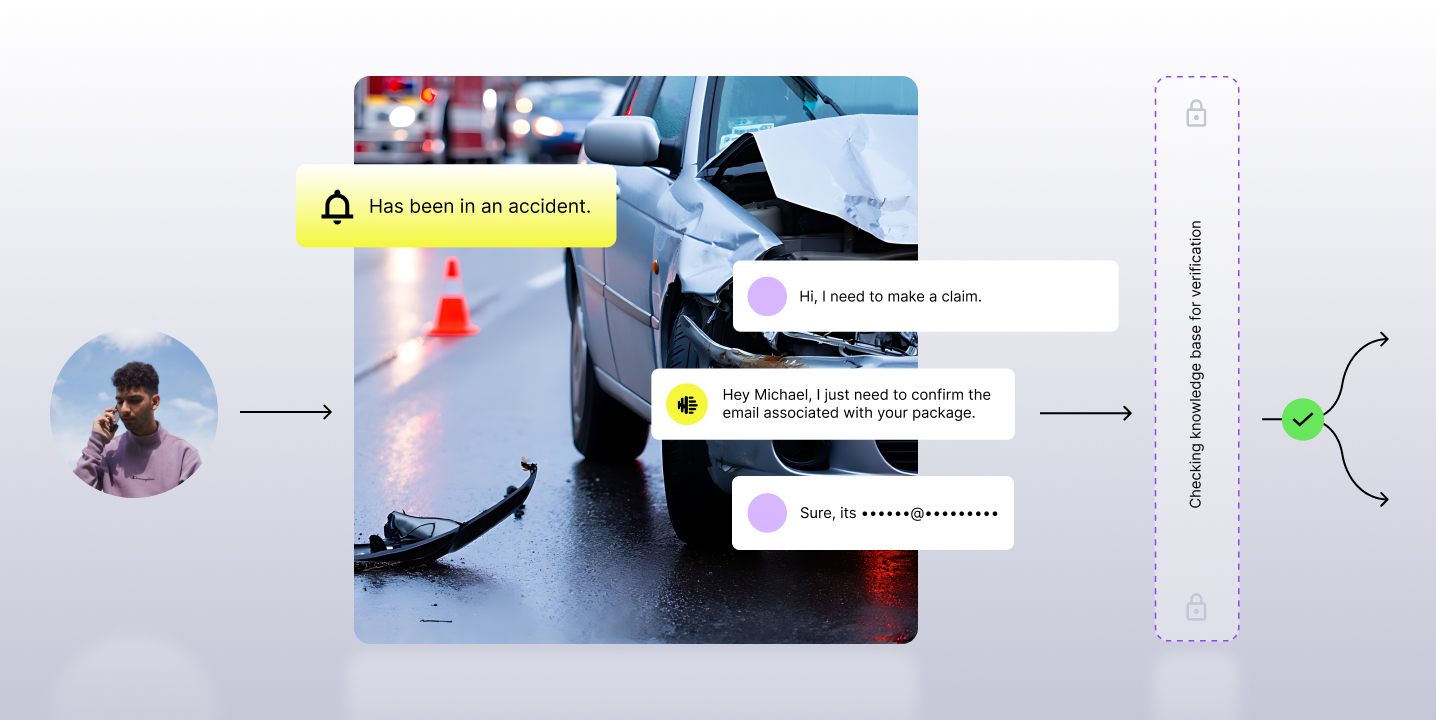
For example, an AI agent should not simply explain how to update a billing address. It should securely complete the update.
It should not only answer questions about claims status or coverage information. It should retrieve the information, guide the customer through next steps, and complete associated workflows.
This is where enterprise AI adoption becomes transformational.
Why Voice AI Adoption Is Accelerating Now
The G2 findings validate several trends we’re seeing across enterprise customer service organizations.
1. Enterprises Are Prioritizing Operational ROI
Organizations are no longer experimenting with AI for novelty.
They are evaluating AI based on measurable business outcomes, including reduced wait times, faster resolution, lower support costs, increased service capacity, and higher CSAT and consistency.
This is exactly why autonomous AI agents are gaining traction. Enterprises need systems that can move beyond conversation handling and directly contribute to operational efficiency.
2. Customers Expect Seamless Voice and Digital Experiences
Today’s customers engage across multiple channels throughout their journey.
They may start in chat, escalate to voice, request follow-up messaging, or transition between self-service and live agents.
Customer-facing AI agents must operate consistently across inbound voice, outbound voice, chat, messaging, and digital support channels.
This omnichannel orchestration is becoming foundational for modern CX.
3. AI Infrastructure Has Matured
The biggest shift isn’t just better language models.
It’s the emergence of enterprise-grade agentic infrastructure that enables AI systems to reliably execute workflows, integrate with business systems, and operate safely in production environments.
Observe.AI’s Agentic CX Platform was designed specifically for this new era.
The platform provides agent builder capabilities, enterprise integrations, tool calling and workflow execution, multi-agent orchestration, simulation, testing and governance, and evaluation and compliance controls.
These capabilities are essential because enterprise customer service environments require much more than conversational fluency. They require operational reliability.
The Real Opportunity: Scaling Customer Service Capacity
One of the biggest takeaways from the G2 report is that enterprises increasingly view voice AI as a competitive advantage rather than an experimental technology.
We agree.
Customer experience leaders are facing an impossible equation:
Customer expectations continue rising while operational budgets remain constrained.
Autonomous AI agents offer a path forward.
By automating repetitive workflows and handling routine service interactions end-to-end, organizations can handle higher interaction volumes, reduce frontline workload, extend service availability, improve consistency and compliance, and free human agents to focus on high-value customer interactions.
Importantly, this does not eliminate the role of human agents.
Instead, AI agents and human agents work together as part of a coordinated customer service system.
AI handles repetitive, high-volume workflows.
Humans handle complex judgment, empathy, escalation management, and relationship-building.
The result is a more scalable, efficient, and customer-centric service model.
The Future of Customer Service Is Agentic
The G2 report makes one thing clear: the market has already validated AI voice assistants as a category. Adoption is accelerating, satisfaction is high, and enterprises are actively increasing investment. (learn.g2.com)
But the next phase of AI in customer service will not be defined by voice assistants alone.
It will be defined by autonomous AI agents that can handle customer interactions across channels, access enterprise systems, execute operational workflows, resolve customer issues end-to-end, and deliver measurable business outcomes.
This is the future Observe.AI is building toward.
Customer-facing AI agents represent the next generation of customer service infrastructure — enabling enterprises to scale support operations, reduce costs, and deliver faster, more consistent customer experiences.
And as the market continues to mature, the organizations that move beyond conversational AI toward operational AI will be the ones best positioned to lead the next era of customer experience.
Learn more about Observe.AI Automation Agents and the Agentic CX Platform at https://www.observe.ai/
Subscribe to our newsletter.
Frequently Answered Questions