When Customers Stop Paying With Time, the Economics of CX Change
Imagine you notice a $12 overcharge on your phone bill.
Would you call customer service?
For most people, the answer depends on how much effort it takes. If resolving the issue requires navigating an IVR, waiting on hold, explaining the problem, and potentially calling back, the $12 probably isn't worth it.
Now imagine having a personal AI agent.
You tell it to review your bills, identify discrepancies, and resolve them. It can call your provider, navigate the IVR, wait on hold, explain the issue, and follow up until there's an outcome.
You don't spend 30 minutes recovering $12. Your agent does.
Now multiply that behavior across millions of customers, thousands of businesses, and every unresolved billing issue, refund, subscription, insurance claim, and service complaint.
For decades, customer service has had a hidden cost that rarely appears on an enterprise's balance sheet: the customer's time.
That cost has quietly shaped the demand for customer service. Customers make trade-offs. Some issues are worth pursuing. Others aren't. Some customers follow up. Others give up.
Personal AI agents could fundamentally change this equation.
The marginal effort required for a customer to pursue an issue could approach zero. Their agent doesn't mind waiting, doesn't forget a commitment, and can pursue multiple issues simultaneously.
This does not mean every customer will suddenly generate hundreds of calls. Personal agents will have limitations, and increasingly, they'll interact with businesses through digital channels rather than phones.
But the underlying shift is significant.
What happens when the effort required to ask for resolution disappears, but the enterprise's cost of providing that resolution doesn't?
I think this question will reshape several foundational assumptions about CX.
Customer service demand might be much higher than we think
Contact centers have historically used contact volume as a primary indicator of service demand.
We forecast incoming calls, plan staffing, monitor peak hours, and optimize capacity around expected volumes.
But contact volume only measures the customers who actually reached out.
It doesn't tell us how many customers experienced an issue and decided it wasn't worth the effort to resolve.
Consider a few examples.
A customer notices a small billing discrepancy but doesn't want to spend time disputing it.
Someone realizes their subscription has become more expensive but never gets around to negotiating a better rate.
A traveler is entitled to a credit but decides the claims process is too complicated.
Another customer was promised a refund but never follows up when it doesn't arrive.
These are all instances of underlying customer demand that might never materialize as contacts.
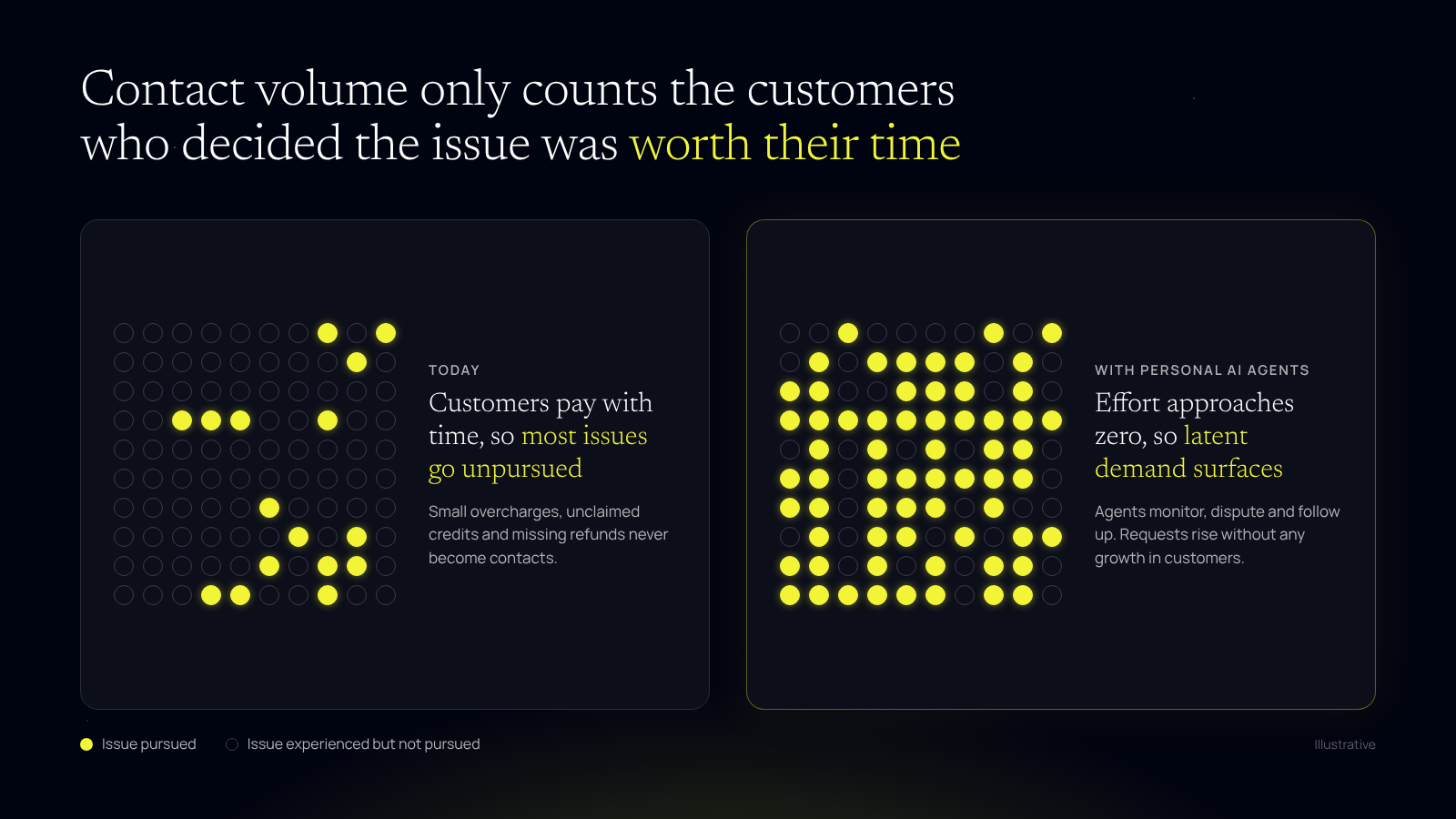
Personal agents change the incentive to act.
They can continuously monitor transactions, identify discrepancies, compare entitlements against policies, submit requests, and follow up automatically.
This introduces an interesting possibility: enterprises could experience a meaningful increase in service demand without any corresponding growth in their customer base.
And that demand won't necessarily arrive as phone calls. Some will come through chat, email, APIs, or direct agent-to-agent interfaces.
In fact, successful digital automation could cause call volume to decline while the total number of service requests rises.
That distinction matters.
The industry has spent years optimizing its ability to handle contacts. We may now need to think much more seriously about the number of underlying problems customers expect us to resolve.
Voice AI: What happens when the caller doesn't need a conversation?
Over the last few years, Voice AI has made remarkable progress.
We have spent enormous engineering effort making AI agents capable of holding natural conversations: low-latency responses, interruption handling, contextual understanding, accurate speech recognition, expressive voices, and seamless transfers.
And rightly so.
Human conversations are messy. People interrupt, change their minds, provide incomplete information, get distracted, or express frustration indirectly. Building an AI system that handles these situations reliably is hard.
But consider what changes when the caller is another AI agent.
Does a personal agent care whether the enterprise agent sounds empathetic?
Does it need carefully paced responses, natural pauses, or conversational finesse?
Probably not.
It wants to establish identity, communicate intent, understand the company's policy, execute the required workflow, and receive confirmation.
Using speech to accomplish that is technically possible, but inefficient.
Imagine one AI converting structured intent into speech, transmitting it over a phone network, and another AI converting that speech back into text before trying to reconstruct the same intent.
There is something inherently inefficient about that architecture.
Voice is a great interface for humans. It isn't necessarily the right interface between machines.
Over time, I expect enterprise AI platforms will need to support two distinct interaction models.
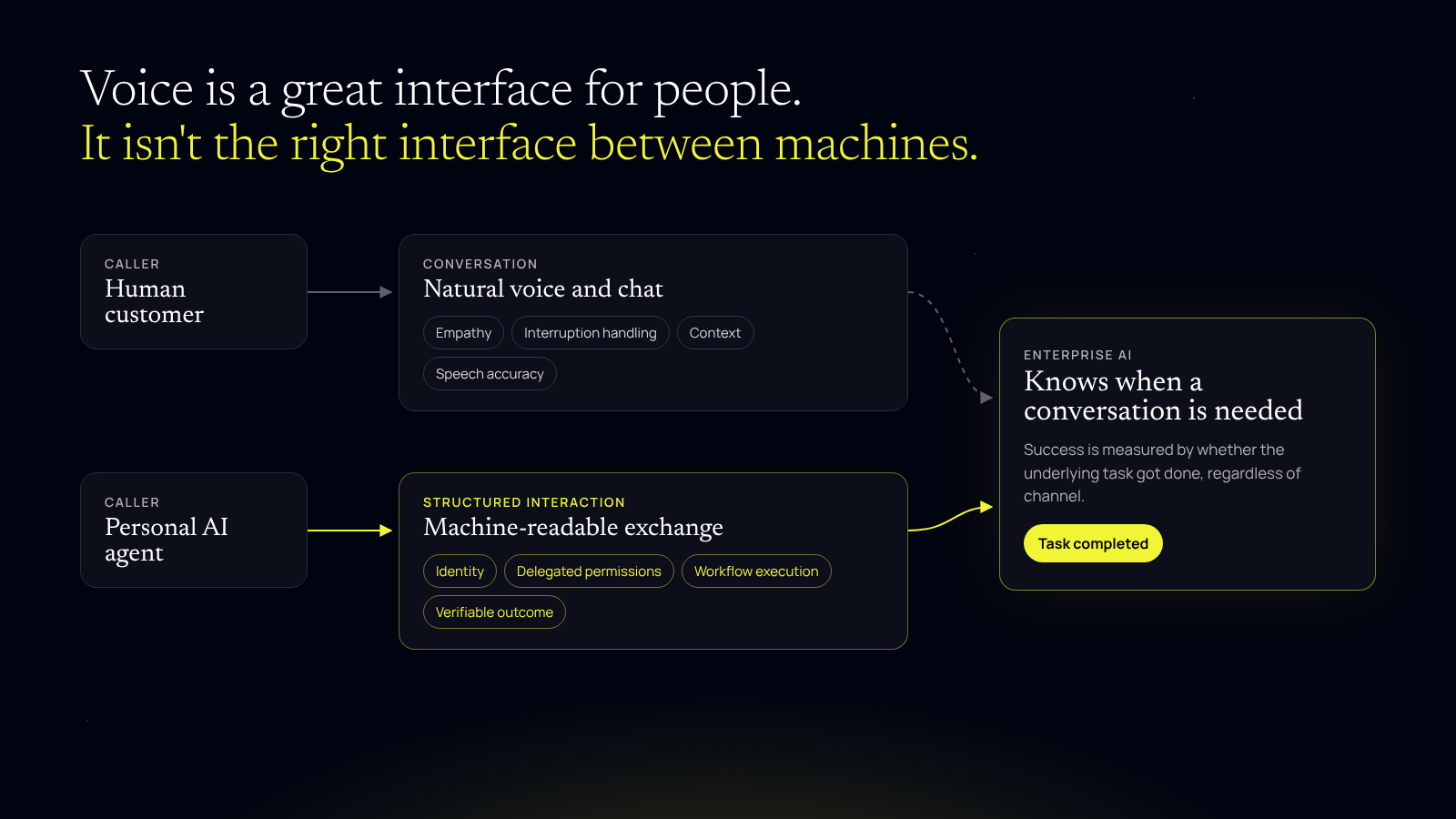
For humans, we will continue investing in natural conversations, empathy, contextual understanding, and conversational reliability.
For authorized personal agents, the priority will increasingly be structured communication, identity, delegated permissions, workflow execution, and verifiable outcomes.
The voice won't disappear. It will remain an important interface for human customers and a compatibility layer for personal agents interacting with businesses that don't offer machine-readable alternatives.
The real opportunity is building enterprise AI that understands when a conversation is necessary and when the same outcome can be delivered more efficiently through a structured interaction.
This also changes what we consider a successful AI agent.
Today, we often measure whether the voice agent contained a conversation.
Tomorrow, the more important question may be whether the enterprise agent completed the underlying task, regardless of the channel used.
Human labor: Less routine work, but potentially much harder work
One common prediction is that as AI improves, contact centers will need fewer human agents.
There is a reasonable basis for that expectation. Routine interactions such as checking an order status, confirming appointments, updating account information, or answering straightforward policy questions are increasingly automatable.
Personal agents could accelerate that transition.
But I think there is a second-order effect we don't discuss enough.
As routine interactions disappear, the average complexity of the work reaching humans is likely to increase.
Consider the types of requests that an enterprise AI agent cannot resolve autonomously.
A refund outside the company's policy.
A disputed insurance claim.
A customer requesting an exception to a contractual commitment.
A complicated financial transaction requiring additional authorization.
A situation where the company's internal systems disagree about what actually happened.
These cases require judgment, investigation, negotiation, and sometimes empathy.
Now imagine that the customer is represented by an AI agent that has perfect recall of prior interactions, can reference previous commitments, and can systematically challenge inconsistent policies.
The human employee may be dealing with a much more informed and persistent representative than a typical caller.
Of course, the personal agent can also be wrong. It may misinterpret a policy, exaggerate an entitlement, or act beyond what the customer intended. That creates another layer of complexity for the frontline.
This is where human assistance becomes even more important.
The frontline needs more than a copilot that summarizes calls or retrieves knowledge articles.
It needs systems that can reconstruct the entire history of an issue, understand what has already been attempted, identify the applicable policies, provide evidence, and recommend actions within the employee's authority.
There is also a workforce planning implication.
Even if the number of human-handled contacts drops, the time spent per remaining case could increase significantly. Some cases may require investigation and follow-up without any live conversation at all.
That makes traditional staffing models based predominantly on call volumes and average handling time less representative of total human workload.
I don't think the right prediction is simply that human labor disappears.
The nature of human work changes, and the value of helping people handle difficult situations consistently becomes greater.
CX operations: From managing queues to managing obligations
This may be the most consequential shift for contact center operations.
Today's operating model is largely organized around interactions.
A customer contacts the business. The system routes the interaction. An AI or human agent attempts to resolve it. The interaction ends.
If the customer calls again tomorrow, that is often treated as another interaction, even when the underlying problem remains unchanged.
Personal agents are much less likely to accept this fragmentation.
Imagine an agent calling about a refund.
The company promises that the refund will be processed within five business days.
The personal agent records that commitment. Five days later, it checks the customer's account. If the refund hasn't arrived, it follows up.
If the company provides another commitment, the agent tracks that too.
From the enterprise's perspective, this might appear as three separate contacts.
From the customer's perspective, it is still one unresolved issue.
When customers have agents that remember every promise, the contact center can no longer treat the end of a conversation as the end of its responsibility.
This creates a need to rethink several operational fundamentals.
First, enterprises will need persistent ownership of customer issues across interactions and channels. A request may start over voice, continue through an API, require human approval, and conclude through an asynchronous notification.
Second, duplicate requests and repeated follow-ups become a much bigger operational concern. Without appropriate controls, multiple attempts to resolve the same issue could create redundant cases, unnecessary human work, or even conflicting business actions.
Third, identity and authorization become critical.
Knowing that a caller is an AI agent doesn't establish that it has permission to act on behalf of a particular customer.
Reading an account balance, disputing a transaction, canceling a service, and accepting a financial settlement are fundamentally different levels of authority.
Enterprises need ways to verify who an agent represents, what the customer authorized, and whether an action falls within that authority.
And finally, workforce management will need to evolve beyond forecasting synchronous conversations.
We will still have real-time queues, but we'll increasingly also have asynchronous workloads, exception backlogs, approval queues, and resolution commitments.
Operational success becomes less about how quickly we answer a contact and more about how reliably we fulfill an obligation.
CX analytics: What happens when the voice on the call isn't the customer?
This is an equally interesting problem for the analytics and quality management space.
For years, customer interactions have been a rich source of intelligence.
We analyze transcripts to identify customer sentiment, understand reasons for contact, evaluate agent behavior, monitor compliance, and surface business problems.
But much of this assumes that the person speaking represents the customer's actual experience.
What happens when that assumption breaks?
Imagine a personal agent says:
"I'm extremely disappointed with the recent price increase, and I want to cancel unless you can offer a better deal."
A traditional conversation analytics system might identify negative sentiment, frustration, and churn risk.
But what if the customer isn't frustrated at all?
What if they simply told their personal agent, "Review my subscriptions and negotiate better rates wherever possible"?
The agent's statement is part of a negotiation strategy. It doesn't necessarily represent the customer's emotional state.
That distinction is significant.
When AI starts speaking on behalf of customers, what is said in a conversation may no longer be a reliable representation of what the customer actually feels or intends.
We will need to distinguish customer-expressed intent from agent-inferred intent, agent-generated statements, and actual business outcomes.
This also challenges some of our most familiar CX metrics.
Consider containment.
A company AI agent successfully handles a personal agent's call, promises a refund, and ends the conversation without human involvement.
The interaction is contained.
But the refund never happens.
The personal agent follows up again. And again.
From an interaction-level perspective, the automation may appear successful every time.
From the customer's perspective, nothing has been resolved.
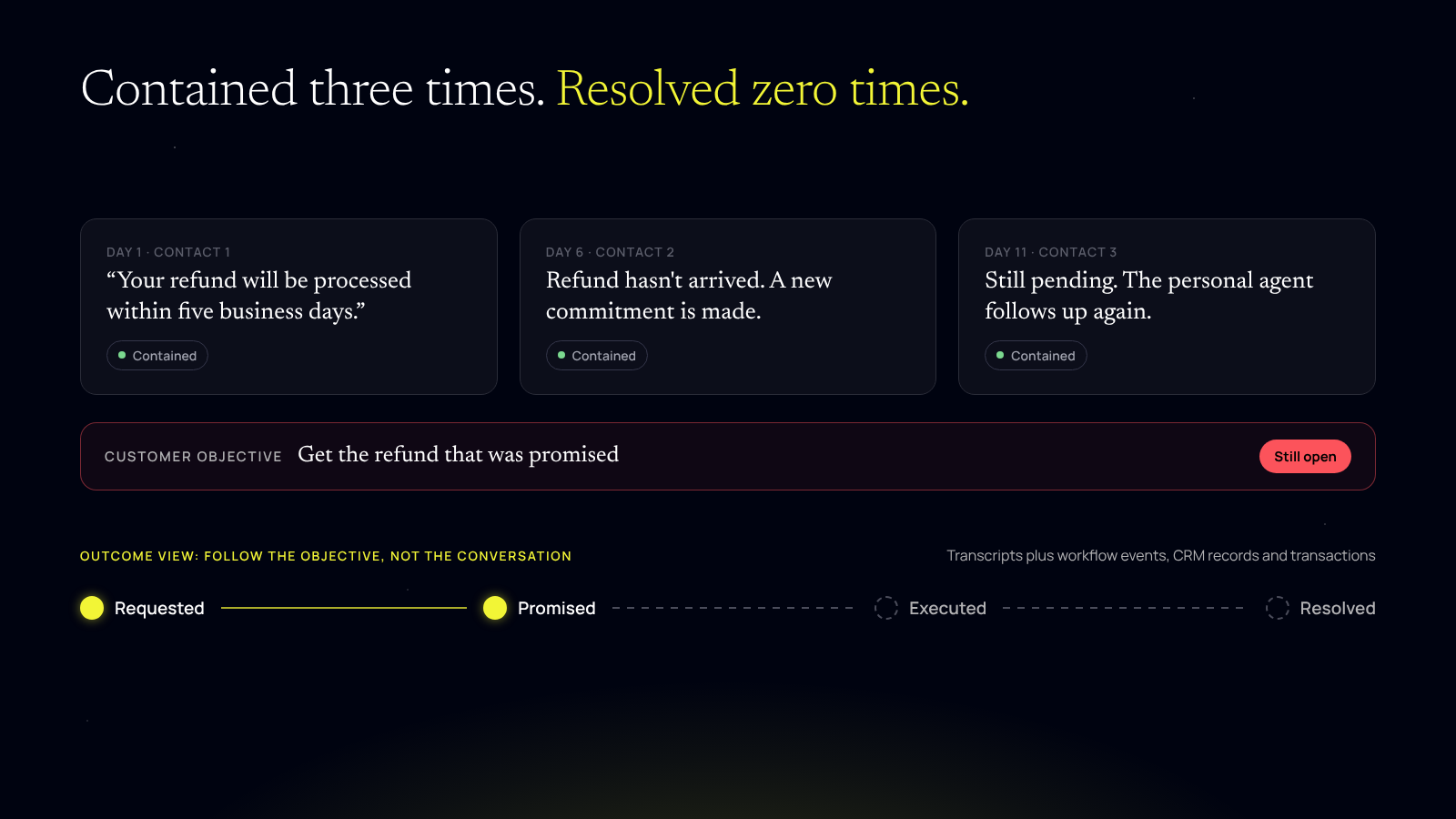
The same problem extends to first-contact resolution, customer satisfaction, and quality scores when they're measured purely at the conversation level.
We need to connect interactions to the underlying customer objective and follow that objective through its lifecycle.
What was the customer trying to accomplish?
What did the enterprise commit to?
Which systems and people participated?
Was the action actually completed?
Did the customer receive the intended outcome?
What did it cost to get there?
This requires analytics to look beyond transcripts and include workflow events, CRM records, business transactions, commitments, and execution traces.
The conversation remains valuable, particularly for human interactions. But it becomes one source of evidence within a much broader understanding of customer experience.
I believe the next meaningful evolution of CX analytics will be from conversation intelligence toward outcome intelligence.
Not simply understanding what was said, but connecting what was requested, what was promised, what was executed, and what was actually resolved.
The bigger economic question: What if automation reduces cost per contact but increases the cost of service?
There is another implication worth examining.
For years, the industry has focused on making customer service more efficient.
Reduce average handling time.
Improve containment.
Increase agent productivity.
Automate repetitive interactions.
All of these help reduce the cost of serving customers.
But personal agents introduce a new variable into that equation: the volume of issues that customers choose to pursue.
Suppose an enterprise reduces its average interaction cost by 80%.
That sounds like an enormous win.
But what if the number of service requests doubles because customers can now pursue small issues effortlessly?
What if refund requests, billing disputes, policy exceptions, and cancellation negotiations also increase?
The enterprise may spend less money handling each interaction while facing substantially more total work and greater financial exposure from the resulting business decisions.
This isn't necessarily bad. Some of these requests represent legitimate customer problems that were previously going unresolved.
But it demonstrates why automation efficiency alone is an incomplete measure of CX transformation.
Reducing the cost of a conversation is not the same as reducing the cost of resolving the underlying customer problem.
And reducing the cost of resolving a problem is not the same as eliminating the reason that problem exists.
If thousands of personal agents repeatedly identify the same billing mistake, the right long-term solution isn't to build an increasingly efficient AI system that issues refunds.
It's to fix the billing mistake.
That is where the next layer of value emerges.
The contact center becomes a much more important source of business intelligence
There is a positive side to all of this.
Today, a significant amount of customer dissatisfaction never makes it into a support system because the customer decides not to engage.
As personal agents reduce the effort required to raise and pursue issues, enterprises could receive a much more complete picture of the problems their customers experience.
Recurring product defects.
Confusing policies.
Unexpected charges.
Broken fulfillment processes.
Unmet commitments.
Unnecessary cancellation friction.
These signals can help businesses identify systemic problems earlier.
But only if CX platforms can distinguish genuine underlying demand from automated retries, duplicated requests, and agent-generated negotiation behavior.
This is an important opportunity for the entire customer experience function.
The contact center has traditionally been viewed as the place where businesses handle customer problems.
Increasingly, it could become the place where businesses understand which problems should never have existed in the first place.
Automating conversations is one part of the equation. Supporting human judgment is another. Understanding what's happening across those interactions, evaluating the results, and continuously improving the underlying operation completes the picture.
As personal agents become more common, I expect the connection between these capabilities to matter much more than any individual automation metric.
The next era of CX starts with a different question
I don't expect this transformation to happen overnight.
Personal agents still have reliability, integration, security, and authorization challenges. Businesses won't immediately expose every service workflow to external agents. Human conversations will continue to matter, especially when trust, empathy, and consequential decisions are involved.
But the direction is worth paying attention to.
For years, the customer service industry has been organized around a simple assumption: customers initiate conversations, and businesses invest in making those conversations more efficient.
That assumption is beginning to change.
When software can continuously represent customer interests, initiate requests, remember commitments, and pursue resolutions, the volume of interactions becomes less useful as a measure of customer demand.
The distinction between human-facing AI and machine-facing AI becomes more important.
Human employees increasingly focus on exceptions and consequential decisions.
Operations become responsible for persistent resolution workflows rather than isolated contacts.
And analytics needs to connect the entire journey from customer intent to verified business outcome.
This brings us back to the question we started with.
What happens when customers no longer have to pay with their own time to get something resolved?
My view is that we will discover that much of what we thought we knew about customer service demand, operational efficiency, and customer satisfaction was shaped by that hidden cost.
The next phase of CX won't be defined only by how efficiently companies handle conversations.
It will increasingly be defined by how reliably they resolve customer problems and how effectively they prevent those problems from happening again.
Because when customers no longer need to spend their time pursuing resolution, businesses will have to get much better at delivering it.
Subscribe to our newsletter.
Frequently Answered Questions