Everyone Says "Behaviors." Nobody Defines Them.
Every quality platform now scores 100% of interactions. That used to be the hard part - sampling 1–2% of calls by hand, hoping the ones you pulled were representative, coaching against a slice too thin to trust. That problem is over. AI scores every call now. Great!
But here's what nobody wants to say out loud: Coverage was never the bottleneck.
A QA score is a verdict on the past. “This call scored 82 pts” - it tells a supervisor what happened. It does not tell an agent what to do differently on the next call. Between "here's your score" and "here's what to change" sits a translation step - and that step, not coverage, is where Coaching actually lives. Scoring everything just means we now have a verdict on 100% of calls instead of 2%. The translation gap didn't close. It just got bigger!
Translation runs through a single object: the Behavior you're going to coach. And this is where the category stops being precise. We all say "behaviors" — discover behaviors, coach on behaviors, correlate behaviors to outcomes as if the word explains itself.
It doesn't. Take two things both called "a behavior":
- "Set clear expectations."
- "Stated the decision timeline before ending the call, without being asked."
The first is an impression — ten evaluators grade it ten ways, and an agent told to "be more empathetic" has nothing to act on. The second is a checkable event: it happened at a timestamp or it didn't, and the agent knows exactly what to repeat. You can't turn a score into coaching through a word as loose as the first one.
The tension nobody names
Here's the part we ran straight into building this. A coachable behavior has to be two things at once, and they pull against each other: specific enough to coach fairly, and observable enough to detect at scale. The catch is that the easiest behaviors to detect are usually the hardest to coach. "Positive sentiment" — the output most sentiment analysis call center tools chase — scores in a millisecond and teaches an agent nothing. The specific, coachable moment is the one that's actually hard to detect well.
Most products resolve that tension by drifting toward what's easy to detect, then calling it coachable. That's the sleight of hand running underneath half the coaching demos you'll see this year.
What we decided a behavior has to be
We took this harder path, because coaching that isn't fair doesn't survive contact with a real agent. While building Performance Agents and reimaging how coaching should be done, we ensured that Behavior isn't a mood or a metric. Behavior is a specific, business-defined thing you want to measure and coach on — and every coaching observation built on it carries three things:
- An observable moment. The observation links to the exact point in the call it came from. Not an aggregate score. A moment you can open and hear.
- An action the agent controls. The behavior is framed as something the agent did or didn't do, and can do differently — not a characterization of who they are.
- A structure that survives a real 1:1. Every improvement area states what happened, why it matters to the customer or business, and the recommended next step. "Why this matters" is non-negotiable — coaching tied to observation alone is just correction.
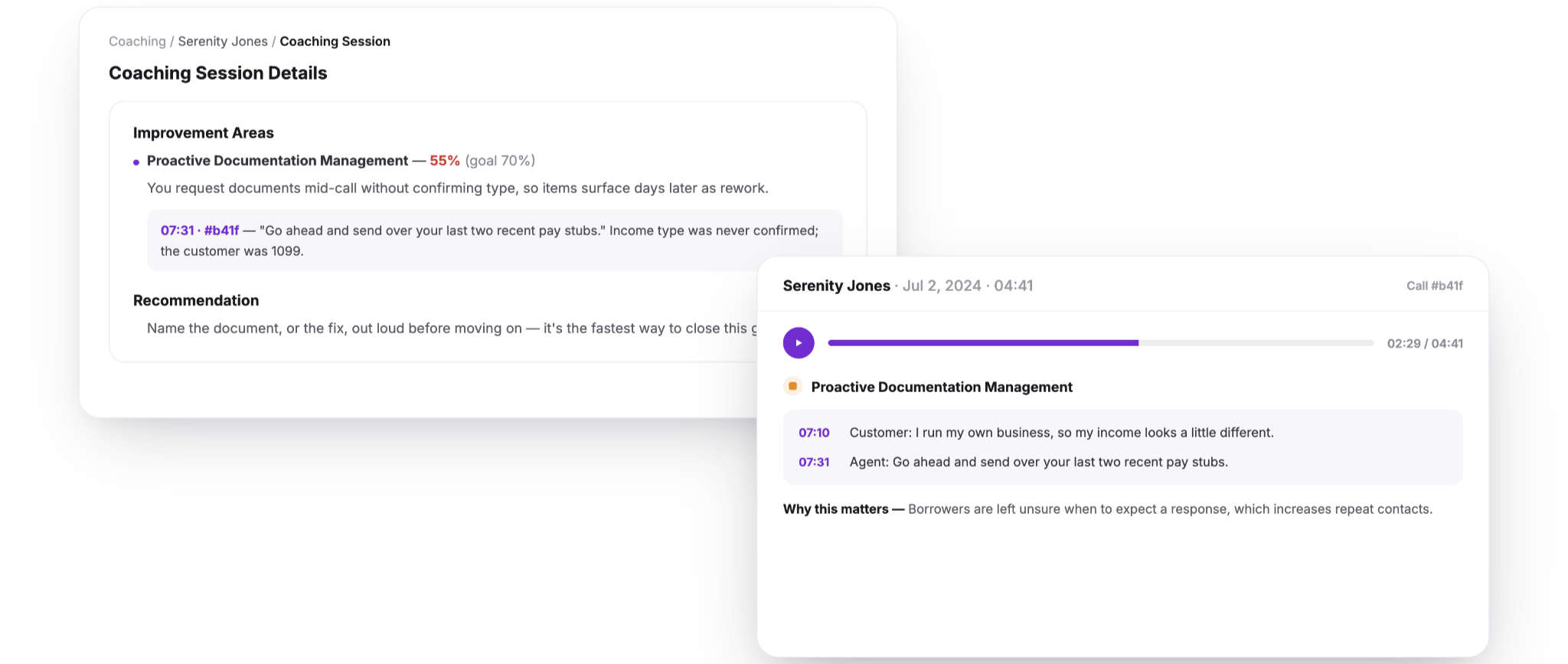
Behaviors are the lens the entire coaching workflow is organized around. That's deliberate. It's what makes a coaching note scannable and comparable across calls instead of a free-form blob of AI prose — and it's the difference between coaching that feels specific to your business and coaching that reads like it was generated by a model that has never heard of your business.
The objection worth taking seriously
"Good supervisors know a coachable behavior when they hear one. Over-defining it just makes the tool rigid."
That intuition holds when one experienced supervisor is coaching twelve people they know by name. It starts to fail the moment you're coaching at scale — across teams, with AI drafting the first pass because now the definition carries the load the supervisor's gut instinct used to. A fuzzy definition doesn't just produce vague coaching; it scales the unfairness with it.
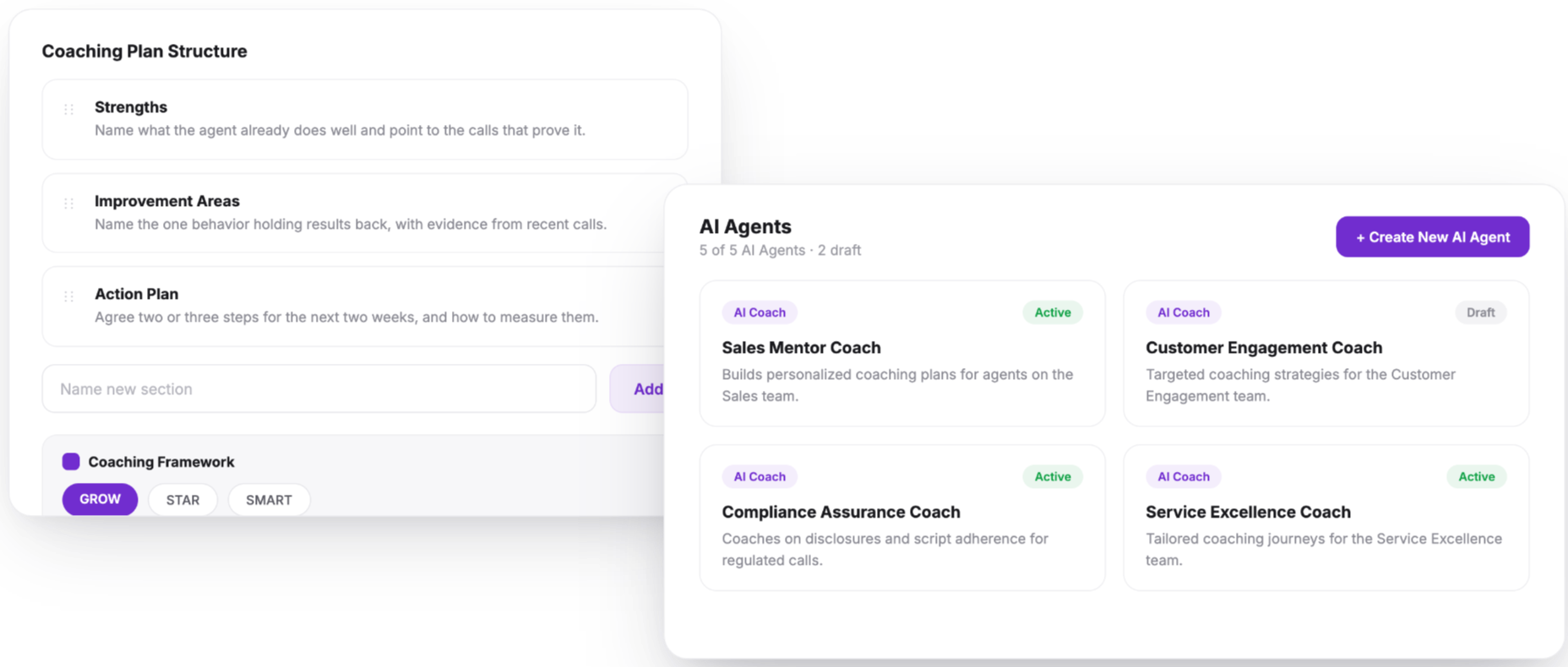
This is exactly why AI Coach — our Performance Agent for contact center agents is built on defined Behaviors rather than open-ended prose. The structure is the thing that keeps coaching consistent and fair as it scales, so "coaching at scale" doesn't quietly become "arbitrary feedback at scale." The precision isn't a constraint on good coaching. At volume, it's the precondition for it.
Where this goes next
Defining behaviors well is the foundation. But a definition doesn't put coaching on anyone's calendar. A supervisor still has to turn those behaviors into a real conversation with a real agent — and that's where most coaching programs quietly break down, not on the thinking but on the time it takes. That's the next question: why doesn't coaching actually happen?
Subscribe to our newsletter.
Frequently Answered Questions