The Next Era of Frontline Performance Starts with Behaviors
As part of AI Agents for Operations, we are launching Observe.AI Performance Agents to help contact centers identify, coach, and improve frontline behaviors that drive customer and business outcomes.
For years, contact centers have invested in quality assurance and coaching with the right goal: help frontline teams deliver better experiences. But the systems supporting that work were built around limited data and manual processes. A supervisor might review a handful of interactions, a scorecard, and examples, prepare notes, and schedule a coaching session. In many organizations, the primary measure of success became whether the evaluation or coaching session was completed.
That is not the same as improving performance.
The purpose of coaching is to change behavior. Yet most organizations still struggle to answer a basic question: Did the behavior actually change after coaching?
Performance Agents are designed to close that gap. These AI agents use the intelligence within customer interactions to help organizations define the behaviors that matter, measure them consistently, prepare evidence-backed coaching, and track whether performance improves over time. You can read more about the launch of our Performance Agents here.
Go Beyond QA Scores to Improve What Matters
Traditional QA scorecards are valuable. They help organizations confirm that required steps were followed, disclosures were delivered, information was accurate, and policies were applied correctly. These standards are especially important in regulated industries, where a missed statement or incorrect action can create real risk.
But high QA scores do not necessarily translate into strong business outcomes. Frontline teams often score well across the board, while KPIs such as CSAT, sales conversion, and customer retention vary widely. When nearly everyone meets the scorecard standard, those scores offer little insight into why some representatives consistently achieve better results. Yet supervisors still use those same scorecards to build weekly coaching plans, reinforcing checklist compliance without necessarily improving the KPIs that matter.
Consider two frontline representatives who both complete every required step. One resolves the concern, earns the sale, or retains the customer. The other does not. The difference may be whether the representative asked a thoughtful follow-up question, acknowledged the impact of the issue, set a clear expectation, or addressed hesitation before presenting the next step.
Those behaviors are difficult to capture through a simple yes-or-no question, but they can make a meaningful difference to the outcome. Effective coaching means identifying which behaviors contribute to stronger KPIs, helping frontline teams put them into practice, and measuring whether customer and business outcomes improve.
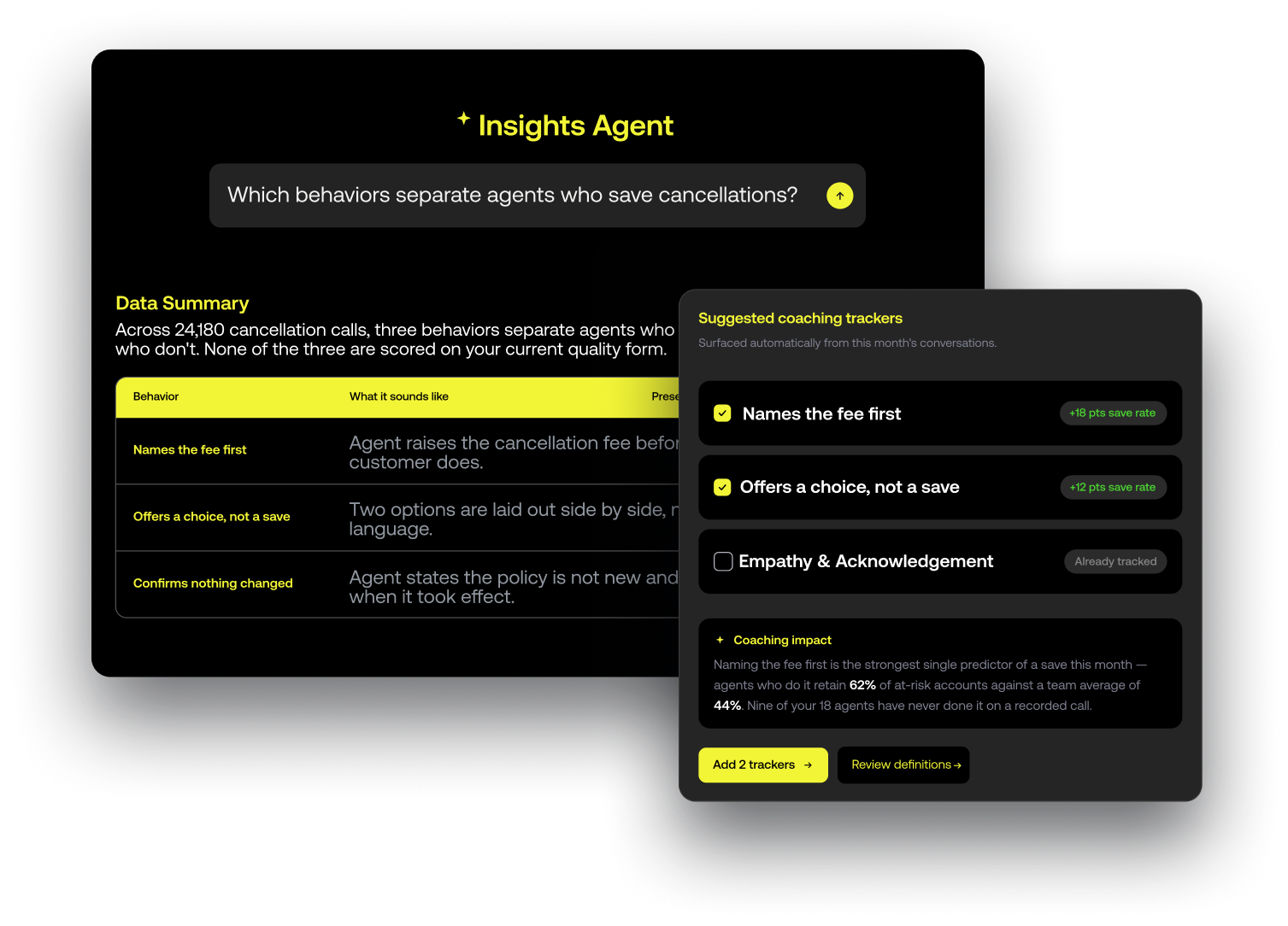
This is where behaviors become the real unit of performance. Performance Agents, working in tandem with our Insights Agents, allow organizations to discover, define, and evaluate nuanced behaviors such as empathy, active listening, ownership, discovery, clarity, objection handling, and de-escalation. They can then examine how consistently those behaviors appear in actual conversations and present the evidence needed for coaching.
This matters across nearly every contact center objective. For a service organization, the right behaviors can help reduce customer effort and improve resolution. For a sales team, they can strengthen discovery, increase confidence, and create more relevant opportunities to upsell. For a collections or financial services team, they can reinforce both effective communication and required compliance practices. The specific behaviors change by team, but the underlying need is the same: understand what strong performance looks like in practice, then help more people achieve it.
Know Who to Coach and Where to Focus
Supervisors should spend their time understanding people, providing context, and helping them improve. Too often, they spend it searching through calls, reconciling reports, selecting examples, and writing notes.
Performance Agents handle much of that preparation. They analyze signals across interactions, identify recurring patterns, locate relevant evidence, and create a structured draft using the organization’s own terminology and coaching framework. A process that can take 30 to 45 minutes can be reduced to under five minutes, while the supervisor remains in control of the final plan.
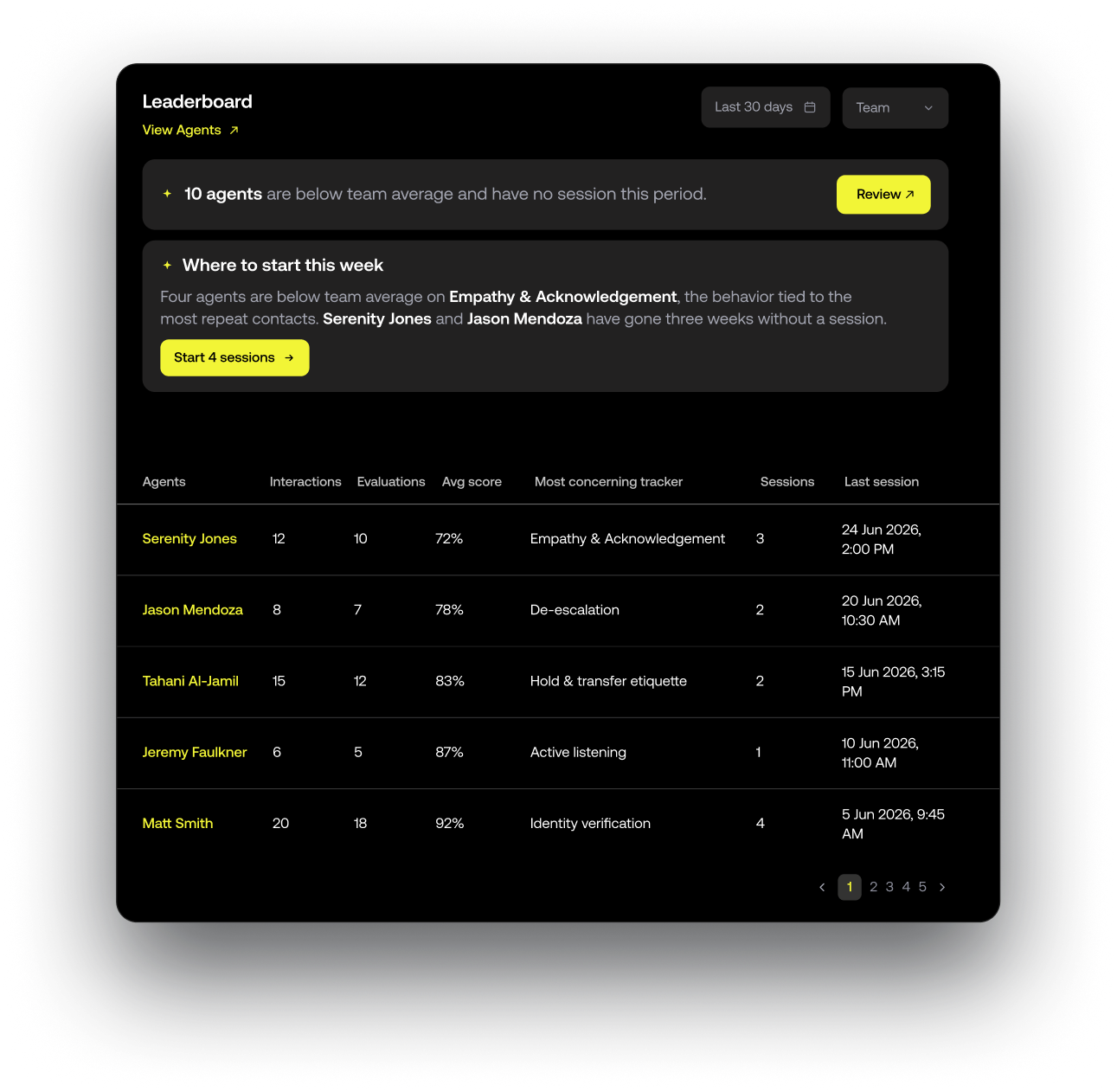
That time matters. It allows supervisors to focus on the human part of coaching: listening, understanding the circumstances behind performance, and agreeing on practical next steps.
A universal standard, applied fairly
At large organizations, consistency becomes its own challenge. When tens of thousands of frontline employees work across teams, regions, business units, and languages, coaching quality can vary widely. One supervisor may emphasize empathy. Another may focus on efficiency. A third may interpret the same interaction differently based on experience, time, or personal judgment.
That variation is understandable, but it makes it difficult to establish a universal standard for a great customer experience.
AI can change this by applying the same defined criteria across every relevant interaction. Instead of grading people differently based on which supervisor reviews the conversation or which calls are sampled, organizations can evaluate performance against a common set of requirements and behavioral definitions
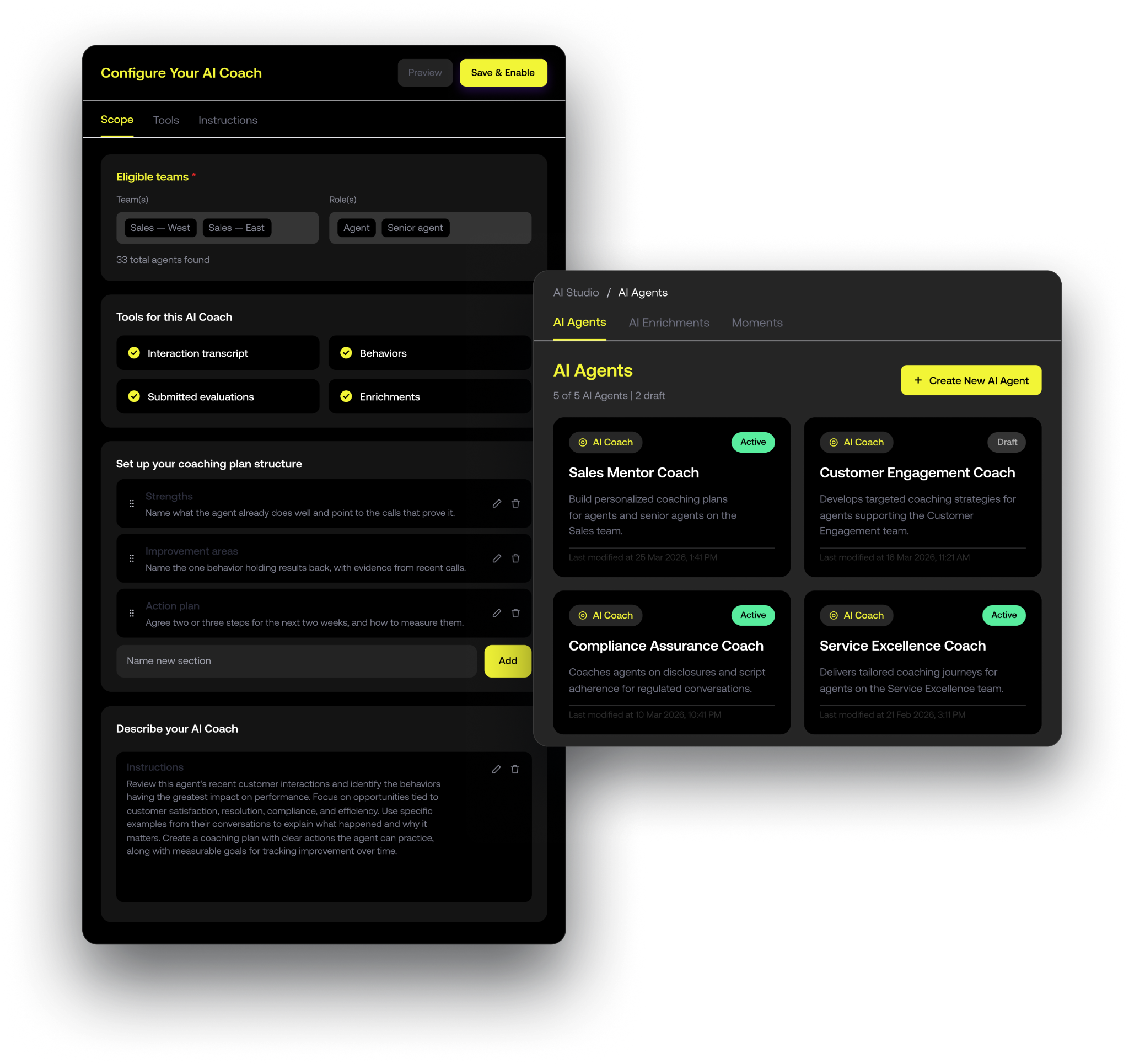
This does not mean removing people from the process. Performance Agents prepare the analysis, surface supporting evidence, and draft a coaching plan. Supervisors review, edit, approve, and decide what should be shared. Their judgment remains essential, especially when a conversation requires context that a system may not have.
The difference is that every supervisor starts with the same evidence standard. Every frontline employee can see the interactions behind a recommendation. Every team can be measured against criteria configured for its role and responsibilities. When applied with the right controls, this approach can reduce bias from inconsistent sampling and subjective interpretation while giving leaders a more reliable view of performance across the organization.
From isolated coaching sessions to continuous improvement
The old model begins when a supervisor finds time to review performance. The new model begins with behavior signals from every interaction.
Performance Agents work across Observe.AI’s Interaction Intelligence, QA evaluations, configured behaviors, and Insights Agents. They identify patterns across recent conversations, distinguish a single miss from a recurring issue, and prepare coaching around the areas most likely to help an individual improve. Each observation connects back to evidence of real interaction, so supervisors and frontline employees can verify what happened rather than accept an unexplained AI judgment.
This also helps organizations separate individual coaching needs from broader operational problems. If one employee repeatedly misses a required step, coaching may be appropriate. If an entire team struggles with the same issue, the cause may be an unclear policy, incomplete training, a product change, or a broken process. Insights Agents help uncover that context, while Performance Agents turn the relevant findings into specific action for frontline development.
Most importantly, the process does not end when a coaching plan is delivered. Future interactions become the next source of evidence. Organizations can monitor whether the coached behaviors and associated QA results move in the intended direction. Leaders gain a clearer view of what is improving, where gaps remain, and whether their coaching program is producing more than completed sessions.
Using agentic AI for CX to raise the standard for every interaction
AI Agents for CX have largely focused on automating customer conversations. But human expertise remains essential, especially when issues are complex, policies require judgment, or customers need more personal support. The next opportunity is to bring the scale, personalization, and power of AI to the operations that support frontline teams, starting with how they are coached.
Performance Agents bring quality, insight, coaching, and measurement into one continuous cycle. They go beyond checking whether a conversation followed the script to identify the behaviors that drive better outcomes, build personalized coaching plans, and measure whether that coaching improves performance.
For the largest contact centers, this means applying a consistent, evidence-backed standard across every team while tailoring coaching to each person. Organizations no longer have to choose between coaching at scale and coaching that is specific, relevant, and actionable.
This is a new era of coaching and a new way to think about CX operations. AI does more than handle conversations. It helps the people who handle them improve, turning everyday interactions into stronger frontline performance and better customer and business outcomes.
Subscribe to our newsletter.
Frequently Answered Questions


.png)

.png)