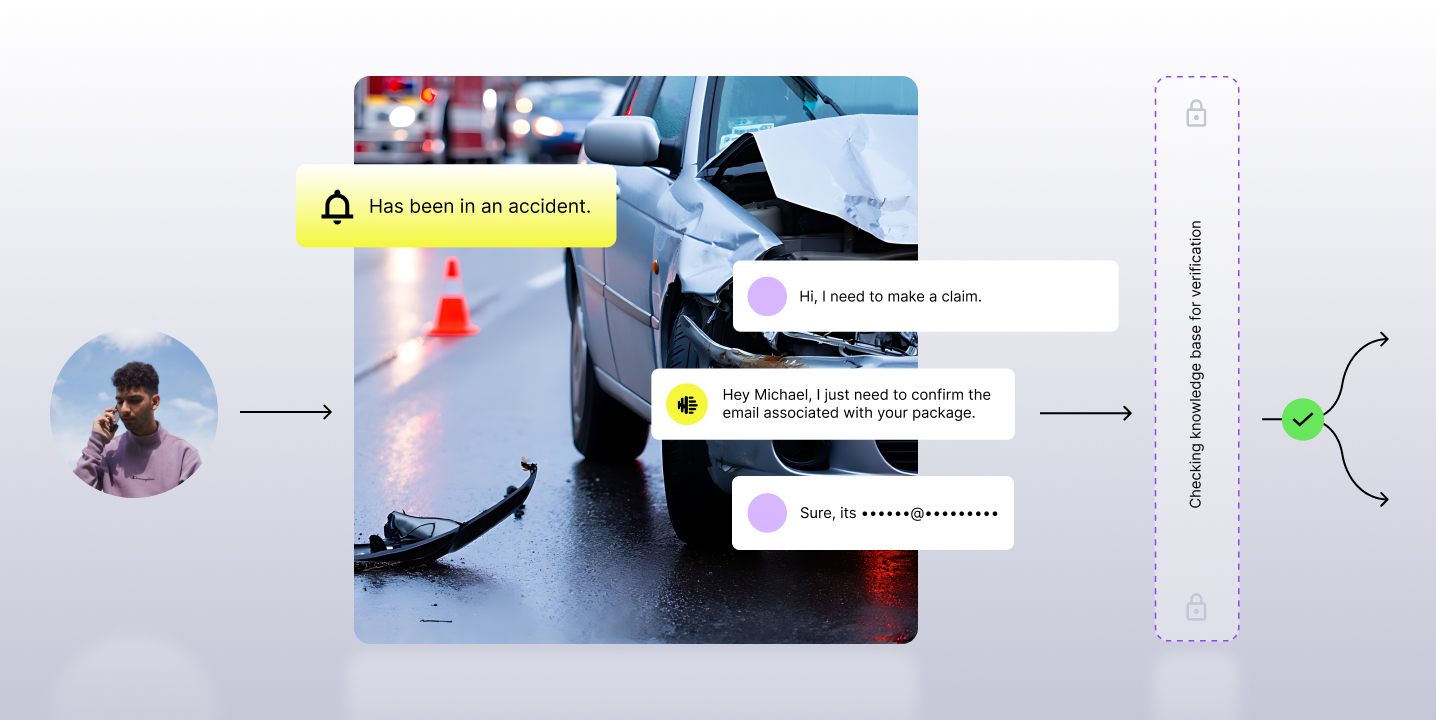
.png)
Conversational Finesse: Knowing When the Person Is Actually Done
THE PROBLEM
The part of voice AI nobody talks about
Voice AI has made extraordinary progress on what to say. The language models are coherent, contextual, and increasingly convincing. The voices are warm. The responses are fast. And yet, on the phone, something still feels off.
The problem is almost always the same thing: the agent does not know when the person is done. It cuts in too early, or it waits a beat too long, and either way the conversation loses its naturalness. That crack in the experience of small, repeated, compounding is what makes a voice agent feel robotic even when everything else is right.
The industry solution today is the silence timer. The agent waits for a configurable gap of quiet, then assumes the speaker has finished. It is simple, universal, and wrong in exactly the moments that matter most.
The silence timer hears quiet. It does not hear a customer mid-number, eyes on their phone screen, about to continue.
Human speech is full of pauses that mean nothing. People hesitate mid-thought, pause to recall a digit, say “hold on” and go quiet while they check something. None of these are turn endings. But to a silence timer, they are indistinguishable from one.
THE GAP
What the market is missing
Most platforms treat turn detection as a solved problem. They ship a silence threshold, let operators tune it, and move on. A tighter threshold means faster responses but more interruptions. A looser one means fewer interruptions but dead air. The operator picks their trade-off, and the system lives there permanently, regardless of what the conversation is actually doing.
What this approach cannot do is read context. The same 600 milliseconds of silence means completely different things in different situations. In the middle of a phone number it means the customer is chunking digits. After “that’s everything, thanks” it means they’re done. A threshold cannot tell these apart. A model that understands what was just said can.
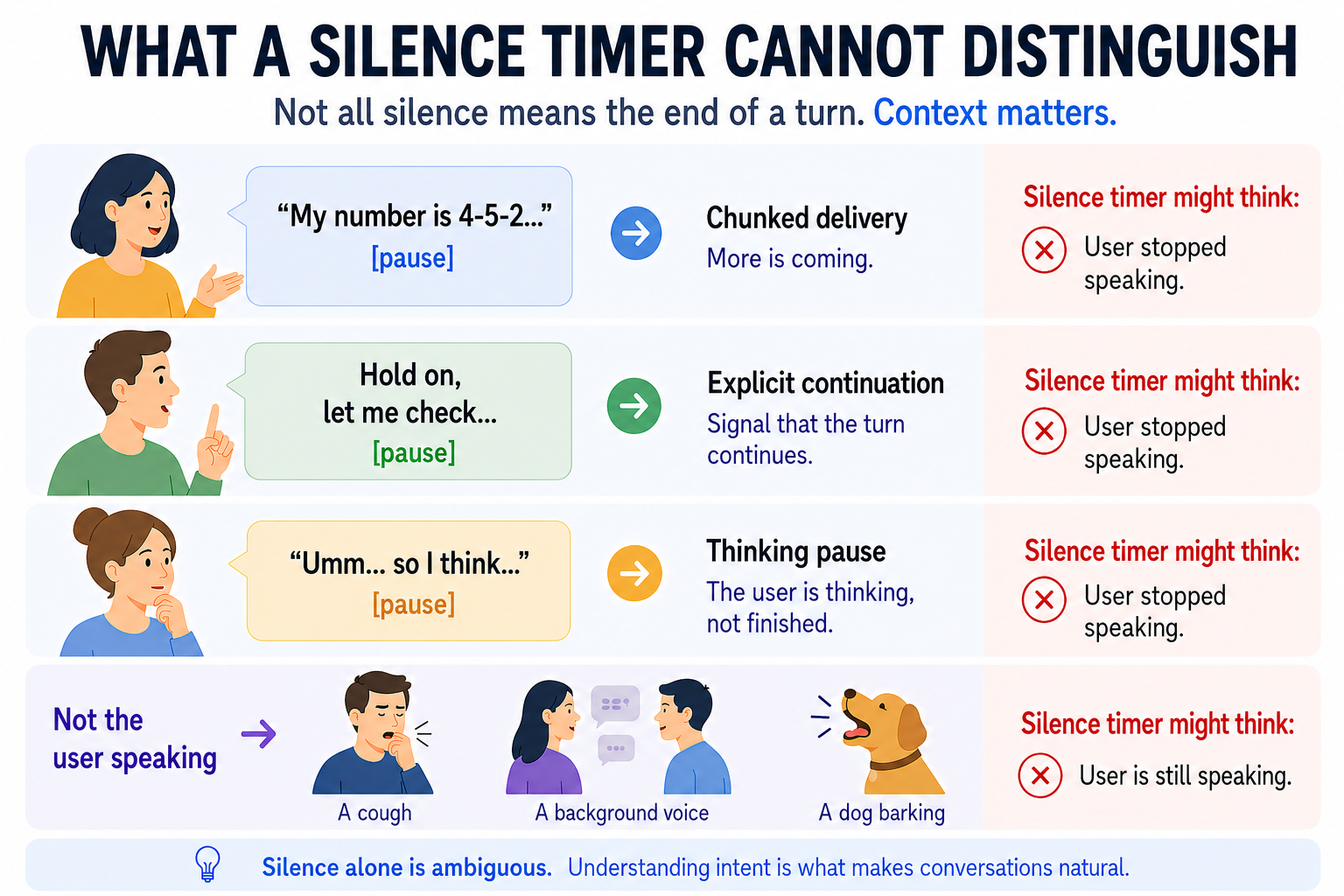
The second failure is noise. Imagine a user speaking to a voicebot in a busy café. A conventional voice activity detector may mistake background sounds, such as nearby conversations or a closing door, for user speech. The voicebot interrupts itself or stops speaking, even though the user never intended to take the turn.
OUR APPROACH
FlowTurn: understanding the shape of a turn
FlowTurn replaces the silence timer with a continuous real-time model that runs alongside the conversation. Rather than measuring quiet, it models intent assessing, every few hundred milliseconds, whether the speaker is still mid-turn or has genuinely finished.
The model is trained on real production calls, not curated benchmarks, which means it has learned the messy reality of how people actually talk: the hesitations, the self-corrections, the structured delivery of account numbers and addresses, the mid-thought pauses that look like endings but are not. It also learns the opposite of what a genuine turn ending sounds like, and how quickly a new speaker’s voice can be distinguished from room noise.
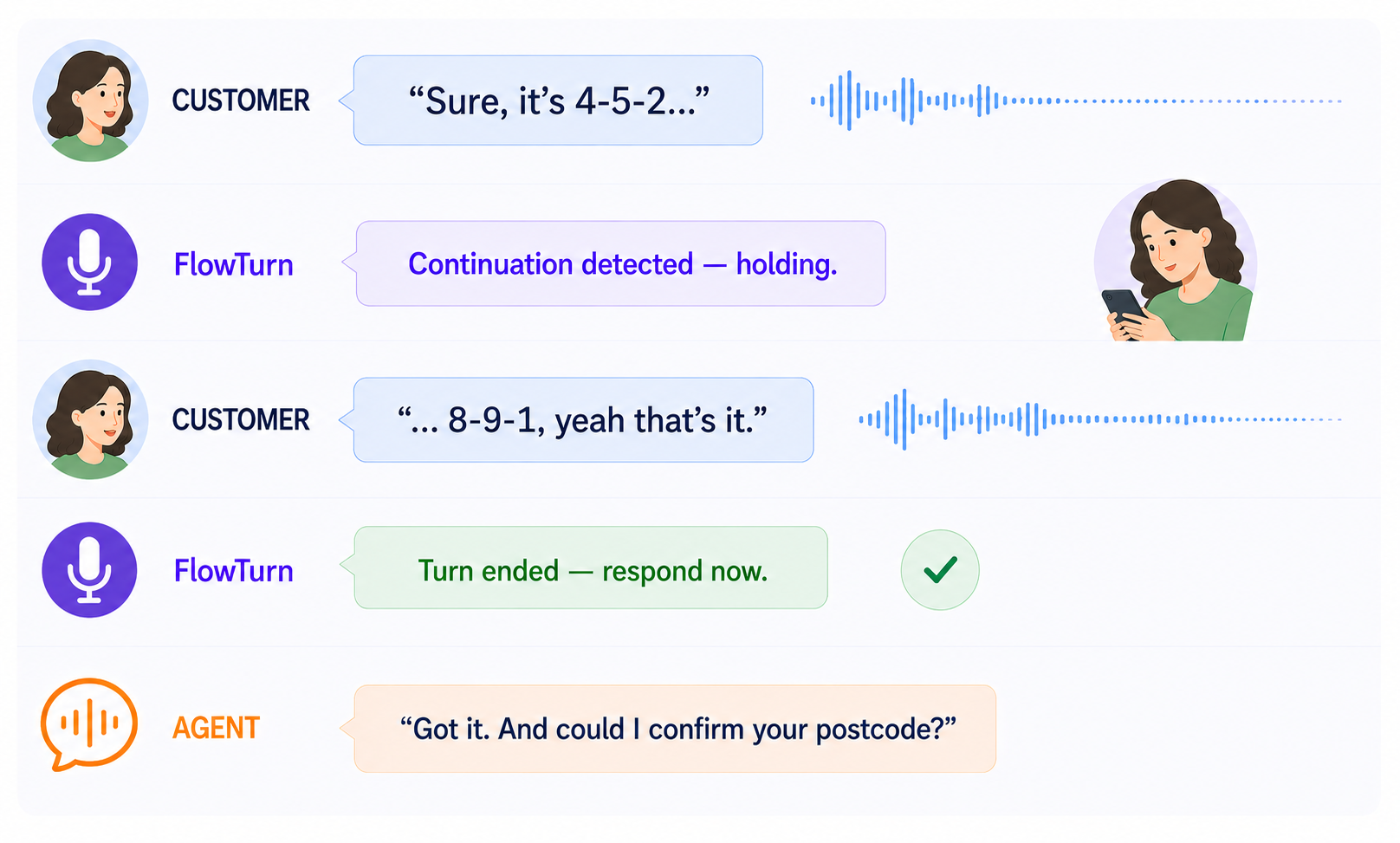
The same system handles the inverse: when a user wants to cut in while the agent is speaking, FlowTurn detects the genuine interruption quickly and cleanly, without being tripped by a cough or a background voice. That asymmetry patient when the user is mid-thought, responsive when they genuinely interrupt is what makes the conversation feel balanced.
THE NUMBERS
What the performance looks like in production
A note on F1 score, which appears throughout. It is a single figure that balances two opposing failure modes: interrupting too early (high recall, low precision) and waiting too long (high precision, low recall). A high F1 means the system avoids both. It is the metric that matters most for a turn detector, because optimising for either side alone produces a bad experience.

When the user interrupts the agent
FlowTurn detects genuine interruptions and importantly, it eliminates 93% of false triggers from ambient noise, which is the failure mode that makes deployed voice agents feel unstable in real environments.

THE DIFFERENCE
What changes when the model understands turns
The most direct effect is on call flow. Users finish their sentences. Agents respond at the right moment. The interruptions that erode trust across a call — small, repeated, compounding — stop happening.
Everything downstream improves too. Transcripts have clean speaker boundaries. Sentiment detection reads the right person. QA scoring reflects the actual conversation rather than the artifacts of a system that fired at the wrong moment. Coaching built on clean data is coaching that works.
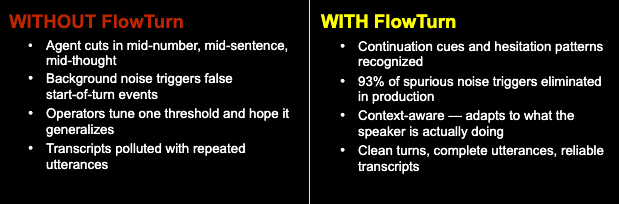
Summary :
FlowTurn replaces traditional silence-based turn detection in voice AI with a context-aware, real-time model. By analyzing the actual shape of speech rather than just silences, FlowTurn accurately distinguishes between genuine turn endings, hesitation pauses, and background noise.
Subscribe to our newsletter.
Frequently Answered Questions


.png)

.png)
.png)